
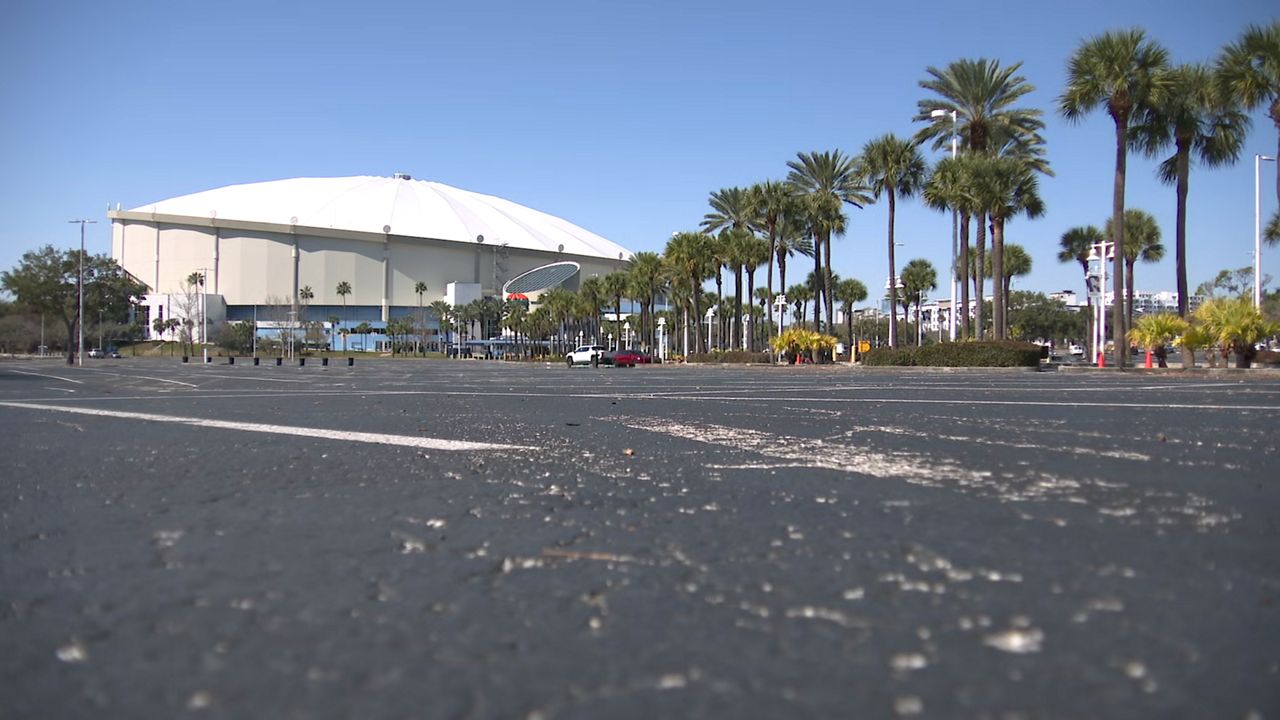
ST. PETERSBURG, Fla. — With Tropicana Field reopening Monday, after being damaged in Hurricane Milton, Spectrum Bay News 9 Watchdogs are digging into mold reports, air quality tests and photos taken inside to answer the question: is it safe?
What You Need To Know
Hurricane Milton badly damaged Tropicana Field in October 2024, most notably its vinyl roof
The EPA says molds can grow anywhere as long as moisture and oxygen are present
City officials hired a mold remediation company to clean the stadium, during and after construction
Officials with the City of St. Petersburg say Tropicana Field is safe for fans to return
To sum it up, city officials say the Trop is safe. More than 10% of the $57 million spent by the city of St. Petersburg at the home of the Rays was spent on remediation.
In the latest round of tests, which just came back, the city’s mold inspector essentially said it’s good to go.
Fans walking in on Monday will be entering a stadium that, the city says, has been tested, treated and, according to their experts, is safe. But getting to that point has been a major undertaking.
When city crews made their way inside Tropicana Field, just two days after Milton hit in October 2024 they found water everywhere: on the floors, in the ceilings, from section 300 down to the 100s.
The responsibility, and multi-million dollar cost, fell mostly to the city of St. Petersburg and Beth Herendeen led the project.
“The first thing they did was get that roof matter down, and then separate the bowl from the concourses and other areas so that we didn’t have further damage beyond what Milton did,” Herendeen said.
But without a roof, any rain potentially brought in water.
Like in late August 2025, when our meteorologists say four inches was recorded downtown. Photos show the dugout flooded, more than waist deep.
“Even the pump system that we had—a fairly complex pump system—just couldn’t keep up with that much water in that short period of time,” said Herendeen.
But the city got creative, using an industrial vacuum, to suck out thousands of gallons of rainwater.
Every time water came in crews were in a race against time because, as the Environmental Protection Agency lays out in this guidance on remediating commercial buildings, “Molds can be found almost anywhere; they can grow on virtually any organic substance, as long as moisture and oxygen are present.”
The city paid a local company, Greenfield Environmental, to look for mold and test the air within the Rays offices, comparing the numbers to what’s found outside.
Spectrum News obtained several tests taken from the fall (view August 2025 report here | view September/October 2025 report here), and took them to Dr. Marie Bouregois, toxicologist at the University of South Florida to better understanding.
“I think the action level is between 1,500 and 10,000 and one of the areas exceeded that but, for the most part, they were all, sort of, unalarming,” Bouregois said.
The city had their contractor test the stadium again in late March. You can view the latest report here.
Inspectors wrote that HVAC equipment, near the 1st base food court, was, “Observed to have significant condensation/dripping water at the time of our inspection”
That, the city believes, is what caused a minor presence of Stachybotrys, commonly known as black mold.
They found 38 spores per cubic meter in both the 1st base food court and rays batting cage, according to documents given to Spectrum Bay News 9 by the city.
“One spore was detected. Greenfield Environmental recommend additional cleaning and remediation, which we did, the area was retested and the area came back completely clean,” said Herendeen.
Further test results, provided to Spectrum Bay News 9 by the city, confirm that.
Herendeen says anything with water damage was ripped out and replaced.
That, and the diligent cleaning and remediation work done by contractors, is what she believes led to the latest positive test result.
Spectrum Bay News 9 Watchdog reporter Andy Cole asked Herendeen whether Tropicana Field was safe for fans.
“The Trop is absolutely safe for fans. That was high priority for both the city and the team. But yes, the Trop is safe,” Herendeen said.
As for that $57 million total repair cost to re-open the Trop, the city says they’re expecting more than $30 million dollars back from FEMA, the state and the city’s insurance company.
Read the latest Greenfield Environment testing report from April 1 below: