
After the son of real estate professionals Cheryl Rubman and her husband, Jeff, arrived in South Florida from a quiet remote town in upstate New York, they offered some house hunting advice: Look north of Palm Beach County; it’s the only way to buy a home you can afford.
He found a place in North Port St. Lucie near the Fort Pierce line: A four-bedroom, three-bath home with a lakeview and three-car garage, for $499,000.
Now, the couple, who are both 64, native New Yorkers and former residents of Coral Springs after 20 years there, have followed their own advice. They moved to Port St. Lucie, 12 miles south of their son, after deciding the home they wanted to build in Boynton Beach was too pricey at $1.3 million. They now own a home with a similar layout for $500,000 less.
“People are coming up from the south because it’s more affordable,” said Cheryl Rubman. She and her husband work for Illustrated Properties, the luxury division of The Keyes Company. “There is nothing down south. If you think of a first-time homebuyer where are they going? Where are they going in Palm Beach or Broward County that’s affordable?”
The question seems to illustrate the price of success for fast-growing counties that benefitted from migration to the Sunbelt from northern metropolitan areas, but are now themselves too expensive. In late March, the U.S. Census Bureau reported that estimates showed major urban counties, including Miami-Dade, either declined in population or showed relatively slow growth between July 1, 2024, and July 1, 2025.
Population growth slowed in a majority of the nation’s 3,143 counties and the District of Columbia during the period, according to the Census Bureau. “Among the 2,066 counties that grew between 2023 and 2024, nearly 8 in 10 saw their growth slow or reverse direction in 2025,” the Census Bureau said in a statement. In many cases, counties already in decline saw losses accelerate.”
Los Angeles County in California topped the nation in estimated declines, with a loss of more than 53,000 people.
Pinellas County in the Tampa Bay area experienced the second largest loss at 11,834 people. Miami-Dade ranked third on a top 10 list of large counties, with a decline of 10,115 people. The drop came after Miami-Dade enjoyed the second-largest population increase of any U.S. county in 2024. The county still ranks seventh nationally in total population at 2,809,029.
The number for Broward was flat, with a slight loss of 372 people to 2,013,317; Palm Beach County saw an estimated upswing of 1,578 to 1,575,726, a possible benefit of inbound relocating companies. The Broward figures came as somewhat a surprise as U-Haul in January named Fort Lauderdale as one of its top move-in destinations.
“They’re like salmon swimming upstream,” Michael Pappas, CEO of The Keyes Company, said of people migrating out of Miami-Dade. “There is no question there is a northerly move. They used to move from Dade to Broward. That was the normal path. The first expansion was after Hurricane Andrew.”
“Palm Beach has gotten to be such a high-priced market they’re jumping to Martin and Port St. Lucie,” he added.
Sellers in the Miami-Dade suburb of Kendall with homes worth $700,000 to $800,000 “can buy a home in Port St. Lucie for half the cost,” Pappas said.
Other homebuyers seem to have caught on. The Census Bureau estimates showed St. Lucie County with a gain of 10,847 to 402,449 in the 2024-2025 period. Martin County saw an increase of 1,070 to 166,272.
“We are actually seeing a population drop in Broward now because people are being forced into Stuart and Port St. Lucie,” said Nick Miceli, regional president, Southeast Metro, at TD Bank, which has 348 locations in Florida. “The construction there continues to be pretty robust for affordable housing.”
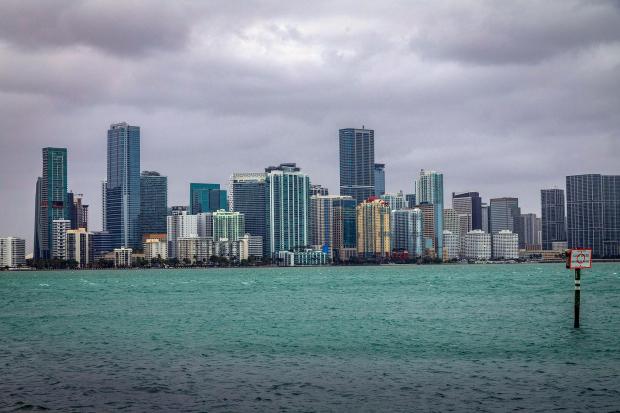 The Miami skyline is viewed from the Rickenbacker Causeway in 2023, when Florida was among the fastest-growing states in the U.S. But now, growth is slowing and Miami-Dade County was among those nationally that experienced a fallback in population, according to Census Bureau estimates for July 1, 2024, to July 1, 2025. (Pedro Portal/The Miami Herald)
In search of affordability
Dr. Ned Murray, associate director of the Jorge M. Perez Metropolitan Center at Florida International University, said the slowing of Southeast Florida population growth has become more profound for a state reputed to be a preferred destination for relocating families, individuals and businesses.
“Even in the last few years, it’s been quite remarkable,” he said. “Everyone is tuned in to the cost of living right now. You are looking for markets that are more affordable and where jobs are abundant and there are competitive wages.”
The Census Bureau estimate for 2025, he said, is a reflection of “everything we’ve been seeing trending in that direction since 2022.”
That’s particularly true for the loss of younger work force members from the ages of 20 to 29. “Our primary working age population is who we’re losing the most,” he said.
For Murray, the population movements in South Florida since 2022 have produced three takeaways:
Federal tax law changes passed in 2017 that allowed the deductability of state and local taxes in places like the Northeast drove out high-income earners from their home states.
Inbound migrants are less challenged by rising housing and insurance costs while incumbents “are being priced out.”
The migration of higher earning residents will grow local economies, “but will exacerbate affordability issues.”
Slide in domestic migration
Murray also noted that while all three major South Florida counties had “positive international net migration between 2020 and 2023,” domestic migration was down 153,950, with Miami-Dade having “the greatest loss in population.”
A net domestic loss in migration means the number of people leaving is exceeding the numbers arriving in the community. It does not include international migrants who arrive from other countries.
In 2022, Miami-Dade had a domestic loss of more than 134,000, with Broward down by nearly 40,000. But Palm Beach County had a gain of nearly 20,400, according to figures provided by FIU. The state of Florida for that year had a gain of 818,762.
The decline in domestic migration noted by Murray appears to be continuing. The Census Bureau estimates determined that all three of South Florida’s big counties had negative domestic migration figures for the 2024-2025 period.
Population growth through foreign immigration is also showing signs of a slowdown, said Miceli of TD Bank.
“There are also the changes in immigration law that have resulted in fewer individuals being able to establish themselves here,” he said. “We’re seeing that even in account openings with that first-time account holder. The volumes are down.”
Economy will still grow, but more slowly
“There is no doubt that the cost of living is an issue,” Jeffrey Kottkamp, CEO of Florida Tax Watch, said in a telephone interview. “Miami is becoming an even more dynamic international city and with that, obviously, the cost of living keeps going up.”
“Our long-term economic forecast is that we will continue to grow at a slower pace,” he added. “We will see wages continue to grow and unemployment is going to hold pretty steady. I think these [population] decreases are temporary.”
Miceli said his bank has seen strength in Small Business Administration loans for operators in manufacturing, exporting and other fields.
Moreover, the uninspiring Census figures don’t appear to reflect a dampened desire of out-of-state companies to relocate and build a presence in South Florida.
In February, Palantir Technologies announced it moved its corporate headquarters from Denver to Aventura in northeast Miami-Dade, just south of the Broward County line.
Ken Griffin, who moved his Citadel and Citadel Securities financial firms to Miami from Chicago in 2022, has been an ardent promoter of doing business in the city, committing millions to the construction of a 54-story high rise that will serve as the firms’ headquarters. Between them, the firms employ 500 people.
Asked about the future of the region given the population movement, a spokesperson referred a reporter to a recent profile of Griffin’s firms in Fortune magazine, which named them to its “100 Best Companies to Work For” list.
“We’re constructing an iconic office building for this century, right here in Miami, in the free state of Florida, on the water,” Griffin said in a profile article. “And people from some of the biggest tech companies in the world who’ve seen the design are saying, ‘We want to be there!’”