
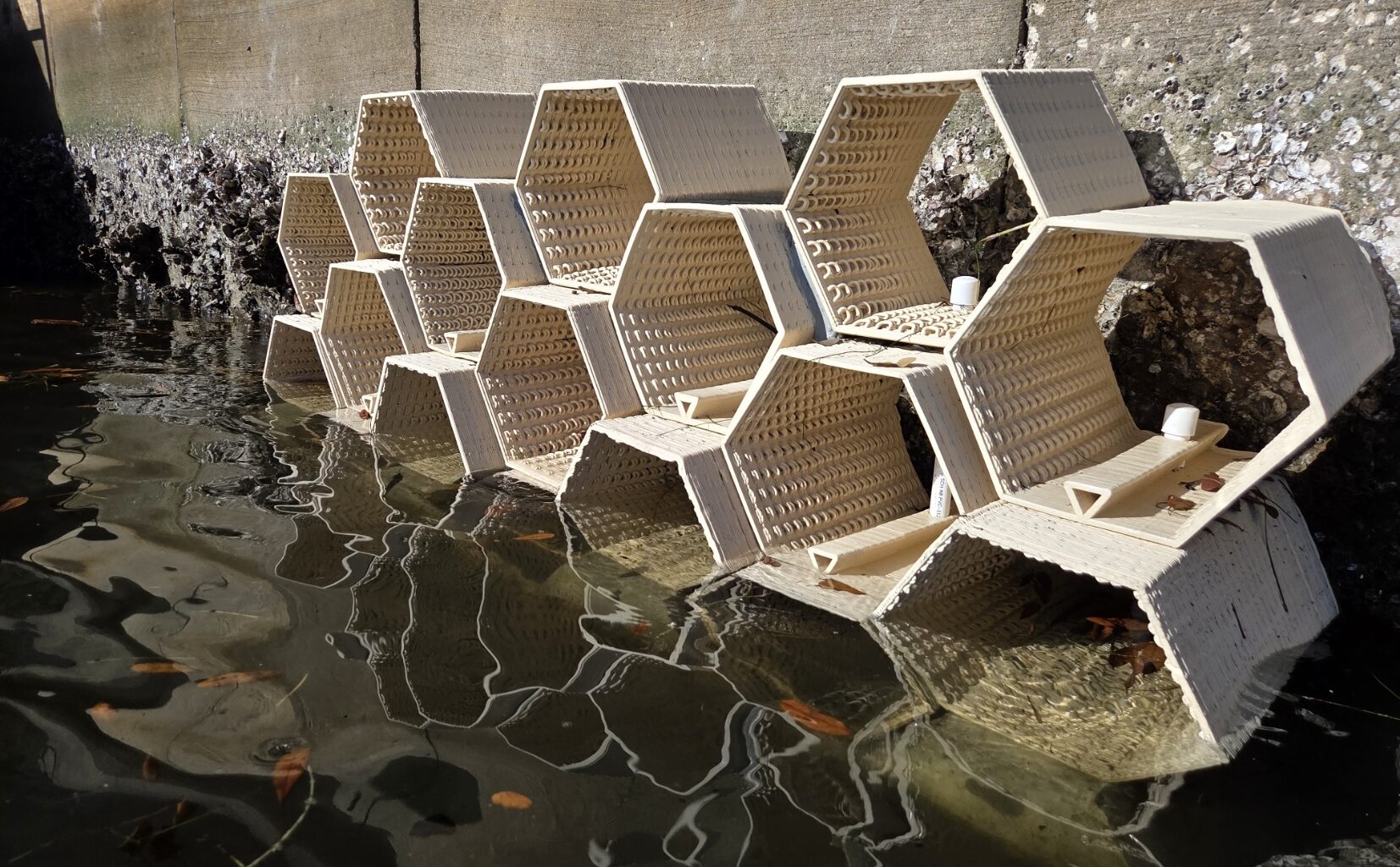
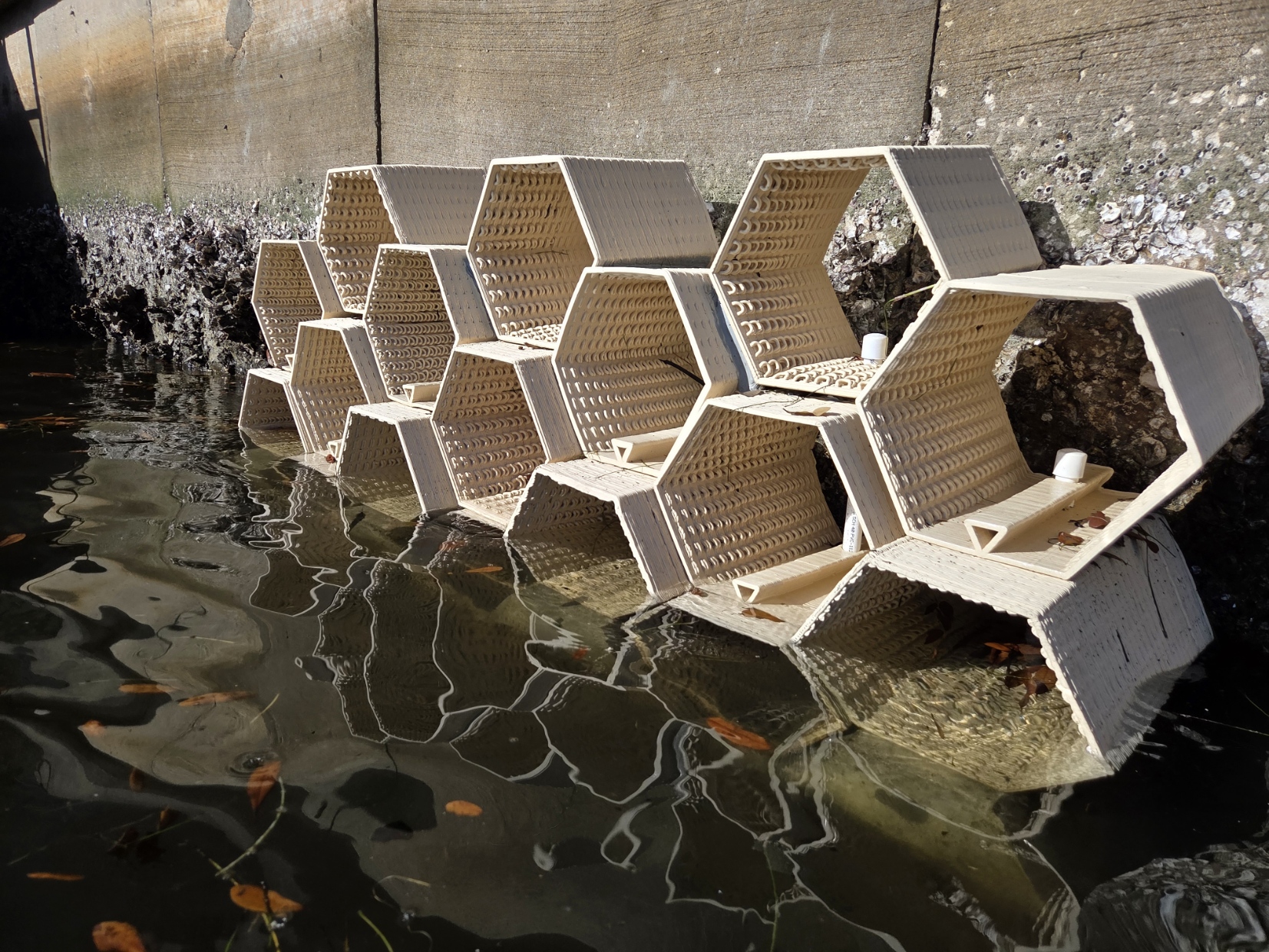
3-D printed clay honeycomb-like cells along Bayboro Harbor. Photos courtesy of USF professor William Ellis.
Listen:
It all started with a student mistake before Professor William Ellis arrived at the University of South Florida’s Department of Integrative Biology.
He was conducting an experiment with students measuring oyster growth. They hung plastic mats with oyster shells on PVC poles near the water and didn’t see much growth.
At least until a student forgot to pick the mats up when Ellis left for sabbatical.
“After a year of being out in the field, I noticed that oysters were growing on vertically oriented structures, very, very well, and just seven feet away, nothing,” Ellis said. “And this is actually where an oyster reef was the year before.”
Ellis then put the mats on a seawall. Half of them were caged and overflowed with oysters.
When he joined the university staff sometime later, he teamed up with art professor Tina Piracci from USF’s Honors College. She leads a lab where clay is used to 3-D print objects that can be introduced in ecosystems.
“And so if you were to imagine maybe even like a hot glue gun, kind of depositing material layer after layer to be able to grow these 3d objects,” said Piracci.
She explains, the printed objects shrink as they dry and are later put in a kiln and fired. They can reach a temperature of up to 2200 degrees.
Then, students install these clay-made oyster homes along Bayboro Harbor’s seawall.
“I think they’re gorgeous and watching the fish go in and out… they look like a honeycomb where the cells are uneven,” Ellis said. “There’s a stair-stepping to them.”
Piracci and Ellis hope to make the project an open-source initiative that can be replicated across Florida.