
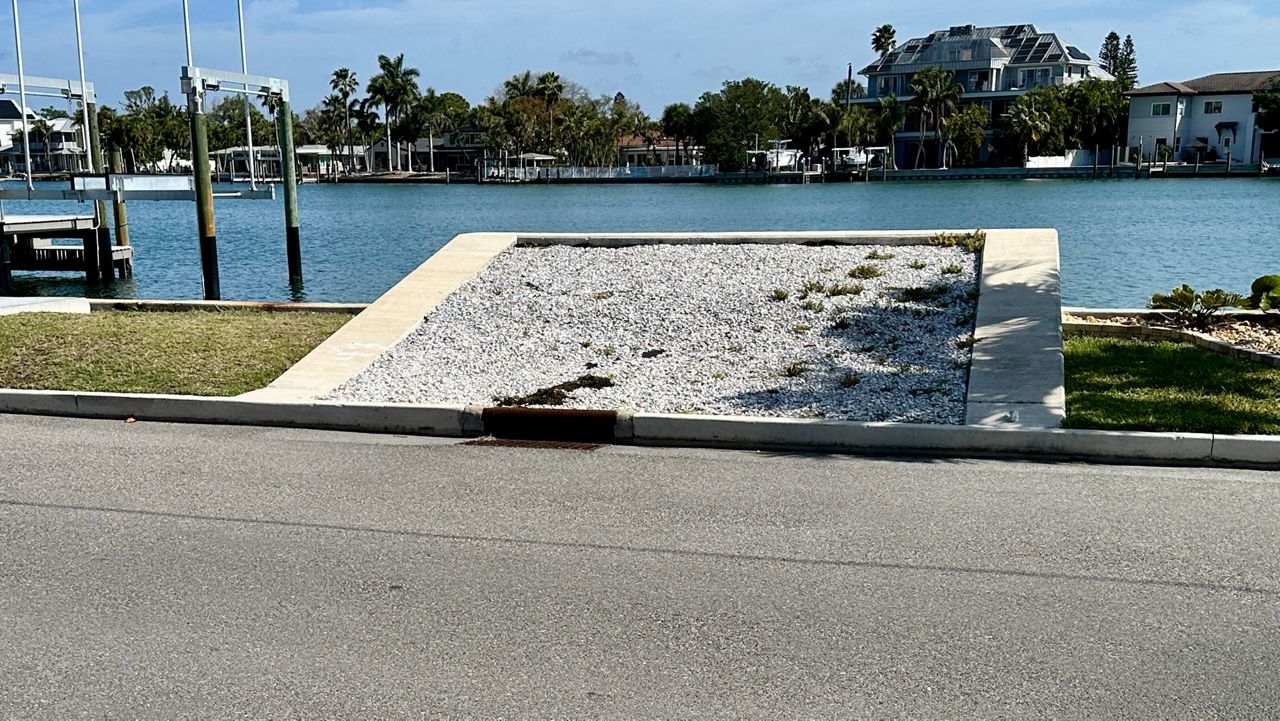
ST. PETE BEACH, Fla. — St. Pete Beach commissioners recently approved spending $1.1 million to install underground concrete vaults for tide check valves to better maintain the devices and stop sunny day flooding in low-lying neighborhoods.
What You Need To Know
St. Pete Beach approved spending $1.1 million to install underground concrete vaults for tide check valves in 13 locations
Those locations include 5 in Don CeSar Place, 9 in Pass-a-Grille and 2 in Belle Vista
The vaults will make it easier to maintain the tide check valves and keep saltwater from flooding during high tides
Public Services Director Camden Mills hopes to begin construction in the next couple of months
“This is a new design for St. Pete Beach,” said Camden Mills, Public Services Director. “So this will be the first time that we’re vaulting our tide check valve structures and moving it closer to the road.”
A total of 13 vaults will be installed in a few neighborhoods, which include 5 in Don CeSar Place, 9 in Pass-a-Grille and 2 in Belle Vista. City commissioners unanimously approved the contract at their meeting on March 24.
“Whatever we need to spend,” said Commissioner Al Causey. “I’m committed to not having saltwater on the city streets.”
Mills said that tide check valves have been installed at the end of storm drain pipes on the water side. Which means divers can only clean one side, while the other side can remain stuck open with barnacles, allowing seawater to flow up onto the street during some high tides.
“Regularly we have high tides that are higher than the roadway elevations,” said Mills. “Without a tide check valve, we could see water into the roads… on a monthly basis.”
The new design will give Public Services the ability to more easily maintain the tide check valves from the land side near the curb, according to Mills.
“That way our crews can come through with their crane tracks,” he said. “Open up the hatch doors in that new structure and then lower the crane so they can disconnect the section of the pipe that will have that tide check valve inserted inside it.”
A baffle structure will also be installed in the vault to help catch debris that could impact the functionality of the tide check valve. Mills said he consulted with other cities including St. Petersburg, Ft. Lauderdale, and St. Augustine who face similar tidal influences on their stormwater systems who agree the vault structures are the best approach.
“We all ran into regular challenges of how we maintain these check valves,” he said. “We’re starting to see municipalities move towards bringing these type of structures closer to the roadway.”
Resident KellyLee McFrederick lives in the Don CeSar Place neighborhood and said she bought an SUV with 22-inch wheels to drive through the tidal floodwater in order to get home.
“So what happens is the saltwater, especially in a king tide, it comes out here and it does not go away,” she said. “I’m at least a foot of water plus and I’m one of the few that can make it home.”
McFrederick has a storm drain directly across from her home with Boca Ciega Bay on the other side of the seawall. She’s happy the project, which has been on the books for a few years, has finally been approved and wants to see more mitigation for the neighborhood.
“These need to be clean and effective,” she said. “We definitely need to get… with the times and get this flooding taken care of. This is not this is not how we want to live.”
Mills said he hopes to begin construction in the next couple of months. Each vault will take about two weeks to build, with the entire project completed in about 6.5 months after construction begins.
“It’s critical to have a tidal defense in place to try and prevent that bay water from getting into our roads,” he said. “Impacting our private property.”
In the future, Mills hopes to get approval for pump stations to be installed in the low-lying neighborhoods.