
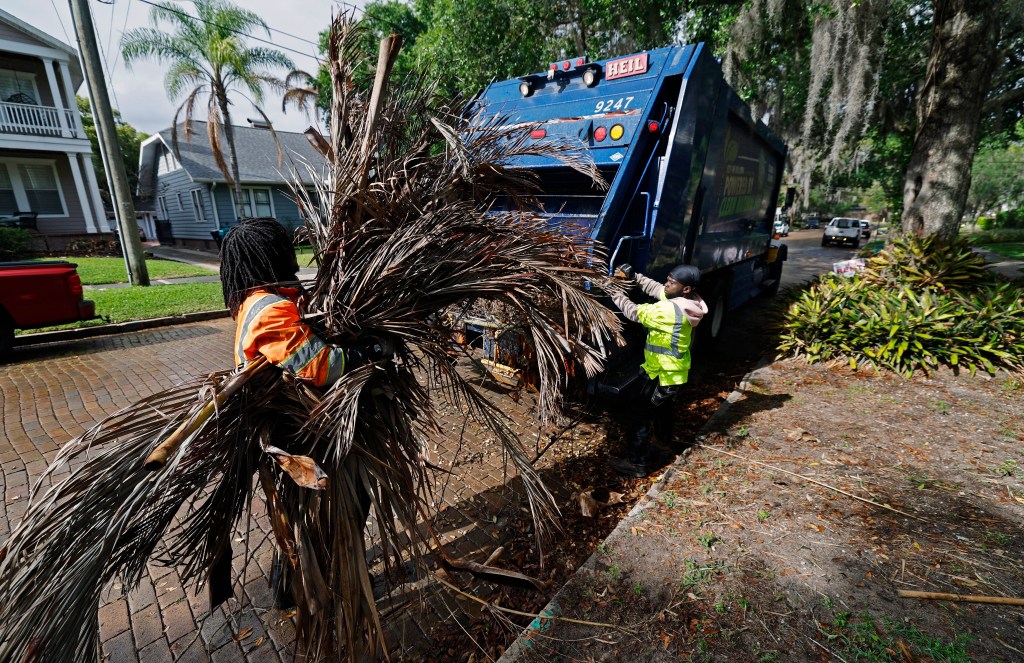
Homeowners across Central Florida have been frustrated to find their piles of dead leaves, branches and plants — victims of February’s hard freeze — still sitting on their curbs because waste haulers haven’t picked it up on time.
In Orlando, crews said they’ve collected about 1,200 more tons of yard waste so far this spring than last year, totals surpassing those of hurricanes. Teams aboard trucks are working 12-hour shifts, six days per week — longer hours and more days than normal — to get it all picked up.
This week was the first since the uptick that crews have completed their routes of roughly 1,200 homes in a 12-hour shift, said Alan Morrison, the city’s Solid Waste manager. But as fast as they pick it up, residents are pulling bags of more debris out to the curb.
“I’ve never seen anything like that,” he said. “I’m thinking we’re at the tail end of it.”
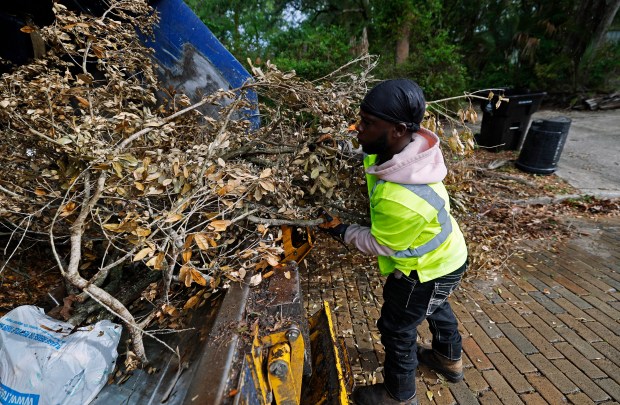 City of Orlando refuse collector Marquis Ashley picks up yard waste along East Concord Street, on Wednesday, April 8, 2026. (Ricardo Ramirez Buxeda/ Orlando Sentinel)
Cities and counties already expect higher debris collections each February and March, as live oaks lining city streets dump leaves and pollen ahead of spring. But this year, the region was hit with multiple days of below-freezing temperatures in early February, with foliage continuing to die over the weeks that followed.
Tropical palms and other warm-weather plants were battered as temperatures dipped into the mid-20s, far colder than many native plants can survive.
Residents who cleaned up in the weeks that followed have sometimes been upset that it hasn’t all been scooped up on schedule. One commenter in a neighborhood Facebook group said she reported her street being skipped three weeks in a row, while others said they were going to ask for a refund on their service fee.
“We have family coming into town for Easter and our street looks terrible,” another commenter wrote.
At a city council meeting this week, Commissioner Patty Sheehan said crews are doing their best, but are inundated with work.
“We’re at hurricane volumes right now,” City Commissioner Patty Sheehan said. “The other thing people don’t take into consideration is not only are trucks getting filled up faster, but there’s a line at the dump to get in as well. So it’s not that we’re not trying — there’s just a lot of yard waste out there.”
In March, Orlando crews collected nearly 2,300 tons from the curb — 862 tons more than last March.
The figure is also nearly 1,000 tons more than it picked up after Hurricane Milton struck the region in in October 2024, though that doesn’t include felled trees and large items scooped up by contract haulers. Milton made landfall in the Tampa area as a Category 3, and passed south of Orlando, with peak gusts of 87 mph at Orlando International Airport.
“We’re at hurricane volumes right now,” City Commissioner Patty Sheehan said. “The other thing people don’t take into consideration is not only are trucks getting filled up faster, but there’s a line at the dump to get in as well. So it’s not that we’re not trying — there’s just a lot of yard waste out there.”
In Seminole County, the county has seen a 125% uptick in its average weekly yard waste since March 1. Despite delays in previous weeks, its haulers are catching up, said Andy Wontor, a county spokesperson said.
The county last month said it was facing delays in some home pickups and had started picking up on Saturdays as well to clear the backlog.
The same is true in Lake County, where haulers surged more trucks and crews into neighborhoods last month to get caught up.