
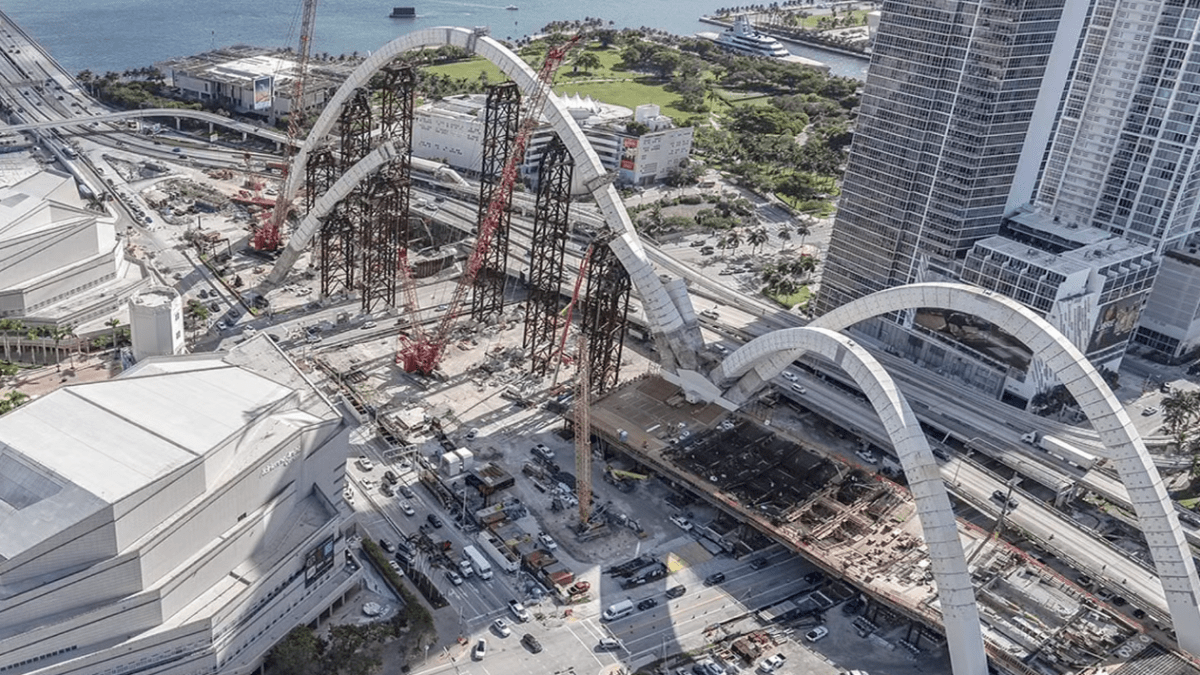
Construction resumed Monday on Miami’s Signature Bridge project, just two weeks after a worker fell from an overpass and died — an incident now under investigation by the Occupational Safety and Health Administration (OSHA).
The massive infrastructure project, designed to connect three of Miami’s busiest highways, was originally expected to be completed in 2021. The Florida Department of Transportation (FDOT), the government agency overseeing the project, expects construction may not wrap up until 2029 — nearly a decade behind schedule.
The project has also drawn scrutiny following an NBC6 investigation that uncovered lawsuits filed by the lead contractor alleging design errors and other construction issues contributed to years of delays and hundreds of millions of dollars in added costs.
‘A mixed blessing’
Miami Mayor Eileen Higgins, who has followed the project for years, called it a “mixed blessing.” While she believes the project will eventually help reconnect neighborhoods in the city, she expressed concern about the prolonged construction and its impact on the city.
“All of it concerns me because this bridge needs to be finished sooner rather than later,” Higgins said, responding to the NBC6 investigation. “What we have now is a giant construction project that is dividing our downtown.”
FDOT has previously attributed delays to factors such as weather and supply chain disruptions. But lawsuits filed by the project’s lead contractor, Archer Western–de Moya Joint Venture, point to something else.
The joint venture said the engineering firm it hired, HDR, miscalculated wind forces acting on the bridge’s signature arches. If built as designed, according to one of the lawsuits, the original design may not have been capable of withstanding Miami’s high winds, prompting a re-design before construction began. The changes, the lead contractor said, added years to the timeline and approximately $405 million in extra costs.
Expert weighs in
To better understand the allegations, NBC6 Investigates consulted Jean-Pierre Bardet, former dean of the University of Miami’s College of Engineering, who reviewed court documents related to the case.
“This is not something simple,” Bardet said, describing the project as “one of the most challenging.”
Bardet, who is not directly involved in the project, noted that while the bridge’s arches may look “beautiful,” their design created some challenges. He explained that rounded edges could have reduced wind forces on the structure. But because the arches feature squared edges, he says additional reinforcement was required.
“Since we cannot smooth the edges, we have to strengthen them,” Bardet said. “We don’t want the arches, when the wind comes, to flutter.”
The joint venture alleges that an HDR engineer had proposed rounding the edges early in the design process. But “after months of discussions… FDOT ultimately rejected the changes proposed by HDR, citing significant alterations to the appearance of the Signature Bridge arches and increased maintenance costs,” according to the lawsuit.
In a separate lawsuit, the lead contractor also alleges that defective concrete forced them to demolish and replace parts of the bridge—an issue that was not allegedly discovered for months and cost an additional $3.6 million.
“That seems to me a simple problem,” Bardet said, adding demolishing and replacing the defective concrete was the right thing to do.
Workers’ accidents
According to the Florida Highway Patrol, a worker died in late March after he fell from the overpass of Interstate 395 in Miami and landed 20 feet below onto Biscayne Boulevard. NBC6 spoke with his uncle, Clifford Thompson, who said his nephew, Jorge Eliud Galindo Thompson, worked in Miami for two years and operated heavy machinery. It’s unclear at this time what caused the fall. OSHA is investigating the case.
Galindo’s death comes after a January construction accident in which a toppled concrete beam sent six workers to the hospital. At the time, FDOT told NBC6 the incident “did not involve the bridge structure or any portion of the roadway open to traffic,” adding that all work was taking place in a controlled, closed area away from live traffic.
Calls for more transparency
Back at City Hall, Mayor Higgins emphasized the importance of completing the project safely and efficiently.
“Imagine if they had given us $1.4 billion to build a new transit line,” the mayor said. “We would be alleviating traffic rather than continuing to watch a big construction project.”
FDOT did not respond to detailed questions regarding the project or the expert’s analysis. An agency’s spokesperson just confirmed construction had resumed.
Bardet said moving forward, transparency will be key. He recommends forming an independent panel of engineers to review the project, explain ongoing issues, and help restore public confidence.
“The public needs to be informed,” he said. “Your channel brought it to the attention of a lot of people and I’m sure now they’re asking, ‘what is going on?’”
NBC6 reached out to the joint venture, through its attorneys and phone numbers listed on the companies’ website, to ask about the lawsuits, the expert’s perspective, and the workers’ incidents. We haven’t received a response.
NBC6 also tried contacting HDR’s attorneys and staff. By the time of publication, HDR had not responded to our multiple requests. In court filings, HDR has said its design work was preliminary and noted that the case was settled without any admission of fault.
This story was originally reported for broadcast by NBC6. AI tools helped convert the story to a digital article, and an NBC6 journalist edited the article for publication.