
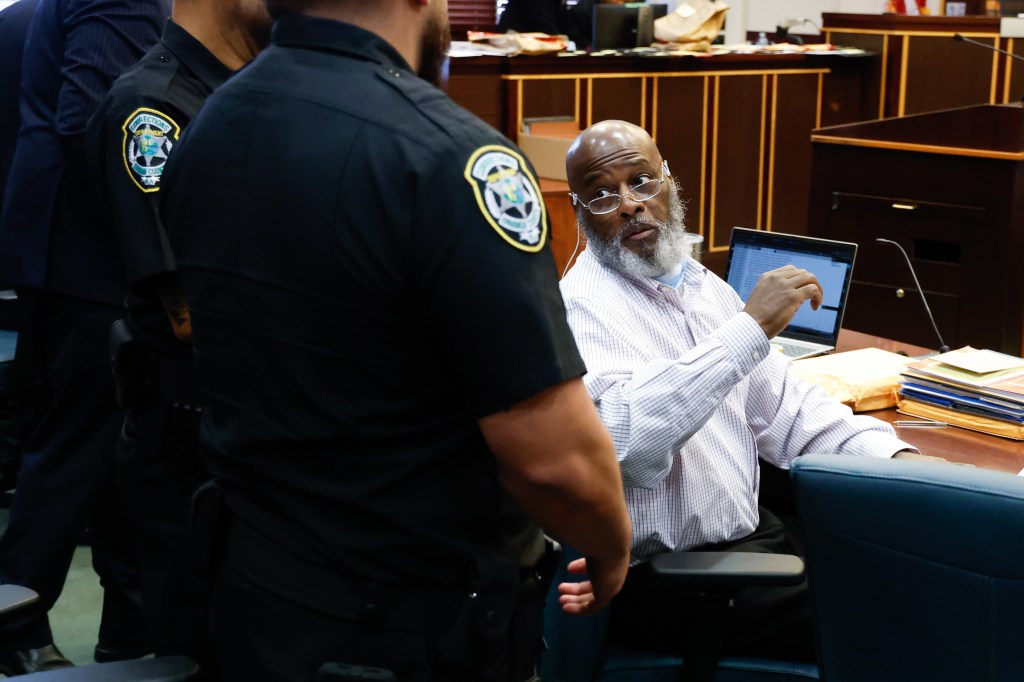
The former boyfriend of a College Park woman was found guilty of her murder late Wednesday after a three-day trial, nearly 24 years after her body was found in the trunk of her car outside a drug store in Sanford.
Demorris Hunter was accused of strangling 38-year-old Teresa Green in May 2002 shortly after a party with their neighbors allegedly ended in a drunken altercation. Found guilty of first-degree murder, he now faces the death penalty.
Hunter, who went by “Mike” at the time, is already serving a lifelong prison sentence for an unrelated murder in California that occurred about two months before Green was killed. He was extradited to Florida in 2015 and has been held in the local jail since then.
In closing arguments, prosecutors relied on testimony by Green’s neighbors, who claimed Hunter and Green tumbled down the stairs during the argument.
The next morning, Hunter enlisted those neighbors to help him take Green’s car to a Walgreens in Sanford. One neighbor alleged that Hunter told him, “I messed up.”
The prosecutors also relied physical evidence on Green’s body, with her battered and bloated face shown repeatedly to jurors, to conclude she had been strangled. Her other injuries, which came from a slap at the party and from the fall down the stairs, could not have been fatal, according to expert testimony.
“All the evidence in this case points to one person, and that’s the defendant,” Assistant State Attorney Rich Buxman told the jury.
The jury returned a verdict after seven hours of deliberation. The panel will return Monday morning to hear arguments to decide Hunter’s sentence.
Green, a labor nurse at the then-Florida Hospital — now AdventHealth Orlando — was living with her 14-year-old son at the time, but the teenager was staying with a friend the night of the party.
When her family called police the next day to report her missing, her son noticed a hole in the drywall that he told investigators was not there the night before. Her car, with her body inside, was found later that night.
After she was killed, prosecutors said Hunter fled Florida in a van stolen from another neighbor, which was found scorched in Texas around the summer before his arrest. More than a decade later Hunter was returned to Florida.
His attorneys, led in closing arguments by Teodoro Marrero, called the prosecution’s case “a complete white-washing” of the facts, pointing to a lack of DNA evidence on Green’s body, in the apartment and in the car demonstrating Hunter’s involvement.
Two forensic analysts disagreed somewhat as to how Green died, with one concluding she was strangled based on the circumstances while another said it was possible but inconclusive.
Marrero also questioned inconsistencies in the testimony of Green’s neighbors, including one who declined to provide DNA and fingerprints to exclude him as a suspect. Mainly, he sought to undercut their testimony by asking the jury why they did not call the police when he noticed Green’s car was left in a parking lot with Green nowhere to be found.
“There’s absolutely no shred of evidence that any of this happened; you just have to take their word for it — or not,” Marrero said. “Without their testimony,” he later added, “all they’ve got is a car in a parking lot with no connection to Mr. Hunter.”
He also went as far as to suggest the neighbors may have been involved in Green’s killing, though no one other than Hunter has ever been accused. Prior to closing arguments, Hunter’s other lawyer, Eben Self, motioned for an acquittal by arguing there was no evidence Green was even killed in Orange County, which Chief Circuit Judge Lisa Munyon quickly denied.
During his time as a fugitive, Hunter was the subject of a segment on the TV show “America’s Most Wanted.” He was captured by the FBI about a year after Green was killed.
But Hunter was not immediately extradited to Florida while he faced justice in California.
Originally handled by the Orange-Osceola State Attorney’s Office, the case was turned over in 2017 to the neighboring Fifth Circuit State Attorney’s Office. At the time, then-Gov. Rick Scott issued an executive order removing certain cases from then-State Attorney Aramis Ayala’s office after she vowed not to pursue the death penalty.
A series of procedural delays and the COVID-19 pandemic pushed back the trial until Monday, when Hunter finally faced a jury. He would have faced a return to a California prison if he’d been acquitted here.
With the guilty verdict, the trial now goes to the death penalty phase. Florida law allows a capital sentence to be imposed with the recommendation of just eight of 12 jurors, the lowest threshold in the U.S.