
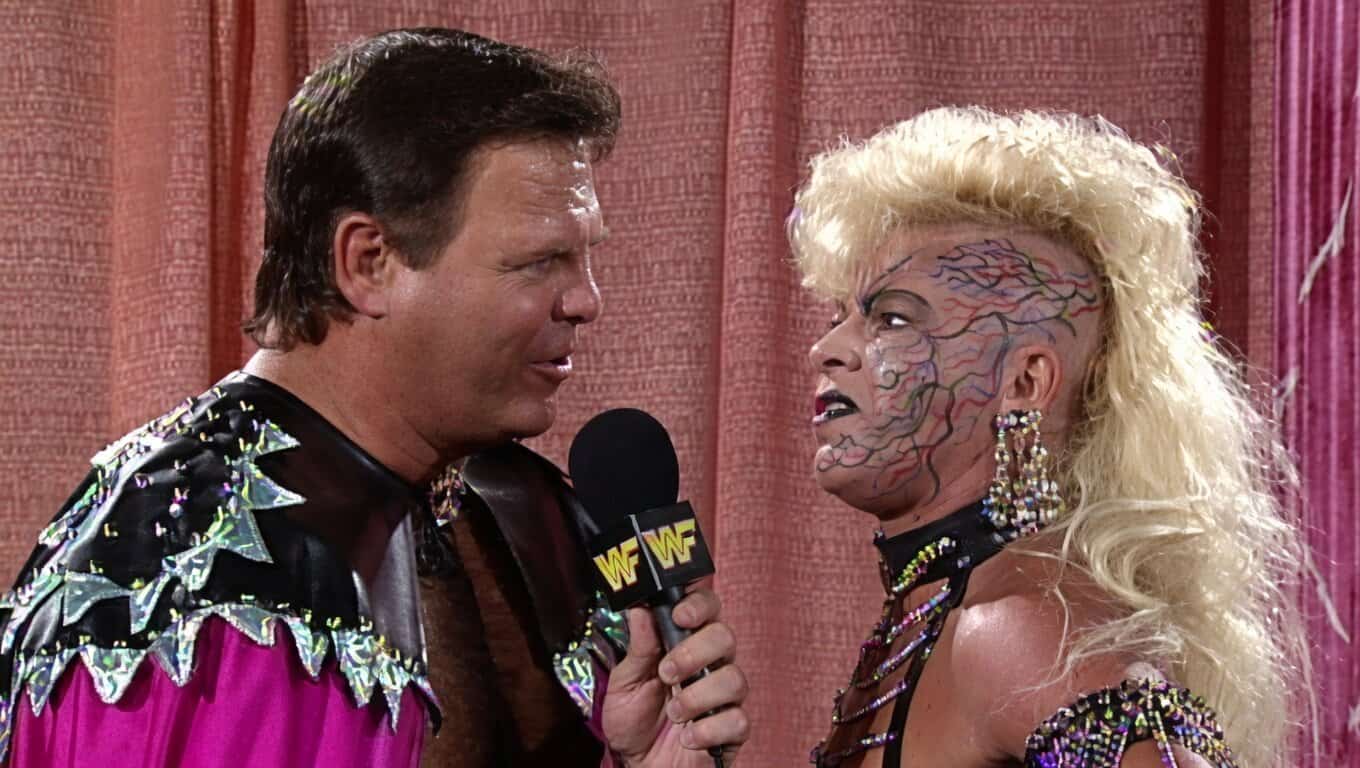
“Lunatic: The Luna Vachon Story,” the feature-length documentary chronicling the life and career of pioneering women’s wrestling star Luna Vachon, continues its festival run in 2026 with an upcoming screening at the Sunscreen Film Festival in St. Petersburg, Florida from April 30 to May 3. Directed by Vancouver-based filmmaker, producer and wrestler Kate Kroll, the film has been collecting positive reviews from critics and wrestling press since its world premiere closed out the 2025 Canadian Film Festival in March. Scroll down to the bottom of this article to see the trailer.
Lunatic profiles Gertrude “Trudy” Wilkerson, the adopted daughter of Paul “The Butcher” Vachon and niece of Maurice “Mad Dog” Vachon and Vivian Vachon, who became Luna Vachon and worked her way through The Fabulous Moolah’s all-women’s wrestling school in Columbia, South Carolina, Mad Maxine’s Florida-based four-woman troupe (where she wrestled as Angelle Vachon), Florida Championship Wrestling (where she debuted in 1985 as a young reporter named Trudy Herd before being slapped by Kevin Sullivan and joining his Army of Darkness as Luna Vachon), the AWA, ECW, WCW and the WWF before her death in 2010 at age 48. Across her 22-year in-ring career, which ran from her 1985 debut to her 2007 retirement, Vachon helped push women’s wrestling toward being treated as a legitimate athletic attraction in an era when the industry treated women’s matches as either novelty acts or eye candy. The film positions her as a direct predecessor to the women’s wrestling revolution that has played out in WWE, AEW and TNA over the last decade.
Kroll, who wrestles as Calamity Kate and co-runs the Vancouver-based independent promotion Wrestlecore with her husband Cobra Kai, started developing the project in 2019 after attending the Whistler Film Festival premiere of Vampiro: Another Nail in the Coffin from Toronto-based producer Michael Paszt of Raven Banner Entertainment. Paszt, who is now a co-producer on Lunatic and whose company is distributing the film, encouraged Kroll to pitch a women’s wrestling documentary, and Vachon quickly emerged as the subject for several reasons.
“Luna has so many layers,” Kroll said in an interview on The Wrestling Classic podcast hosted by Justin Dhillon. “She comes from a Quebec wrestling dynasty. Her aunt Vivian was a wrestler in the 70s, so we have that connection to the past. We have the whole 80s, 90s, 2000s era with Luna. And then we have her legacy, which we can see now. Her story takes us through a long span of the evolution of women’s wrestling. She was diagnosed bipolar. She suffered from addiction. She had mental health issues. She was a mom, which a lot of people didn’t know. The way she died was really, really tragic. And I thought, you know what, she’s got a story that everyone can relate to, even if you don’t know anything about wrestling.”
The film features interviews with David “Gangrel” Heath, Paul “The Butcher” Vachon, Vachon’s sons Joshua and Vincent “Van” Hurd (the latter known to reality TV viewers from his appearances on Gordon Ramsay’s Hell’s Kitchen), AEW referee Aubrey Edwards, Debra “Medusa” Miceli, Jacqueline Moore, the late Kevin Sullivan, Missy Hyatt, Penelope Paradise, indie scene fixture Craig Cohen and many others. Sullivan and Paul Vachon, who passed away in 2024 at age 86, both gave what are believed to be among their final on-camera interviews to Kroll. The film also surfaces VHS tape footage from the 1980s women’s promotion Wild Women of Wrestling that had been thought lost. Kroll discovered the tapes through her associate producer, longtime wrestling journalist Greg Oliver of SLAM Wrestling, after the death of WWoW co-founder Howard Brody in 2024.
“At his memorial, our associate producer Greg Oliver came across these tapes, these VHS tapes, and he said, ‘What are these?’” Kroll told Sean Sirianni on The Creative Imbalance podcast. “And no one knew what they were. They were just out and no one knew. And then we discovered they were all this old footage that no one knew existed of Luna’s time in the late 80s at Wild Women of Wrestling. And like, no one had seen this footage since the 80s.”
Lunatic does not shy away from the difficult parts of Vachon’s story, including her bipolar diagnosis, her addiction struggles, her experiences with sexual abuse and assault dating back to childhood, the toll the road lifestyle took on her relationships with her sons, and her death in August 2010 from an accidental overdose of oxycodone and benzodiazepine, which came roughly a year after she had completed a WWE-funded stint in rehab. But Kroll has been clear in interviews and at festival Q&As that she did not want the film to function as a sensationalized cautionary tale, and reviewers have responded to the balance she struck.
Writing for SLAM Wrestling, reviewer Jen Engle called the film “a must-watch for anyone who loves professional wrestling, especially women’s wrestling,” and praised it for presenting Vachon “as a person, not just a gimmick.” Engle highlighted Kroll’s dual perspective as both a filmmaker and a working wrestler. “The wrestlers interviewed in the documentary speak honestly and openly as they talk with someone who understands the business.”
Jeremy Thomas of 411mania, reviewing the film out of Fantastic Fest in Austin, called Lunatic “one of the better wrestling feature documentaries in recent memory” and singled out Kroll’s editorial restraint. “The biggest thing that Lunatic has going for it is Kroll’s choice to treat Luna more like a person and less like a tragic cautionary tale that a less sensitive documentary would jump on as an approach. Kroll is interested in more than just the usual focus on the drug abuse that was rampant in the industry. She doesn’t shy away from that, nor the oft-made allegations against the Fabulous Moolah, but she doesn’t overly linger on them, taking more time to explore Luna’s bipolar disorder and how the lack of interest from WWE at the time and other promotions in actual women’s wrestling stymied her.”
Whitlock and Pope gave the film four stars and praised the testimony Kroll captured from her interview subjects. “Luna Vachon was unforgettable in the ring and unprotected outside it. Kate Kroll’s Lunatic: The Luna Vachon Story restores her to scale, showing the human cost of a system that could not contain her. The film’s most devastating passages are not about the ring but the culture surrounding it.”
Nerdly’s Fantastic Fest review described Lunatic as “a compelling portrait of a women’s wrestling pioneer who never got her due” and noted that the film works for both hardcore wrestling fans and viewers who have no background in the industry.
The documentary has generated some critical conversation along the way. Writing for POV Magazine, Pat Mullen called the film “celebratory” and praised Kroll’s interview roster, but argued that Vachon’s story has now been covered across multiple recent documentaries and that some of the same beats are repeated. The 2021 documentary The Last Villains, which centered on the broader Vachon family wrestling dynasty, and the Dark Side of the Ring episode focused on Luna both predate Lunatic. Kroll has acknowledged in interviews that she had to cut her first edit down from over five hours to roughly 114 minutes to keep the film focused on Luna’s own arc rather than the family legacy or wider industry context.
In addition to its festival run, Lunatic was nominated for Best Canadian Documentary at the Vancouver Film Critics Circle awards in February 2026. The film has also screened at the Calgary Underground Film Festival, Fantastic Fest in Austin and the Black Sunday Film Festival in London for its UK premiere. Vachon herself was posthumously inducted into the WWE Hall of Fame as part of the Legacy wing’s Class of 2019, the Professional Wrestling Hall of Fame in 2020, the Canadian Pro-Wrestling Hall of Fame in 2022 and the Women’s Wrestling Hall of Fame in 2023.
Beyond wrestling, Kroll’s previous documentary work includes No Fun City, about Vancouver’s underground music venues, and the Tibetan self-immolation short Rangzen. She is the recipient of the Canadian Media Producers Association’s Kevin Tierney Emerging Producer Award for her work on the dramatic comedy Portraits From a Fire. She is also a former story producer on the CTV reality dating series Farming For Love, and her credits include the CBC Gem series Future Futures and the Vision TV documentary Path of Pilgrims.
Lunatic is produced by Kate Kroll, Pasha Patriki and Michael Paszt under Kroll’s Black Moon Media banner, with Raven Banner Entertainment handling distribution. The film is edited by Aynsley Baldwin (who also co-wrote the screenplay with Kroll), with cinematography by Claire Sanford, Alysha Galbreath and Sarah Thomas Moffat, and an original score by Conan Karpinski.
Kroll has indicated she is still trying to lock down a U.S. streaming home for the film. In Canada, Lunatic is currently available on demand through Hollywood Suite, accessible via cable providers and Amazon Prime Channels. Wrestling fans in the United States who want to push for a streaming release are encouraged to follow the film’s official social media accounts and tag distributors and platforms with their interest.
The Sunscreen Film Festival, now in its 21st year, runs April 30 through May 3, 2026 in St. Petersburg, Florida. The official festival hub is the AMC 12 Theatres at Sundial in downtown St. Petersburg. Tickets and the full festival schedule are available through the Sunscreen Film Festival website, with the Lunatic listing on the festival’s Eventive page. Wrestling fans in the Tampa Bay area, or those willing to travel, will have a chance to see one of the most well-received wrestling documentaries of the past year on the big screen.
Fans can follow the film on Instagram at @lunaticdocumentary and on Facebook at Lunatic: The Luna Vachon Story. Kroll can be followed on Instagram at @calamitykateshowgirl for her wrestling work and at @katekroll.blackmoonmedia for her filmmaking projects.