
Every winter, thousands of blacktip sharks migrate to South Florida’s waters, coinciding with beach nourishment projects that aim to counter erosion and protect the shoreline. “Sand is either pumped from offshore onto the beach to build it up, or shipped in on occasion to provide a way to build up the beach to counter erosion,” researchers said. Erosion caused by storms, sea level rise, and hurricanes necessitates these projects every few years during the winter. The widened beaches help protect homes and condos near the water and provide habitat. “We need this sort of protection to prevent the houses and condos from being washed away. It’s the natural sort of product of building these buildings so close to the water,” researchers said. A recent study by Florida Atlantic University tracked sediment movement and beach nourishment projects from 2020 to 2021 to explore their impact on marine life. “This was part of a project for a graduate student, Nick Brown, who was studying these plumes as part of his dissertation research,” said Dr. Steve Kajiura, co-author of the study and shark researcher. “This was his interest in looking at the impacts of what was happening, not only on the beach, but also offshore. So how is this impacting sandbar formation or other things offshore.” Kajiura explained that sediment disturbances from these projects create low visibility in nearshore waters, which could negatively affect blacktip sharks that migrate to South Florida during the winter. “These sharks will come down to South Florida and spend the winter off South Florida. During the spring, they’re migrating north, along the beach. And they still stay along the beach because that’s where the bait fish are,” Kajiura said. The murky waters caused by sediment movement could increase the likelihood of negative interactions between beachgoers and sharks. “If the sharks are there and the water’s turbid, that tends to lead to the potential of really bad negative encounters. In murky water, it’s really hard for the sharks to resolve visually if that’s a small fish or the palm of your hand catching the light,” Kajiura said. He emphasized that the timing of these projects ideally should not coincide with the sharks’ migration. “The timing couldn’t be worse. Because at this time of year we have a lot of people coming down from up north because spring breakers coming down here enjoying our beautiful beaches, but if the water is muddy and there’s a lot of sharks there, there’s lots of potential for negative interactions,” Kajiura said.
PALM BEACH COUNTY, Fla. —
Every winter, thousands of blacktip sharks migrate to South Florida’s waters, coinciding with beach nourishment projects that aim to counter erosion and protect the shoreline.
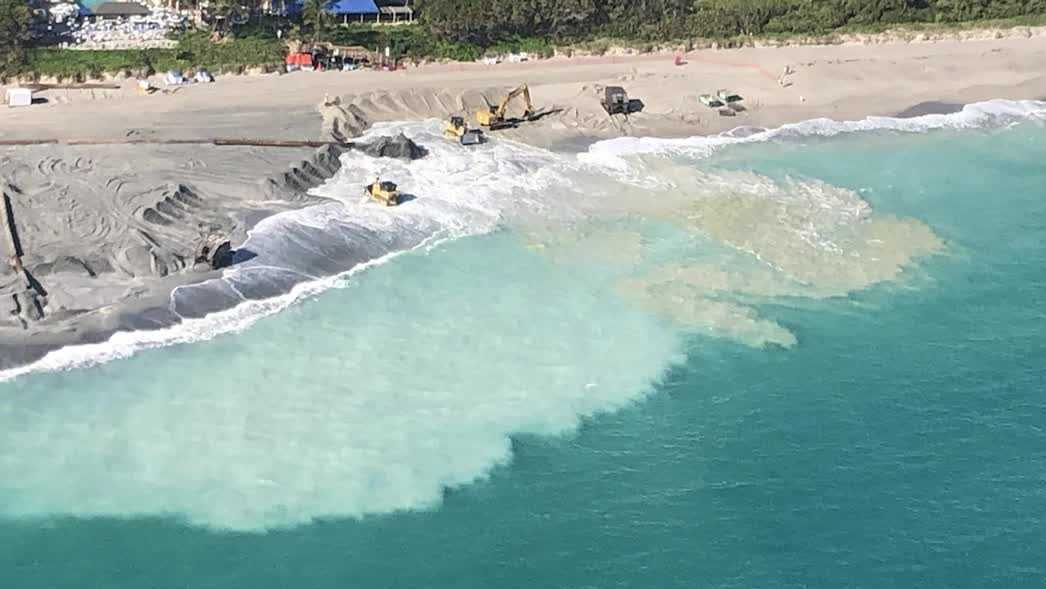
“Sand is either pumped from offshore onto the beach to build it up, or shipped in on occasion to provide a way to build up the beach to counter erosion,” researchers said.
Erosion caused by storms, sea level rise, and hurricanes necessitates these projects every few years during the winter. The widened beaches help protect homes and condos near the water and provide habitat.
“We need this sort of protection to prevent the houses and condos from being washed away. It’s the natural sort of product of building these buildings so close to the water,” researchers said.
A recent study by Florida Atlantic University tracked sediment movement and beach nourishment projects from 2020 to 2021 to explore their impact on marine life.
“This was part of a project for a graduate student, Nick Brown, who was studying these plumes as part of his dissertation research,” said Dr. Steve Kajiura, co-author of the study and shark researcher. “This was his interest in looking at the impacts of what was happening, not only on the beach, but also offshore. So how is this impacting sandbar formation or other things offshore.”
Kajiura explained that sediment disturbances from these projects create low visibility in nearshore waters, which could negatively affect blacktip sharks that migrate to South Florida during the winter.
“These sharks will come down to South Florida and spend the winter off South Florida. During the spring, they’re migrating north, along the beach. And they still stay along the beach because that’s where the bait fish are,” Kajiura said.
The murky waters caused by sediment movement could increase the likelihood of negative interactions between beachgoers and sharks.
“If the sharks are there and the water’s turbid, that tends to lead to the potential of really bad negative encounters. In murky water, it’s really hard for the sharks to resolve visually if that’s a small fish or the palm of your hand catching the light,” Kajiura said.
He emphasized that the timing of these projects ideally should not coincide with the sharks’ migration.
“The timing couldn’t be worse. Because at this time of year we have a lot of people coming down from up north because spring breakers coming down here enjoying our beautiful beaches, but if the water is muddy and there’s a lot of sharks there, there’s lots of potential for negative interactions,” Kajiura said.