

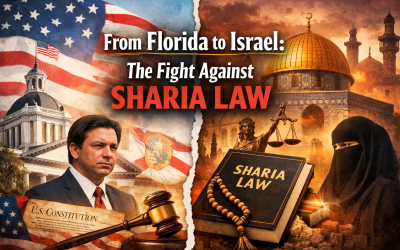
 Recently, Florida Gov. Ron DeSantis reinforced a clear legal principle: Sharia law and any form of foreign or religious law cannot be applied within the state if they conflict with the Constitution. The message was direct and unambiguous. In Florida, there is one legal system, and it applies equally to everyone.
But Florida is not alone.
Across the United States, multiple states have taken steps to reinforce this principle. States such as Oklahoma, Tennessee, Louisiana, Arizona, Kansas, Alabama, North Carolina, South Dakota and Missouri have passed laws or constitutional amendments limiting the use of foreign legal systems, including religious law, within their courts.
Most of these laws do not mention Sharia directly. Instead, they reinforce a broader rule: no foreign or religious law can be applied if it violates the US Constitution. Even in states that have not passed such laws, the principle remains the same. Courts may recognize private agreements, including religious arbitration, but only if they fully comply with American law. There is no parallel legal system with official authority.
The guiding idea is simple: one law for all.
Yet in Israel, a very different reality exists.
In Israel, there is no general “Sharia law” that replaces state law. However, there are official Sharia courts for Muslim citizens, operating as part of the state’s legal system under government oversight. Their authority is limited primarily to personal status matters such as marriage, divorce, child custody, alimony and, in some cases, inheritance. Similar arrangements exist for Jewish rabbinical courts and Christian ecclesiastical courts.
Sharia courts do not deal with criminal law, national security, taxation or general civil rights. Israeli law always overrides them. Although they operate nationwide as part of the state system, in practice they primarily serve the Muslim population.
This is where the core difference emerges.
While the United States, even without uniform legislation across all states, maintains a single legal standard under the Constitution, Israel formally recognizes religious courts as part of its legal structure in family matters.
One example often raised in this debate is polygamy. Israeli law prohibits it for all citizens. However, in practice there have been cases, particularly within parts of the Muslim community, where polygamous marriages occur through religious frameworks such as Sharia courts or arrangements outside the standard civil system, with inconsistent enforcement. This creates a perception of unequal application of the law, as Jewish citizens are strictly bound by the state’s prohibition.
Critics argue that when religious legal frameworks operate alongside state law, even in a limited capacity, it can lead to gaps in enforcement, unequal realities and ultimately undermine the principle of equal treatment under one unified legal system.
A second example can be seen in matters of marriage and divorce. In Israel, there is no option for civil marriage within the country. Jewish citizens must marry through rabbinical courts, while Muslims marry through Sharia courts and Christians through their respective religious institutions. This means that personal status is determined not by a single civil system, but by separate religious authorities depending on one’s identity.
As a result, two citizens living under the same state can face different legal processes when it comes to fundamental life decisions. Critics argue that this structure reinforces division rather than unity and raises difficult questions about equality before the law.
The debate is not limited to Florida. In Texas, leaders including Gov. Greg Abbott, Lt. Gov. Dan Patrick and activist Valentina Gomez have pushed to ensure that no form of foreign or religious law, including Sharia-based frameworks, influences the legal system. Their position reflects a broader effort to maintain a single legal standard.
The contrast remains striking.
In one democratic system, the rule is clear and consistently enforced: constitutional law comes first and applies equally to all citizens. In another, multiple legal frameworks continue to operate side by side, shaped by religious identity.
At the end of the day, a nation must be built on one foundation: one constitution that applies equally to all its citizens, no matter their religion, background or identity. Only then can it truly live up to the ideal of being one nation under God, with justice for all.
Maoz Druskin is an Israeli-born entrepreneur and writer based in the United States. Having grown up in Israel and later building his life in America, he writes about Jewish identity, Israeli society and politics, and the moral and political challenges facing democracies from a personal, cross-cultural perspective.