
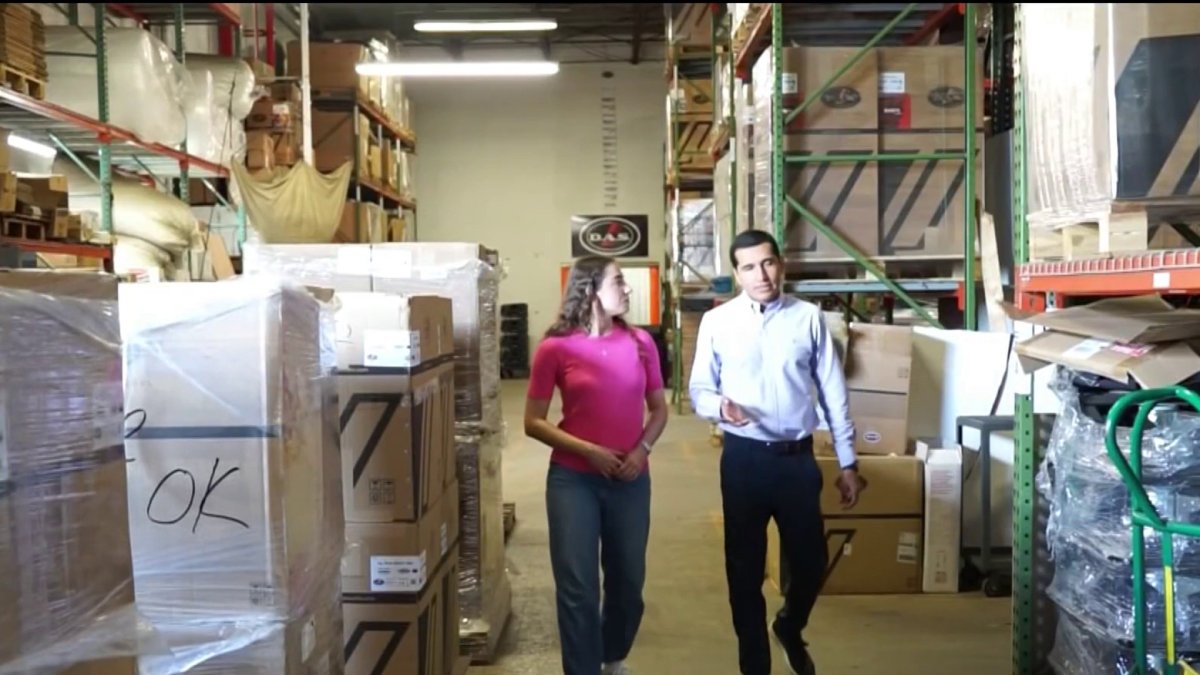
Amazon, Atlas Air- these are just some of the many corporations moving warehouse operations to Miami within this year.
But why is South Florida seeing a boom in big-box spaces?
“With the increase of consumption from e-commerce, hotels, the airport and all those, those, those providers that need warehouse space to supply to their customers,” Edison Vasquez explains.
Vasquez, a Managing Partner with ComReal Miami, has over 20 years of experience in the warehouse real estate space, and it’s changed drastically.
“The transition has been Miami has become a major market,” he said. “Similar to LA, similar to New York and New Jersey, where the limitation of land has attracted capital and attracted views from, from users, looking to place capital.”
Vasquez said, “This has translated from an, a type of ownership where owners, small owners have been transitioned to bigger funds and bigger owners own multiple properties, multiple portfolios.”
So small businesses are becoming bigger or absorbed by bigger corporations, meaning more stuff which needs more storage.
According to data from Miami Realtors, sales of commercial real estate in Southeast Florida rose to $16 billion in 2025, up 26% from 2024. In Miami-Dade County, sales rose more than 30%. In Broward County, it was roughly 27%.
According to data from ComReal, as of the start of this year, Miami-Dade has more than 281 million square feet of total industrial inventory.
Vasquez said it’s projected that every year developers will add 4 to 5 million square feet into the market because our warehouse sale prices far exceed national averages, at roughly $275 dollars per square foot.
But who is buying these properties?
Vasquez said there are lots of e-commerce companies like Amazon, but it’s more so logistics companies that help to supplement our tourism and consumerism.
“You see millions of tourists visiting, visiting us through different airports, the cruise lines, millions of passengers, all those consumers need to be supplied, need to be services from laundry to frozen treat, to everything that goes on an airplane,” he said. “All that has to go through a warehouse space. Also, consumption in the malls. You go to the malls and buy a suitcase, and luggage and electronics, all that goes through a warehouse space and then transit. And then the tourists take it to their countries or their destination.”
And while warehouses are booming, there’s a problem.
In South Florida, there’s only so much land to build on.
“I think the future is going to depend a lot on the and the creativity of developers and finding land sites,” he said. “That has been the challenge for many years. Finding a five-acre site, a ten-acre site, even more is challenging. So, owners have been creative about, buying all office buildings and all the retail and all of that buildings to, basically demolish those and, and, and build warehouse space.”
While the warehouse boom has brought about an increase in employment in industries like trade and construction, the problem is finding labor to man these warehouses, like forklift drivers or reception.
As the price of residential real estate has risen, in Miami-Dade County it’s now at more than $515,000, according to Zillow.
And the pay for a warehouse worker, according to Indeed, is just over $18 an hour.
So, could there be a future where warehouses eventually stop growing?
“I don’t think so, I wouldn’t bet against Miami,” Vasquez said.
He furthers, “I’ve been in the business for 16 years and we always seen growth. We have a huge engines like Port of Miami, Miami Airport and many tourism that come through the market. So, I don’t worry about that.”
Vasquez continues, “I think the biggest constraint is finding land and finding ways to develop and develop those developments.”
Vasquez said he anticipates that with the growth of e-commerce and its footprint here in South Florida, more warehouses will need to be acquired by those companies.
Also, with the growth of Latin American businesses in Miami, the city will continue to be used as a sort of hub to store products and goods that are then shipped out to the rest of the U.S. or other countries.