
LARGO — Over the past decade, schools across the country have installed new safety equipment and procedures in response to mass shootings at Marjory Stoneman Douglas High School in Parkland and Robb Elementary School in Uvalde, Texas, among others.
When perimeter fences with locking gates first went up on school grounds, or resource officers began patrolling hallways, confusion, anxiety and backlash typically followed.
The latest addition in Pinellas County arrived April 7, when weapons detection systems were activated at Palm Harbor University and Gibbs high schools. The rollout is part of a Pinellas County Schools-funded pilot program that runs through the end of the academic year in May and will help determine whether to install the systems at other schools.
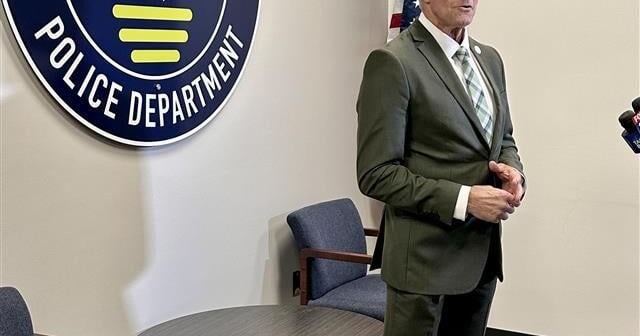
“In October, during a Pinellas County School Board workshop, staff presented an idea of installing a pilot program for a weapons detection system in our schools,” said Isabella Mascarenas, a Pinellas County Schools spokesperson, during an April 6 news conference at the Walter Pownell Service Center on Belcher Road.
The equipment, which uses two different software platforms and resembles the upright stanchions found in big-box retail stores and theme parks, is designed to be unobtrusive, detecting weapons while allowing students to move efficiently through designated entry points.
The idea has drawn some pushback since it was first discussed at a school board meeting in October. Sean Jowell, director of safety and security for Pinellas County Schools, said that was not unexpected.
“I would say it’s a good balance,” Jowell said of the feedback. “I think it’s more accepted because of everything we’ve implemented, in Florida specifically, since Marjory Stoneman Douglas in 2018. Is there going to be some pushback? Yes. There always is. But it’s a balance.”
The biggest questions to be answered by the pilot, which required extensive training for the staff and administrators running it, include how the systems will mesh with existing safety protocols and how they will affect daily routines, Jowell said.
“We fully believe there’s going to be a backlog at the start when we get used to it,” he said, noting that field research at schools using the systems in Sarasota and Manatee counties showed “the first few days, you’re going to have some delays.
“But once we get through the first few days, I’m fully confident it will be a much more efficient process.”
Those comments proved prescient. Reports of long lines and technical glitches surfaced the next day at Palm Harbor University High.
But officials said the setbacks would not deter the district from pressing ahead.
“The whole concept behind what we do in safety and security is to make the school as safe and as secure, but make it a welcoming learning environment,” Jowell said. “We’re fortunate we have a lot of things in place.”
Continued training for students, staff and administrators on how the systems work is vital, he said.
“To help with the efficiency, we’re asking them to remember BLUE,” Jowell said, referring to an acronym for binders, laptops, umbrellas and eyeglass cases — items that must be removed from backpacks before entering the scanning equipment.
Signs remind students to pull those items out as they approach checkpoints. Common items such as cellphones, keys, coins and jewelry do not need to be removed, he said.
Asked how the two schools were chosen, Jowell said the district focused on large high schools “because high schools are our biggest campuses with the most entry sites, the most checkpoints and the most students.”
“The idea was, if we could get this done correctly and efficiently at these high schools, we could then go to our elementary, our middle and our fundamental schools, if the school board chooses to move forward,” he said.
Jowell said the program would be judged on whether staff and students demonstrate a fair understanding of the systems, find them easy to use and are satisfied with the process. If deemed successful, the systems could be installed at other schools on a tiered basis over time.
“There will be surveys going out to our staff and our students to see how well they are received and how well they work,” Jowell said. “And from there, we’ll take them to the school board to see what the next steps may be.”