
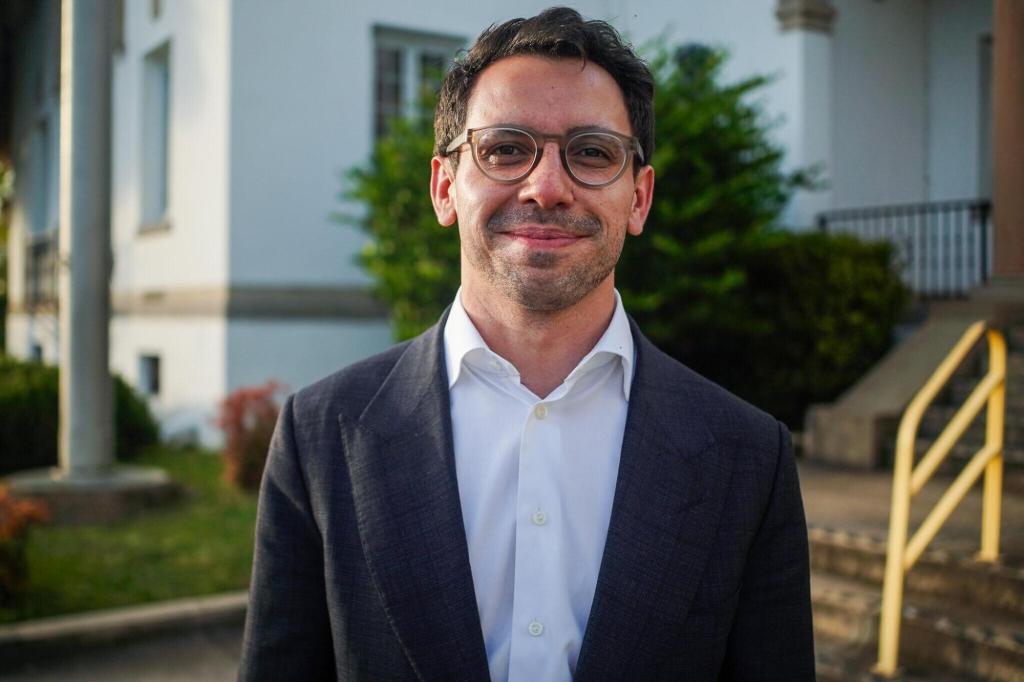
TALLAHASSEE — Newly obtained voting records and tax returns shed serious doubt about whether James Fishback, the provocative candidate with a penchant for slinging racial and anti-Semitic slurs, is qualified to run in Florida’s 2026 race for governor.
Fishback’s tax returns, made public as part of a federal court case in Tallahassee, list a Washington D.C. address as his residence from 2019 to 2022. Additionally, voting records obtained by the Orlando Sentinel show Fishback voted in D.C. in 2020 and requested absentee ballots from the city’s election office in 2022 and 2024.
Gubernatorial candidates in Florida must be residents and registered voters of the state for the preceding seven years. The new records suggest Fishback, a Republican, has resided here for no more than the last four.
Fishback, 31, an investment executive, filed to run in November and trails well behind GOP front runner Congressman Byron Donalds, who has the endorsement of President Donald Trump. But Fishback has drawn attention, and even stories in the The New York Times and Vanity Fair, for attracting Gen Z ultra-conservatives with his “rage-baiting” tactics and often-criticized comments, including referring to Donalds, who is Black, as a “slave” to his donors.
Fishback has also stirred controversy by saying the congressman wants to turn Florida into a ghetto and for telling another Black person that he should be lynched for asking about the sexual misconduct allegations Fishback has faced.
An ex-fiance has accused him of sexual misconduct when she was 17 and he was 27, which he has denied.
In addition, he has used the term “goyslop,” an anti-Semitic term for junk food, saying it should be banned from schools. He defends his choices of words, saying he has a First Amendment right to speak as he wants.
Responding to the Sentinel’s reporting on his residency, Fishback said the voting and tax records that indicate he lived in D.C. are incorrect and denied ever voting in that city or requesting absentee ballots.
“I was born and raised in Florida, and have only lived in this state,” Fishback told the Sentinel in a phone interview Friday. “I have been a registered voter in Florida since I was in high school.”
Fishback currently owns a home in Florida and a condominium in Washington D.C., where his parents also own a residence.
The District of Columbia voting records obtained by the Orlando Sentinel using Fishback’s birthdate and his parents’ D.C. address show that Fishback has been registered to vote there since 2020 without any party affiliation and voted in the city’s November 2020 general election. The records show he requested absentee ballots for 2022 and 2024 but did not return them.
D.C. elections officials said his registration is still active, and he remains eligible to vote in the district. To vote in the district, a person must be at least 17, a resident of the city for at least 30 days prior to the election in which they want to vote, and not claim voting residence outside the district.
An audit of his Florida voting records shows Fishback voted in every Florida general election since 2012, except in 2020.
Fishback acknowledges failing to vote in Florida that year.
He said the fact that the D.C. registration shows him as a non-party affiliate proves that it could not be him because he has been a registered Republican since high school.
Fishback’s federal and D.C. tax returns for 2019 to 2022 became public as part of a lawsuit brought against him by a former employer, Greenlight Capital, which has won a $229,000 judgment against him for breach of contract and other charges.
The tax returns shows he claimed a D.C. address as his residence four years ago. Another document signed by Fishback in 2022, and attached to a mortgage for his home in Madison — about an hour east of Tallahassee — says that house is his permanent residence going forward, and that his D.C. condo would be a second home and “future investment property.”
In the Sentinel interview, he said the address on his income tax returns belongs to his parents. He used their address because he was moving between places when he filed his 2019 tax returns and said that became the default address used by his accountants who prepared his subsequent tax returns.
Washington D.C. law requires anyone who is a resident of the district any time during the taxable year, or who maintained a residence for at least 183 days of the tax year, even if they don’t live there, and whose gross income exceeds $15,000 a year, to file a D.C. tax return.
Fishback’s income and taxes paid are blacked out on the tax returns available in the federal court file.
D.C. property records show his parents bought their place on December 2019. Fishback bought his condominium there on September 27, 2021 for $400,000.
Fishback said he bought the condo because he wanted to have a place to stay when he visited his parents and insisted has never spent more than a couple of weeks there in a year.
But his D.C. property has a homestead exemption, according to D.C. property appraiser records, and so does his home in Florida. State law allows a person or family to have only one primary residence with a homestead exemption and prohibits claiming an exemption here, if someone has a homesteaded residence in another state.
Concerns about Fishback’s residency, based on property records obtained by other media outlets, have been raised by Donalds and questioned by the media for months. Fishback said he can’t wait for Donalds to take him to court so he can prove he’s qualified to run.
“I won’t get any closure until Byron Donalds sues me,” Fishback said. “I look forward to putting this to rest.”
Fishback’s tax returns were filed by Greenlight Capital’s lawyers as they sought additional financial records in an effort to track down his assets and collect on the judgment he was ordered to pay. They requested details on his income, investments, mortgages and nearly $40,000 worth of luxury items — including a $7,400 Cartier watch he claimed was a gift for someone else.
Fishback worked for Greenlight from 2021 to 2023 when he started his own company, Azoria Capital. He sued Greenlight in a dispute over his job title and pay. Greenlight countersued for breach of his employment agreement, making false claims about his job title and defamation.
In September, Fishback admitted to sharing confidential portfolio data to a private email address and to operating a secret trading account. But he said he couldn’t pay back Greenlight’s legal expenses and that his Tesla Model Y had been repossessed.
A federal judge ordered Fishback in January to turn over his own company’s shares and several luxury items to U.S. Marshals as a way to reimburse Greenlight, but Fishback has said he doesn’t have access to records and doesn’t possess the luxury items requested.
He now has until Wednesday to produce the requested records or claim under oath that he doesn’t have them. He will face contempt charges if his statements don’t square with records produced by a third party, said Judge Mark Walker during a federal court hearing April 1.
“He hasn’t made one single payment on this judgment and has made public statements that he will never pay one single payment on this judgment,” Edward H. Davis, a lawyer for Greenlight, told Walker at the April 1 hearing.
Walker said he would not hesitate to refer the matter to the U.S. Attorney for prosecution if Fishback’s statements are inconsistent with evidence given in his court.
“Everybody has got fair warning,” Walker said. “If you put in a declaration that this (record) doesn’t exist and it clearly does and the records show you had a reason to know it exists then you are going to be subject to the wrath of the court.”