
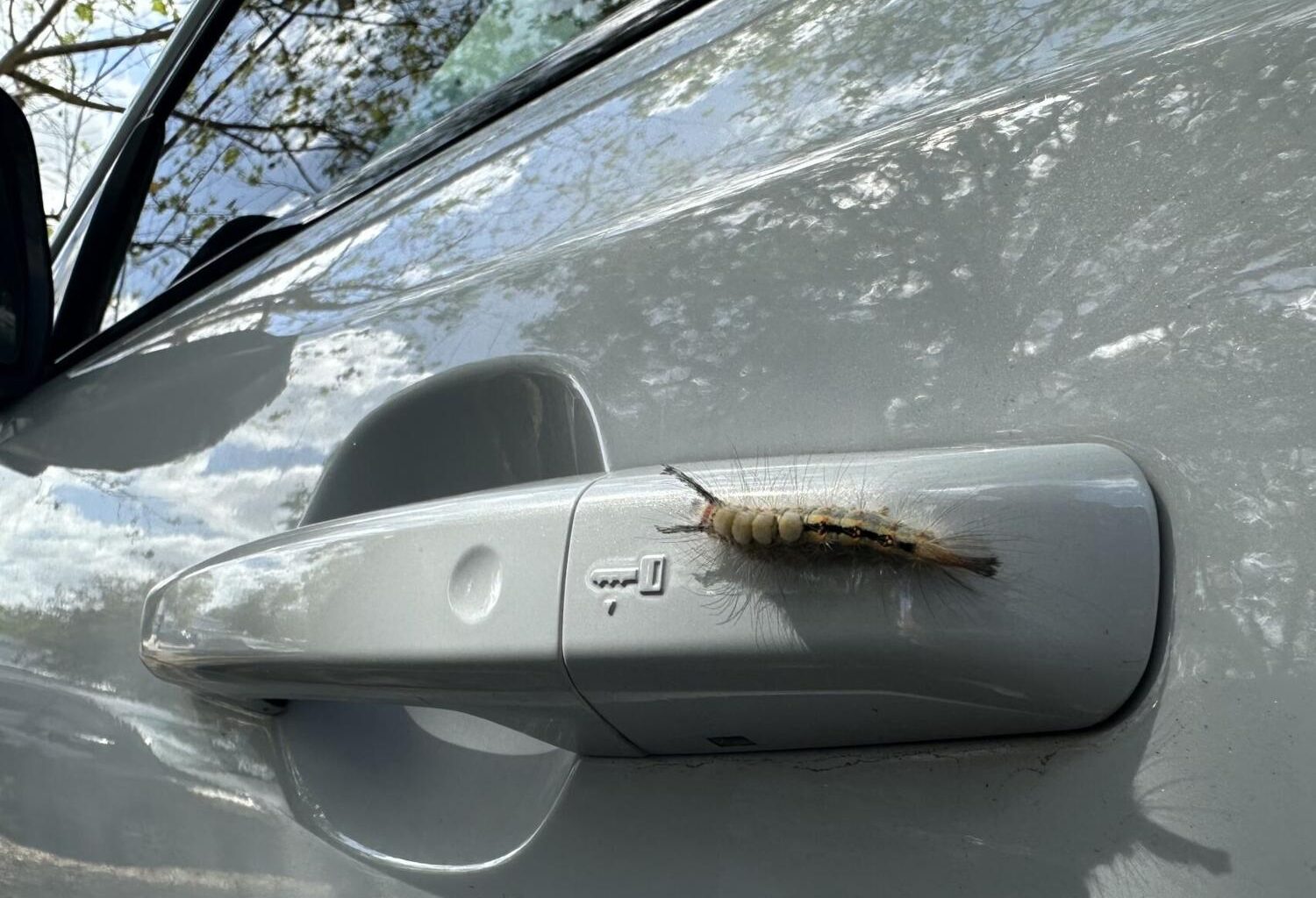

Tussock moth caterpillars are infesting campus this spring, making it difficult to avoid the stinging insects. The warm and humid climate is ideal for these insects to lay eggs and hatch larvae.
Sophie Natasha Jackson
An alien invasion might sound like science fiction, but some UCF students say their campus has been overrun this spring by swarms of fuzzy caterpillars that are coating stairwells, railings and walls.
Tussock moth caterpillars are the larval stage of tussock moths, a species native to North America. According to the Journal of Integrated Pest Management, the insects thrive in high temperatures. This makes Florida’s spring climate an ideal environment for their eggs to hatch.
Garage I has become a focal spot of activity for the caterpillars, where hundreds of cocoons line the stairwell pillars and collect between bricks. Students say the infestation is getting difficult to avoid in these high-traffic areas.
Kenneth Li, freshman mechanical engineering major, said he tries to avoid the caterpillars altogether.
“The handrails were full of those fuzzy caterpillars, and the floor was full of dead ones that people stepped on,” Li said. “Each step is just caterpillar bodies.”
For Li, the issue goes beyond appearance. He said the caterpillars are a cause for concern due to potential bodily harm through toxic stingers.
“I don’t really like them because if they touch your skin, it leads to rashes and itchiness.” Li said. “I try to avoid them.”
Despite their soft and fuzzy appearance, the hairs act as a defense mechanism. The tufts are connected to toxin-connecting sacs that can break when they come into contact with the skin. This releases irritants, according to the Cleveland Clinic. The stings serve as a natural defence against large predators. In this case, students are the ones often bearing the brunt of the caterpillars.
Experts with the Cleveland Clinic say reactions can include redness, itching, swelling, welts, and blisters. In rare cases, allergic reactions such as anaphylaxis and severe burning have been reported.
Nicoli Williams, a UCF alumnus, found a tussock moth caterpillar stuck to his arm in the engineering atrium in 2015. His friend Derrick Greenspan, a UCF alumnus and multi-degree holder, was with him when his reaction started.
“He tells me that his arm is hurting and that he found a little fuzzy caterpillar stuck to it,” Greenspan said. “After the lecture ends, he tells me that his arm is still hurting and it’s even worse, and that he needs to get it checked out ASAP.”
Greenspan said he drove Williams to the Minute Clinic on University Boulevard, where they explained the situation. They waited over an hour with Williams in agony before deciding to go to the Oviedo Medical Center, a local hospital.
“They immediately give him something to numb the pain,” Greenspan said. “Then they gave him some additional painkillers, and he was on his way.”
According to Medical News Today, those who come into contact should use tape to remove the hairs before gently washing the area with soap and warm water. To reduce any burning and swelling, apply an ice pack. Hydrocortisone cream should be applied, and if the itchiness continues, it’s recommended that those affected take an oral antihistamine.
Early-stage caterpillars are able to move around easily. According to the University of California’s Agriculture and Natural Resources, they spin silk threads and use the wind to migrate to new trees. Often they land on people in the process and on pavements beneath walking feet.
Beyond personal safety, some students are focusing on the conditions the infestation is leaving behind.
Garage I’s pillars are filled with Tussock moth cocoons, containing the same stinging fibers as the caterpillars; touching them could lead to painful rashes, itching and skin irritation.
Sophie Natasha Jackson
Bianca Valentin, junior computer science major, said the aftermath of the infestation has created unsanitary conditions on campus.
“Their deceased bodies are caked all the over the stairwells in Garage I,” Valentin said. “I feel UCF should step in to clean it up.”
University officials have not yet publicly addressed the increase in caterpillars, outlined any plans for their removal, or cleaning of the space.
While the tussock moth caterpillars do not typically cause long-term harm to trees, outbreaks have led to widespread defoliation in parts of the United States, according to the Florida Museum of Natural History.
Jasmine Neville, senior anthropology major, said she has mixed feelings about the caterpillars. She agreed that the infested spaces should be cleaned, but hopes they can find a safer space to populate.
“At the end of the day, they’re not really causing trouble for students,” Neville said. “But it’s definitely a little gross to walk through a ton of bugs to get to my car.”
Daniella Douvert, senior biology major, had similar thoughts. She said her first encounter with them was a week ago. She not only noticed how many were crawling along the floor, but how many had been squished.
“I know people don’t like them that much, which is okay,” Douvert said. “I just hope people leave them alone, because being considered a nuisance shouldn’t carry a death sentence, especially as a native species.”
Douvert said there are, what she described as, “billions” in the gazebo near the Foxtail located on campus.
“I think they’re funky and delightful,” Douvert said. “I wish them well on their journey to mothhood.”
Another location where these fuzzy creatures can be found is between the John T. Washington Center and Howard Phillips Hall. They are known to be anywhere near oak trees. Benches between buildings should be checked before sitting down and closed-toed shoes are highly recommended.
As temperatures continue to rise over the coming weeks, tussock moth caterpillars are likely to remain a part of UCF’s campus and ecosystem for the time being. Students should continue to be cautious in affected areas.
The infestations are seasonal, but there is no guarantee when these insects will disappear.
Although Williams was stung over a decade ago, the experience still resonates with his friend, Greenspan. He shared some final words for UCF students who may come into contact with the fuzzy insects.
“My advice to anyone who sees the caterpillars is to leave them well enough alone,” Greenspan said. “Even if you’re not allergic, it’s painful.”