
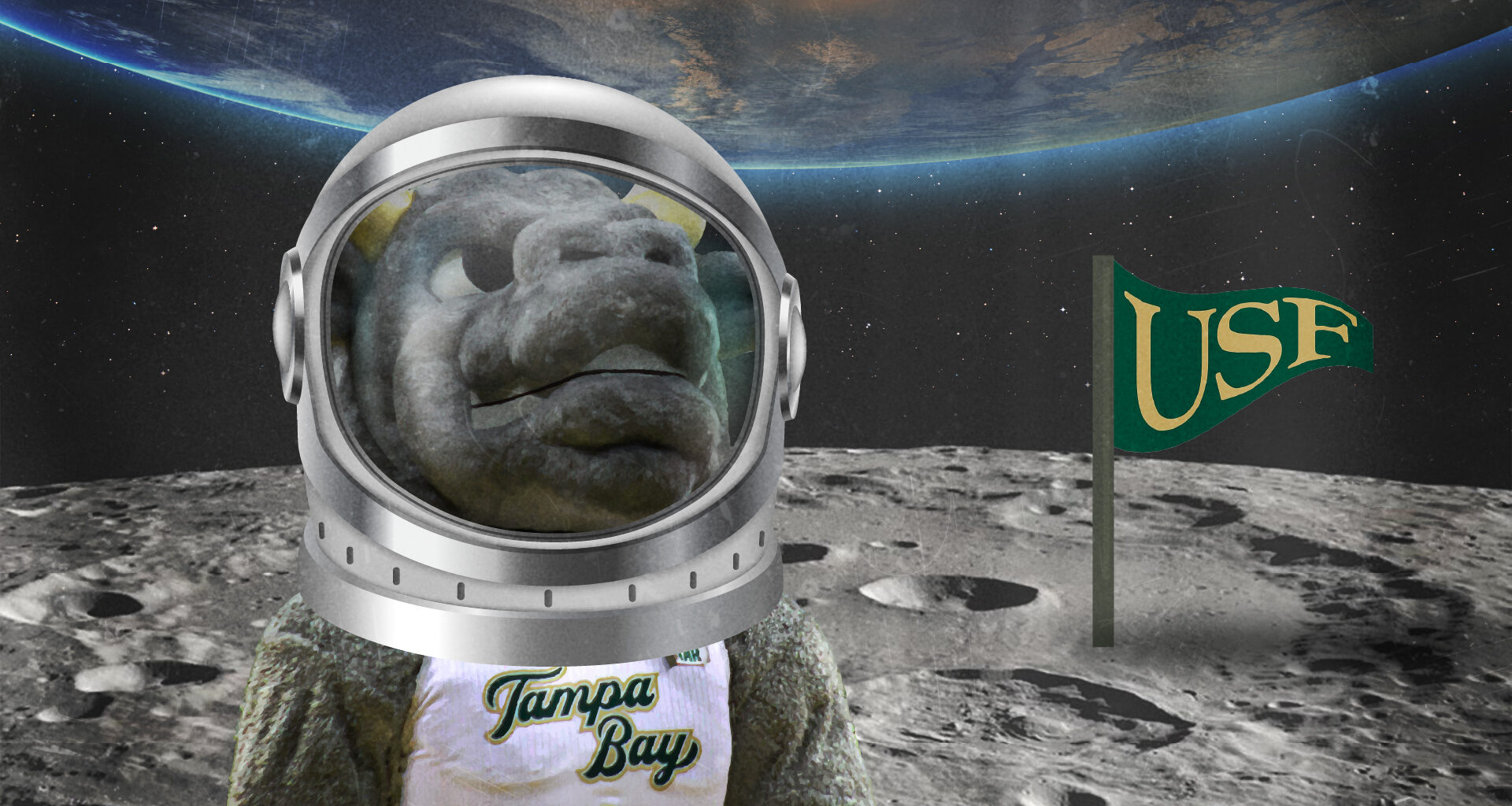
 USF students said they feel excited for the future of the aerospace industry after Artemis II’s launch and splashdown this month. ORACLE GRAPHIC/CAROLINA MOLERO ROCA
Kyle Shum said about 50 members of USF’s Society for Aeronautics and Rocketry met in the Interdisciplinary Sciences building’s main lecture hall to watch the Artemis II launch.
NASA launched the Artemis II mission on April 1 from the Kennedy Space Center — making it the first crewed mission to orbit the moon since Apollo 17 in 1972.
Artemis II’s 10-day mission was also the farthest humans have ever traveled into space, making it a pivotal stepping stone for space exploration and technologies, according to NASA.
“We got all of the club to get in there, and we all watched it on the projector,” Shum said. “It was really cool,” said Shum, a senior mechanical engineering major and SOAR’s president.
USF’s SOAR club has about 491 members and two teams — the Torito Liquid Propulsion and the International Rocket Engineering Competition Solid Rocket Propulsion — that build and launch rockets in various national competitions.
Shum said he has been involved with SOAR since 2023, when he joined as a member and helped plan and calculate the club’s rocket launches as a lead engineer on the rocket propulsion team.
Some USF students involved in rocket and aerospace engineering said they’re feeling inspired to stay involved in the field following Artemis II’s splashdown off the coast of San Diego.
Related: USF’s aerospace engineering major fills gap for growing industry
Shum said he initially feared for what would happen if the Artemis II mission did not succeed.
“I told a lot of people if NASA does not launch [Artemis II] correctly, and it goes wrong in any capacity, whether they have to either emergency, abort the mission, or, God forbid, someone dies, I would say NASA is one step away from being defunded, as things are right now,” Shum said.
NASA receives about 0.35% of the U.S. federal budget and has consistently remained under 0.5% since 2010, according to The Planetary Society.
In 1969, when NASA launched Apollo 11, the first manned mission to the moon, it accounted for 2.31% of the federal budget.
Since then, NASA has undergone significant budget cuts affecting its missions and research, and is subject to an additional 47% funding cut in 2027.
Still, Shum said watching Artemis II’s launch through a projector at the USF Tampa campus left him feeling inspired and optimistic about NASA’s future missions and possible budget increases.
“I think this is a huge success for them, and this would be a major point for them to start regaining some of their budget,” he said.
Related: USF student orgs hit with budget cuts as funding shortfall deepens
Drew Brickell is a sophomore mechanical engineering major and the chief engineer of SOAR’s Torito Liquid Propulsion team.
In his role, Brickell oversees and maintains the “organizational excellence” of various subteams — much like a NASA mission.
SOAR alternates between competing in NASA’s Student Launch Challenge and the International Rocket Engineering Competition based on the club’s budget and competition location.
Last year, USF’s Engineering Council awarded a SOAR rocket with the Innovative Project of the Year for designing and launching a high-powered rocket with air brakes.
SOAR’s last rocket launch was in May 2025 in Alabama, when they competed nationally against 53 other teams in NASA’s Student Launch Challenge and placed No. 18 for launching a rocket 4,000 feet in the air.
Brickell said SOAR has pushed him to continue pursuing his passion for aerospace, with the goal of one day working on SpaceX programs.
SpaceX, officially known as Space Exploration Technologies, is a private aerospace and space exploration company known for advances in satellite technology, according to its website.
“There are so many incredible people in [SpaceX], and the experiences that we get are second to none,” Brickell said.
Brickell said he has been a “space fan” since childhood, and said NASA’s Artemis II launch meant a lot to him as an aspiring aerospace engineer.
“I have been waiting for this for years and years and years, and to see it finally happen has just been incredible,” he said.
But beyond being a historical launch, Brickell said seeing the Artemis II crew work together as a cohesive, connected team makes him believe this is a core part of space exploration.
“When people are on board, you can connect with it on a much deeper level than if it’s just hardware sending back photos,” Brickell said.
Throughout the mission, NASA posted updates from the crew on Instagram, including selfies and photos of the moon.
Brickell said this crew-audience connection inspired him to continue pursuing his passion for aerospace.
“In the fractured society we live in right now, getting to just have connectivity, and something that inspires humanity as a whole, is really important right now,” he said.