
Just south of Jacksonville, near Clements, a bird with a rare condition that impacts 1 in 30,000 birds has made its summer home in the yard of Aaron Wills.
After showing up for the first time last year, a leucistic robin has found its place among the branches of Wills’ trees.
“This is the second year it’s been here,” Wills said. “Last year when I saw it, I noticed a bit of white, which I thought was odd. I thought it was a fluke. This year, she has a lot more on her on her left side and in her wings.”
The white coloring likely is caused by leucism, a condition in which there is a lack of pigment, causing whitish fur, plumage or skin. The condition is not the same as albinism, in that it is not a total lack of melanin, nor does the bird have pink eyes.
According to the Avian Report, leucism and albinism occur in roughly 1 in 30,000 birds, with leucism being the more common of the two.
According to the report, Cornell Lab of Ornithology’s Feederwatch Program gets 5.5 million bird observations at participating feeders each year. Of those, 1,650 of the birds between 2000 and 2007 had unusual plumage.
Pat Ward, a local bird watcher and member of Morgan County Audubon Society, said birds with leucism are not totally uncommon, but they aren’t ones you see every day.
“You seldom see a bird that is completely albino, but you do see white feathers from time to time,” Ward said. “It’s a mutation and doesn’t hurt the birds. It’s just a lack of melanin in the skin. Melanin brings the color. We see it, but it’s still not very common.”
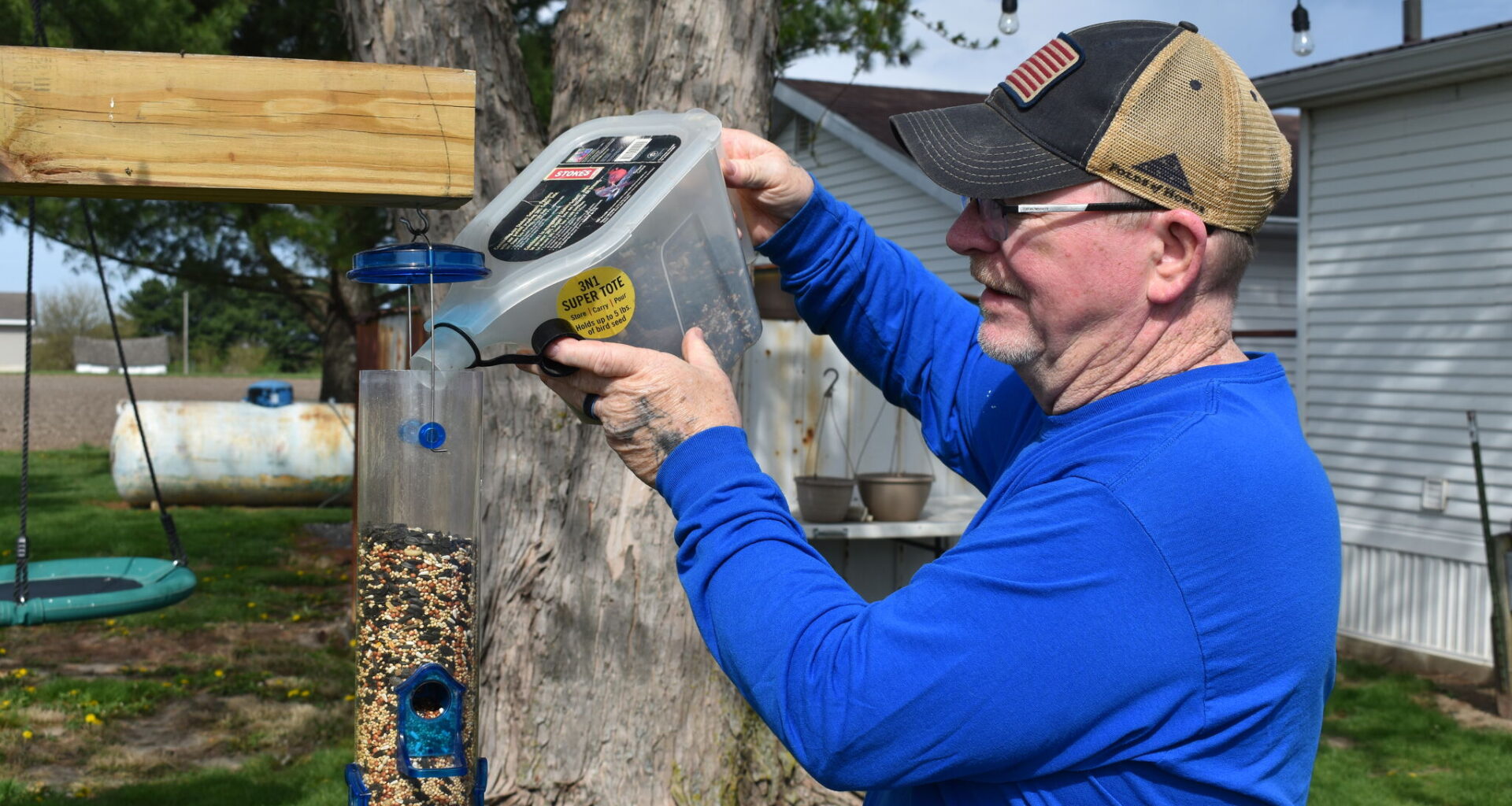
Watching the birds and spotting those that return each year has become something Wills enjoys since he retired, he said, noting he’s not as dedicated as many bird watchers.
“I feed the birds and I’ve tried to create a sort of bird oasis out here,” Wills said. “We get 10 to 20 nests in our trees each year. I’ve been here 28 years and we planted all these trees. I think that’s part of what attracts the birds. They have a food source, water source and a lot of cover.”
The robin is one of Wills’ favorite visitors to his yard because of its uniqueness.
“I just thought it was an unusual coloring,” Wills said. “Birds, to me, look the same, so when you get an anomaly like that, you notice.”