
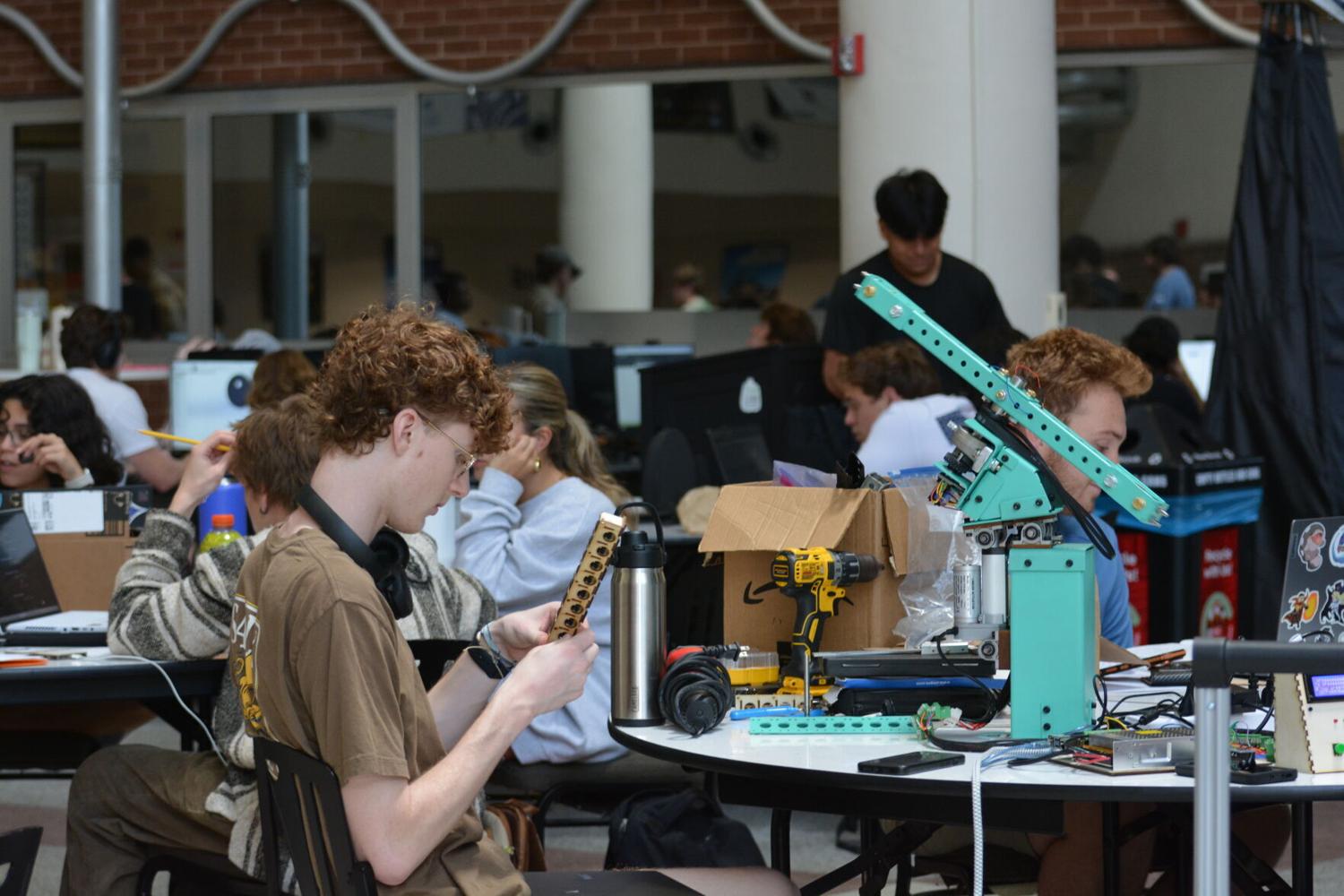

A student focuses on calibrating an extension piece of a rotating mechanical device in the engineering atrium on Thursday, March 26. Various engineering student groups collaborated on projects for different classes.
Kendal Asbury
If there is one thing Austin Wehle remembers from his real estate investments course last semester, it is that his professor revealed UCF plans to divert support, funding and enrollment from other programs to prioritize the engineering and business colleges.
Wehle, senior finance major, was sitting in a late-night lecture in the fall 2025 semester when Dr. David Harrison brought up the university’s strategic plan, which he had heard in an administrative meeting. Wehle said that, in a side tangent on investments, Harrison disclosed UCF planned to invest less in other academic programs to increase the business and engineering colleges.
“He said something one time about how the university’s investing more capital in engineering and business schools, and less in other schools because they’re high-yield fields,” Wehle said. “I remember that one line, so clearly.”
Harrison, the director of the Dr. Phillips School of Real Estate, declined to comment on his statements to the class of around 40 students.
While the Board of Trustees’ goals to increase enrollment in engineering, business and technology fields have been outlined, the plan to limit enrollment and investment in other areas of study has not been disclosed publicly.
Dr. Alexander Cartwright, UCF’s president, announces that the university has reached preeminence at the UCF Board of Trustees meeting on Monday, Sept. 22, at the Fairwinds Alumni Center. Cartwright stated in the same meeting that the university would aim to enroll “50,000 engineers and domain technologists by doubling down on our strengths.”
Jeremy Gottschalk
President Alexander Cartwright unveiled portions of the university’s vision at a Board of Trustees meeting on Sept. 22, 2025. He said that, following last semester’s preeminence designation, the university would aim to enroll “50,000 engineers and domain technologists by doubling down on our strengths.”
While on the surface, the growth seems promising, some UCF students, faculty and alumni said it could have detrimental impacts.
When asked about the plan to manage enrollment and recruitment of students outside these fields and how it would affect them, Courtney Gilmartin, vice president of strategic initiatives and communication, declined to comment.
“Overall enrollment fluctuates,” Gilmartin wrote in an email to The Charge when asked about how the plans would affect students in other areas of study.
Margot Winick, director of media relations, stated in an email “existing capacity” would be maintained when asked whether the university planned to expand overall student enrollment.
“UCF is focused on maintaining academic quality and the student experience while operating within existing capacity for housing, classrooms, facilities, and infrastructure,” Winick said.
Brayden Cox, third-year finance major, was also sitting in Harrison’s lecture when the university’s shifting priorities were used as an example for investments in high-yielding products or companies.
“It was just tying finance and real estate into real-life examples,” Cox said. “But then he hinted at the direction that the university is planning to go.”
Cox and a few other students in the course confirmed they were told expansion of the business and engineering programs would be prioritized, and other academic programs may have to remain the same or decrease in enrollment numbers to accommodate.
The university denied a request to speak to Dr. Paige Borden, a Board of Trustees faculty member responsible for the design and development of enterprise analytics and integrated planning, to confirm the university’s plans. However, in a Dec. 4 board meeting, Borden commented on the aim to “convince more students to pursue programs that are STEM-heavy.”
Representatives also denied all requests to speak with any member of the board about comments made in both the public and private meetings.
When asked directly if the plan would include capping the number of students accepted to other majors to reach enrollment goals, Gilmartin and other university representatives declined to respond.
According to the university’s analytics and integrated planning website, enrollment in the fall 2025 semester reached 70,989 students.
Students walk to attend classes, presentations or study sessions inside the Business Administration II building on Thursday, March 26. “The state university system’s role is to support the economic priorities of the state,” Dr. Ronald Piccolo, dean for strategic initiatives in the College of Business, said.
Kendal Asbury
UCF as Florida’s Technological University
Dr. Ronald Piccolo, the associate dean for strategic initiatives in the College of Business, attributed the university’s shifted focus and the president’s goal to the state’s economy and industrial needs.
“The state university system’s role is to support the economic priorities of the state,” Piccolo said in an interview. “There’s not as much flexibility as one might think.”
He also said that, because of this, it is important that the university offer programs and resources that help students get jobs in the current market.
“As a university, we always want to be preparing students for what’s next,” Piccolo said. “The Florida economy is becoming increasingly technology-focused with several initiatives at the state level.”
This aligns with the goals outlined in a statement published on UCF Today in August of last year, welcoming the incoming freshman class for the fall 2025 semester.
“UCF continues to align its academic programs with the needs of vital industries that power Florida’s economy and provide students with strong employment opportunities,” Ryan Randall wrote in the article.
Though the university refused to confirm, in a local initiatives funding request to the Florida Senate for the fiscal year 2025-26, Cartwright and the vice president of governmental relations, Janet Owen, outlined priorities in public documents.
Owen, lobbyist for the university, wrote that the funding would be aimed at “increasing STEM enrollment and graduates for increasing the available talent pipeline and highly skilled workforce needed by Florida high-tech employers; increasing workforce in higher-paying jobs.”
Melissa Dagley, director of the Center for Initiatives in STEM, stated in December’s board meeting, when discussing academic programs aimed at increasing students enrolled in STEM-related majors, that “increased earning by STEM graduates” was a motivation for the direction.
“Most important is the attempt to capture the full institutional return on investment, specifically looking at the impacts created by students staying at UCF and in their STEM majors,” she said.
The investment potential is something Wehle said Harrison shared when discussing the reasoning behind the university’s shifting focus.
“If you’re shifting to be a technological university, then investing more in that department is going to happen,” Wehle said. “If they’re investing more into the high-income makers, they’re hoping they’ll give back for the education that they’ve received. It helps the university grow.”
Students collaborate on different projects for their classes on Thursday, March 26, inside the engineering atrium. “The vision of Engineering and Computer Science is to be a top producer of engineering and computer science talent and to advance the state of the art in our disciplines in ways that impacts the global society,” Dr. Michael Georgiopoulos, dean of the college, wrote in an email.
Kendal Asbury
The dean of the College of Engineering and Computer Science, Dr. Michael Georgiopoulos, echoed this goal, yet declined to acknowledge the university’s plan.
“The vision of Engineering and Computer Science is to be a top producer of engineering and computer science talent and to advance the state of the art in our disciplines in ways that impact the global society,” Georgiopoulos wrote in an email to The Charge.
“We cannot speak to the president’s comments,” he added.
However, the university’s goal was reflected in an unannounced landing-page website rebrand that occurred the first week of classes in January, according to Wayback Machine, an internet archive.
On the new website, UCF is branded as “Florida’s technological university,” rather than the previous statement, which included the university’s tagline, “Building a bold new future for Florida and beyond.”
“As Florida’s Technological University, we are focused on preparing students across all majors for a technology-driven future but integrating digital and tech competencies across all disciplines,” Winick wrote in an email when asked about how this vision would impact recruitment strategies.
Financial investments in STEM-focused programs
The board is set to approve and allocate the largest financial donation in university history to the College of Business during a scheduled meeting on April 15. The investment is set to further business education and resources, as well as rename the building.
The investment will lead to “positioning UCF to lead in technology-driven business innovation and marking a defining milestone in the university’s trajectory,” according to a news release sent by Winick.
According to the university’s 2025 Accountability Plan, the university is also projected to spend $290 million in science and engineering research in the 2026-27 academic year, with an overall research allocation of only $350 million.
The State University System also requested funding from the Florida Legislature to continue providing the Programs of Strategic Emphasis waiver, also known as the STEM waiver, which provides a 50% tuition and fee reduction for students in 12 eligible programs, including finance, accounting, engineering and related fields.
Moreover, 50% of students who received a merit scholarship in the 2025-26 year were in the College of Engineering and Computer Science, according to university statistics. Additionally, around 7% of recipients were going to the College of Business and 10% in the College of Medicine.
Only 1% of students who received a scholarship were in the College of Community Innovation and Education, and just over 4.5% were in the College of Arts and Humanities.
Winick said “scholarships are awarded regardless of a student’s field of study” and that specific majors are not taken into consideration.
In the legislative budget request the Board of Trustees submitted to the Florida Board of Governors in 2024, the academic programs the university was prioritizing were outlined. The first goal stated by the board under strategic investments was “continue to expand the university’s capacity to educate 20,000 students annually in engineering, computer science and related programs.”
UCF currently holds the No. 2 spot in best colleges in the state for engineering, according to U.S. News and World Report, and is among the top 75 in the nation.
The diversity dilemma
Florida House Representative Anna Eskamani — who earned her bachelor’s, master’s and doctorate at UCF — said the shifting focus on STEM fields had the potential to harm the university, especially if the university planned to gut other programs or cap enrollment.
“Cuts to these programs would harm faculty morale, diminish intellectual diversity, and make it harder for UCF to serve as a space for open inquiry,” Eskamani wrote in an email.
Eskamani, who earned a dual undergraduate degree in political science and the discontinued women’s studies major, said that it could also “erode the very values that make it a model for access and inclusivity.”
Out of the 16,778 students enrolled in the university’s engineering college in the fall semester, only 3,679 are female. Similarly, only 39% of the students in the College of Business are female.
The gender disparity has raised concerns among students and alumni that the university is neglecting its commitment to a diverse student body, especially if the administration plans on keeping overall enrollment the same.
“Engineering and business programs already have significant gender and racial disparities,” Eskamani said. “If any university intends to keep total enrollment flat while dramatically increasing engineering and business majors, that inherently means fewer opportunities for students in other disciplines.”
Other programs have more diverse demographics, like the College of Arts and Humanities, where more than half of enrolled students are female. Moreover, around 66% of students in the College of Education and Community Innovation identify as female.
Shia Kirby, third-year political science and writing and rhetoric double major, said she has noted a difference in gender composition between colleges in the past and that shift in programs of focus “definitely raises some concerns.”
Kirby said she wishes the university would promote more collaboration between the two areas of study, rather than invest more in one.
“It’s not just the prioritization of majors and fields that are predominantly male-centered, but also thinking about the lack of prioritization that all of the majors across UCF are equally represented and invested in,” Kirby said.
The impact on other academic programs
The increasing emphasis on STEM-focused areas of study has raised concerns among faculty and students about the value of other programs.
Dr. Emily Johnson, a professor of technical writing within the College of Arts and Humanities, said in an interview that this disparity of funding and resources had “been on her mind recently.”
Kyle Bloomfield, freshman mechanical engineering major, builds a boat out of a plastic bottle in the Texas Instruments Innovation Lab in the Engineering Atrium on Thursday, March 26, for a required project for first-year engineering students.
Kendal Asbury
Johnson recounted a faculty senate meeting last semester in which Cartwright and the board discussed the importance of focusing on technology and engineering.
“Their messaging was, ‘We’re pitching UCF as Florida’s premier engineering and technology university,’” Johnson said. “It’s hard sometimes to hear that your university is focusing, publicly, on fields that aren’t necessarily, obviously, your own field.”
Many students, like first-year English technical communication graduate student Alexa Wareck, have noticed a shift in focus and are worried about how this will affect their studies and professor morale.
“One of the most exciting points about the program is how enthusiastic the professors are about their research, and our research, and our opportunities,” Wareck said. “Losing this university support and funding will impact that.”
Johnson said the impact of decreasing support on instructors’ passion has concerned her, seeing how recent decisions and lack of funding have affected her work, along with that of her coworkers and students.
“I worry that it’s hurting collaboration and perceptions of different fields and areas of expertise,” Johnson said. “When everything’s focused on STEM, it can be tempting to look at everything else as less important, less rigorous, less prestigious or less worthy of your time.”
Kirby also works as a writing consultant at the University Writing Center within the College of Arts and Humanities. She said that, in her time as a student at UCF, she has seen a “heavy shift in focus on more STEM projects and institutions.”
She said she has seen this most in the resources, programs and opportunities offered to students outside of STEM fields by the university.
“I have noticed that humanities and liberal arts programs at UCF have been affected by budget cuts,” Kirby said. “As somebody who has two majors within the humanities and liberal arts, and really studying these less-STEM focused careers and paths, it really feels like there’s a lot less to access in terms of next steps.”
“It’s not that the jobs aren’t there; UCF just isn’t investing in opportunities for students in these programs,” she added.
Humanities-based resources — such as the University Writing Center — that have been affected by the university’s funding support students of all majors. The UWC itself promotes “cross-disciplinary learning,” according to the center’s website, and has reached more than 10,000 students last year, said center director Dr. Amy Cicchino.
In addition to helping students with essays and papers for ENC courses, tutors often help with lab reports, graduate school applications, business reports, dissertations and more.
“People don’t realize how deeply intertwined these majors are,” Kirby said. “That cross-disciplinary exchange from students of different programs is really cool, and the university should capitalize on that.”
However, resources available to STEM students alone seem to be the focus, she added.
Borden, in a board meeting on Dec. 4, reiterated the administration’s focus on students pursuing STEM-related majors through a coaching program that John Buckwalter, the provost of the university, said aligned with UCF’s analytics and strategic vision.
“This program is a true example of how a seed of an idea has evolved into a powerhouse of student outcomes and is really supporting our student success and well-being of our College of Engineering and Computer Science students and all students interested in STEM,” Borden said.
The board also stated in the 2024 funding request that “UCF has hired top-producing faculty in the College of Engineering and Computer Science, as well as other STEM-focused colleges.”
This was supported by an ambitious and record-breaking hiring initiative for the College of Engineering and Computer Science last semester, as the university brought on 39 new faculty members. This was the third consecutive year that the college had appointed more than 30 new faculty members, according to the CECS department website.
“The College of Engineering and Computer Science has hired several faculty members in the areas of AI, energy, digital twins and hypersonics, among others,” Georgiopoulos stated in a UCF Today article about the hiring initiative. “It has expanded the college’s research and educational expertise in areas that are of national importance and are in line with UCF’s vision of being Florida’s premier engineering and technology university.”
No public plans exist to increase hiring or program offerings for other areas of study, according to The Charge’s findings. Upon request, university representatives declined to confirm whether there were any goals to increase enrollment in other majors aside from engineering and business.
The strategic plan’s effect on admissions
The university’s acceptance rate was 33% as of fall 2025, and has been steadily declining in recent years, down from 44% in 2020. However, the rate of admittance varies by college and reflects this concern.
The university accepted roughly 49% of students who applied for the College of Engineering and Computer Science for the fall 2025 semester, while accepting only 15% of students who applied for the College of Community Innovation and Education that same semester.
University officials stated that “UCF does not admit by major,” but did not respond to inquiries on whether each college had allotments or caps on the number of students they could admit.
The board revealed goals to increase the percentage of bachelor’s and master’s degrees awarded in Programs of Strategic Emphasis each year in the Accountability Plan, aiming to ensure that 60% of degrees awarded are in the designated STEM fields.
Students visit the Office of Undergraduate Admissions on Friday, March 27. The university accepted 48% of students who applied for the College of Engineering and Computer Science for the fall 2025 semester, while accepting only 15% of students who applied for the College of Community Innovation and Education.
Kendal Asbury
In February of 2025, Winick reported in a UCF Today article that “enrollment in UCF’s engineering and computer science programs has increased 17% in just three years.” However, it was not explained how this increase came about or at what cost to other programs.
According to UCF’s 2024-25 deleted course report, 34 courses were removed from the regular offerings. Only one of these courses was from the College of Business, and four were from the College of Computer Science and Engineering. However, eight were removed from the College of Arts and Humanities, four from the College of Community Innovation and Education and 15 from the Nicholson School of Communication.
Wareck has a younger sister applying for the university in the current application cycle who wants to major in environmental resource management. Wareck said the changing direction of the university was “upsetting,” and she is concerned about how it will impact admissions.
“This is her dream school,” Wareck said. “It would be really sad to have to watch her change her major, or if she had to go to a different school that wasn’t her dream school because of her area of study.”
University professors and those in administrative positions across different colleges have heard mixed information as to how the university plans to reach higher enrollment of students in engineering and business fields. Piccolo said he was under the impression that overall enrollment would grow.
“We’re still driven to cover basic higher education here, to my understanding,” Piccolo said. “Even though there have been changes at the state level, we’re still giving people exposure to as much as possible. That’s never to be compromised.”
However, another professor in the business college, who did not want to be identified due to concerns about his job and program funding, said that high-ranking administrative personnel confirmed in a meeting that the plan was to cap student enrollment in other majors.
“I know UCF as a diverse campus, not only in ethnicity and identity, but also in majors and different niches within academic programs,” Wareck said. “We’re losing that part of the university, and I feel like a lot of students will no longer feel supported.”
As the enrollment and investment plans for specific academic areas remain uncertain, students hope UCF will continue to support students of all majors, regardless of estimated earning potential.
“If we want to continue fostering our Knights to be one and be a community, we really do have to ensure that every member of the community feels represented, feels heard, seen and appreciated for the contributions they make,” Kirby said. “We all have something to bring to the table.”