
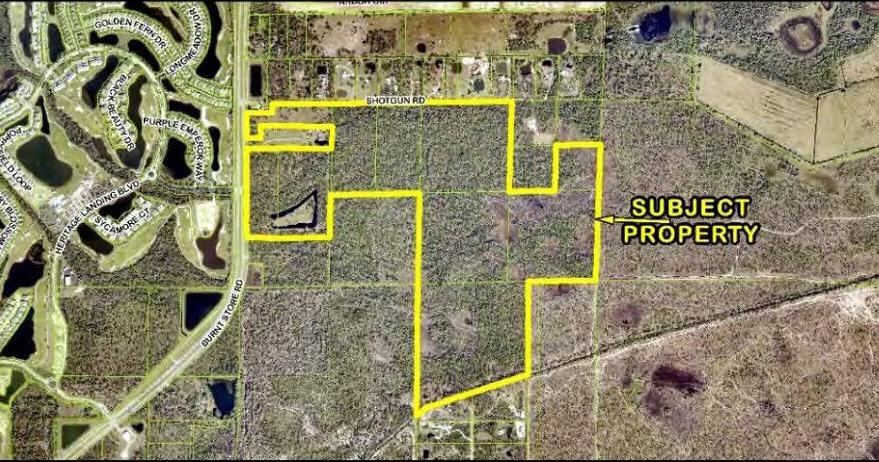
Residents in about a dozen communities along Burnt Store Road may not have to drive to Punta Gorda or Cape Coral for shopping in the future, as the Charlotte County Planning and Zoning Board voted 3-0 on April 13 to approve a project that would bring 195,000 square feet of commercial space to the area.
The board’s recommendation now goes to the Board of County Commissioners for an adoption hearing May 26.
Certified planner Daniel DeLisi, of West Palm Beach, representing developer Burnt Store Road RET LLC, said amended plans increase land designated for commercial use. Rather than a smaller strip mall, the changes would allow for a larger shopping center.
That drew support from area residents, including Frank Petrosino, representing the Burnt Store Corridor Coalition, whose members have long pushed for more retail and services. “Clearly, this would be a benefit for those of us residing at Heritage Landing and the numerous homes that are going to be built in the very near future,” Petrosino said.


Frank Petrosino, representing the Burnt Store Corridor Coalition, speaks in support of adding commercial space during a Charlotte County Planning and Zoning Board meeting April 13.
Charlotte County government
Petrosino said he travels from Heritage Landing to Punta Gorda along U.S. 41 for shopping and basic services. As residential growth continues near the Walmart, Publix and Aldi corridor between U.S. 41 and Interstate 75, added housing will place greater strain on those stores, he said.
The coalition supports the commercial portion of the development, citing dual benefits. Residents along Burnt Store Road would have closer access to shopping, and the county could gain additional tax revenue from Lee County residents who may patronize businesses in the corridor.
Some residents raised concerns about stormwater runoff affecting nearby properties as nearly 1,000 homes are proposed as part of the project.
Still in the planning stage, the residential component could include a mix of single-family and multifamily homes, along with up to 300 recreational vehicle units.
Charles Russell and Curtis Newberry said their properties have experienced flooding from a nearby development along Shotgun and Burnt Store roads. They asked what measures would be taken to prevent runoff from the Burnt Store Road RET LLC project.
John Henderson, who owns property on Shotgun Road, also cited increased flooding following nearby development. He raised safety concerns about a proposed road running through the project near his property, noting children, including his grandchildren, live nearby.
Civil engineer Todd Rebol, of Atwell LLC, said runoff would be directed either into the project’s stormwater management system or a swale. He said engineering staff must demonstrate there are no impacts on adjacent property owners before the project can proceed. Homes bordering the development would not have access to the new road, he added.

A site map shows the Burnt Store Road project, with the development area outlined in black. Pink indicates residential use, while the red horizontal section to the left marks a 12.55-acre commercial area where a shopping plaza could be built.
Charlotte County government
Before stepping away from the podium, Russell said he would welcome a Publix, while his wife hopes for a Starbucks and a small gas station.
The proposed 277.75-acre development is east of Burnt Store Road and was previously zoned Agricultural Estates. County staff noted a prior concept plan expired Sept. 19, 2008. A request to extend the plan was submitted in November 2022, and the County Commission approved the extension Feb. 28, 2023, when the property was under different ownership.
Burnt Store Road RET LLC already had approval to build up to 999 homes, but revisions required board approval. Those changes include reconfiguring greenways, preserving wetlands, providing wildlife corridor access and updating plans to accommodate a larger commercial center.
Under recommendations from the Florida Fish and Wildlife Conservation Commission, the National Estuary Program and environmental studies, the developer agreed to preserve 59.41 acres, or about 92.6%, of on-site wetlands, along with upland buffers.