
Fort Myers could lose $22.4 million in annual revenue if property taxes are eliminated on all homesteaded properties.
Council members received a cautionary update during a workshop April 13 on proposals in the Legislature to eliminate property taxes and the potential impact on the city’s budget. They also reviewed legislation awaiting Gov. Ron DeSantis’ signature that would require municipalities to complete a 10% budget-cutting exercise at least 14 days before adopting a budget. The requirement is only an exercise, and the cuts would not be mandatory.
“Property tax reforms don’t look likely, especially for the development of next year’s budget. However, knowing that there’s that potential out there, anything that would be on the ballot this coming November would impact our fiscal year 2028 budget,” said Christine Tenney, director of financial services. “But preparing the 2027 budget and knowing there’s so much talk out there, we just need to be very mindful of that as we look at the department requests and moving forward, we need to be very strategic and mindful of that.”
Tenney outlined several scenarios. The $22.4 million loss, based on the current 6.5 millage rate, or $6.50 per $1,000 of taxable value, would occur if a constitutional amendment eliminating property taxes on all homestead-exempt properties passes. The city receives $87.2 million, about half its general fund budget, from property taxes.
The city would lose $8.75 million annually if the tax is phased out over 10 years, one of the proposals discussed by legislators. Property taxes for schools would not be affected.
The Legislature did not agree on wording for a constitutional amendment during its spring session but has until August to call a special session to place it on the November ballot. Even if lawmakers do not reach agreement, House member Ryan Chamberlin, R-Belleview, has begun gathering signatures for a citizen-backed constitutional amendment for the 2028 ballot to eliminate all property taxes.
“There’s a lot of uncertainty at this point, and uncertainty is never good,” City Manager Marty Lawing told council members.
Tenney also updated Council on four capital projects — a police headquarters, fire station No. 18, a STARS expansion and Billy Bowlegs Park. The city would need to take on $182 million in debt to fund the projects, with debt service over 30 years totaling about $11 million annually.
Increasing the millage rate by one mill would generate slightly more than $11 million annually to cover the debt, Tenney said.
She said future budget growth could be very limited, meaning decisions on moving forward with projects must account for the heavy debt service burden, as well as the uncertainty surrounding potential property tax reform.
The city is not expected to benefit from increased property values or new construction next year, Tenney said. Property values have declined, and new construction would need to offset that decrease.
Her hope is the tax base remains stable compared with last year. “I could be wrong. I hope I’m wrong,” she said.
The proposed 10% budget-cutting exercise also raised concerns. The city would need to identify $18.3 million in reductions from its $183 million budget.
“That’s not an easy exercise when you can’t touch debt, you can’t touch public safety. There’s not a lot left, so those cuts would be severe,” Tenney said.


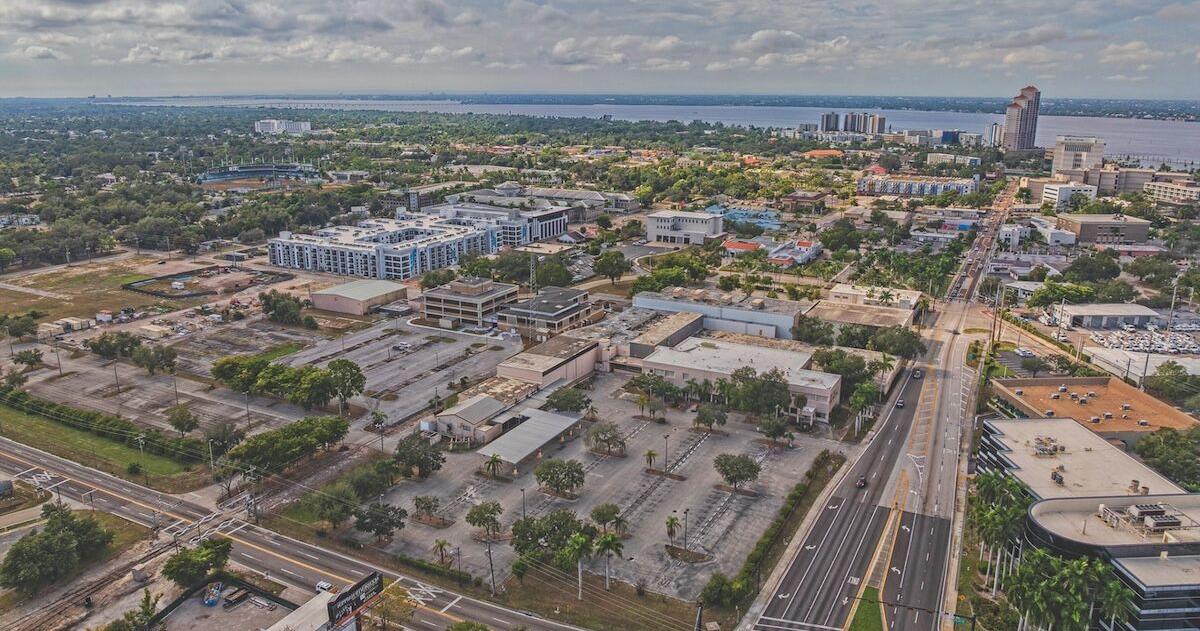
Fort Myers City Hall is shown in downtown Fort Myers.
Evan Williams
Public safety spending includes $64.5 million for police and $36 million for fire services.
Tenney said details of the requirement remain unclear, including how specific the proposed cuts must be.
Council member Fred Burson questioned how the city could cut 10% while accommodating 15% growth.
“You need a certain amount just to keep up with growth, so, you’re talking about a 25% swing between growth and cutting,” he said.
Council will continue discussions at future workshops and a scheduled retreat.
They may have more clarity by then, Lawing said.
“How cautious do we want to be if some of these drastic measures get on the ballot and get approved? Do we want to be taking on $8 million or $10 million in debt if our taxes are going to be cut by $20 million? So, we don’t know which proposal, if any proposal will come forward,” he said. “But I don’t think we can put our heads in the sand.”