
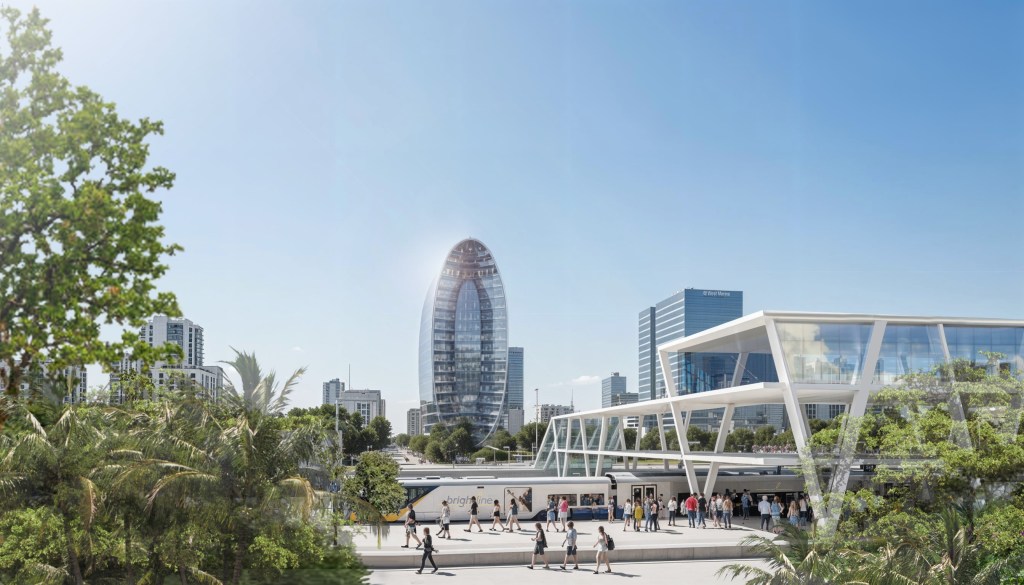
Critics worry that Fort Lauderdale’s plan to build a pricey new City Hall in the face of an uncertain economic climate could lead to layoffs and cuts to key services.
Current city estimates say the $268 million venture will end up costing taxpayers a staggering $724.8 million over 30 years — or $24.2 million a year.
Vice Mayor Ben Sorensen, unnerved by talk of statewide property tax reform and a looming multiyear budget deficit, is now having second thoughts about committing all that money to a futuristic City Hall.
Sorensen was one of four “yes” votes when the commission approved a plan in December to build a new City Hall. That was before commissioners were told the owner of a nearby office tower offered to sell the 25-year-old building to Fort Lauderdale for $86 million — an option Sorensen has repeatedly said he’d like to pursue.
Commissioner John Herbst, who cast the lone dissenting vote in December, also says it makes more sense to buy an existing building.
Mayor Dean Trantalis and Commissioners Steve Glassman and Pamela Beaskey-Pittman, who cast the other three “yes” votes in December, have resisted attempts to change course.
A vote on an interim comprehensive agreement with the top-ranked developer chosen to build City Hall is coming on April 21.
Sorensen told the South Florida Sun Sentinel he thinks the commission needs to delay that vote.
“The interim agreement will require the city to reimburse the developer for their expenses, which is going to be millions of dollars,” Sorensen said this week. “We should not sign the interim agreement on April 21. We are already looking at a massive budget deficit.”
Sorensen says he is worried the city won’t be able to afford making $24.2 million in annual payments over the course of 30 years without hiking the tax rate, cutting services and resorting to layoffs. The total payout for the new City Hall comes to $724.8 million when accounting for other fees, including interest payments over 30 years.
Trantalis and Glassman dismissed Sorensen’s concerns during a recent City Hall meeting.
“We are where we are because Commissioner Sorensen was part of a 4-1 vote to move forward with this development team,” Glassman told the Sun Sentinel. “Negotiations have begun and a majority of the commission has reiterated its commitment to draft an interim agreement and then a comprehensive agreement.”
Glassman argues that buying an old building could end up costing more than building a new one. He pointed to a recent Miami Herald article detailing the spiraling costs to transform a 52-year-old office building into a new Miami-Dade County government center.
The office building’s original price of $256 million has ballooned into a nearly $438 million undertaking due to soaring renovation costs, the Herald states.
It’s a tale worth noting, Glassman said.
“One only needs to look at the debacle of Miami-Dade’s renovation of an old building for its suburban government center,” Glassman said. “I am not interested in going down that rabbit hole and wasting taxpayer dollars.”
The mayor also saw the article.
“There’s no savings when you have to rehab a building,” he said. “It’s very clear that a used building saving a city money is a myth.”
When asked for comment, Sorensen rejected the comparison.
“I can share with you just as many examples of government buildings that went way over budget,” he told the Sun Sentinel. “It’s an irrelevant argument.”
Fort Lauderdale’s current plans call for a $268 million City Hall tower with 200,000 square feet, large enough to hold 630 employees.
The developer’s original proposal called for a $340 million building with 302,150 square feet that would serve 700 employees.
Commissioners asked the developer to pare down the size of the building to bring the cost closer to $200 million.
During a goal-setting meeting in January, the mayor referred to the suggested $200 million cap as a “pie-in-the-sky” target.
“I know it’s going to be more than that but that’s certainly a nice target,” he said. “I don’t know how you can go from $340 million to $200 million. So let’s not assume that that’s going to be the final number.”
City Manager Rickelle Williams alerted the commission of the estimated new price tag for City Hall in an April 2 memo.
During last week’s City Hall meeting, Sorensen questioned why the projected cost had increased beyond $200 million.
“Maybe that was aspirational, but there’s a reality,” Trantalis said. “I don’t think it’s anywhere out of line in terms of the numbers.”
Trantalis noted that the county is planning to spend nearly $2,000 per square foot for its new governmental center. Fort Lauderdale will be spending much less at $1,200 per square foot.
Sorensen pushed back.
“Right now we’re leasing space to have people in offices and that is costing $5 million a year,” he said. “This would be a difference of $19 million more a year for 30 years to fund City Hall.”
Sorensen laid out what might be coming in terms of future budgetary constraints.
“We have collective bargaining going on right now with police and fire,” he said. “We have the state Legislature meeting in special session this month to possibly enact some form of property tax reform. And we’re already projected to be in a budget deficit next year. Where are we getting another $19 million a year for 30 years? What will get cut?”
Trantalis insisted the commission stay the course.
“If the state Legislature enacts tax reform, we would have to rethink everything. Not just this new City Hall but everything we do in this city,” he said. “We can’t stop everything now. We should continue our planning process. We’ll know sooner rather than later what’s going to happen.”
Sorensen pressed on.
“These are not the only options for City Hall,” he said. “As I’ve suggested before and I’ll suggest again, we should evaluate other options, including buying an existing building. It would have a dramatic difference in city annual obligations. The $24 million a year obligation would require us as a city to reduce services or have layoffs. And that is a significant sacrifice for a City Hall.”
Herbst told Sorensen he had his support. But they were not in the majority.
In previous meetings and again last week, Herbst insisted the city seek voter approval for a general obligation bond to pay for the new City Hall. A general obligation bond would not be impacted by property tax reform, Herbst said.
“The only way we can afford this thing for the next 30 years is through a general obligation bond,” he said.
That would require a referendum vote.
Barbra Stern, a labor and employment attorney who lost a race for mayor in 2024 but intends to run again in 2028, urged the commission to give residents a say in whether to spend millions on a new City Hall.
“If we are going to spend that kind of money for a City Hall, the public should have a say in that,” Stern told the commission. “It should go out to a vote.”
Susannah Bryan can be reached at sbryan@sunsentinel.com. Follow me on X @Susannah_Bryan