
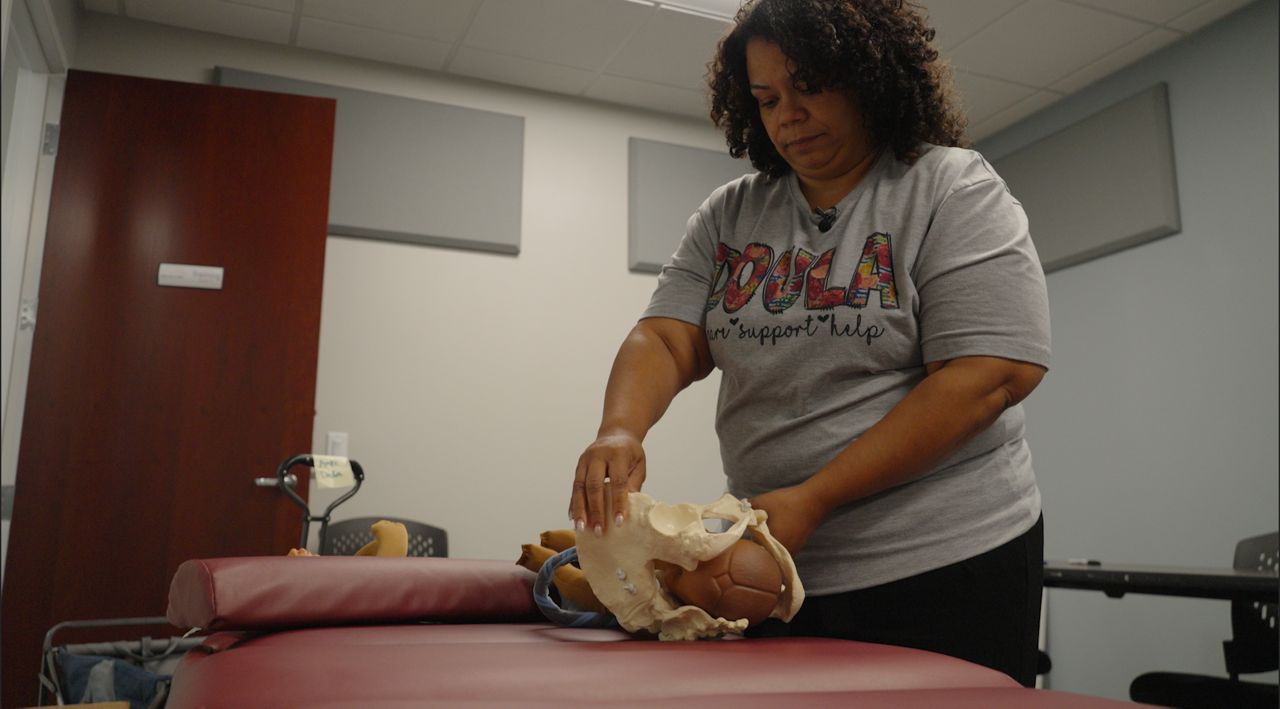
TAMPA, Fla. — Black Maternal Health Week runs from April 11-17. Every year since 2018, the week has been used to highlight the need to address high rates of preventable maternal mortality among Black women.
What You Need To Know
Research shows Black women are more than three times more likely to die during childbirth when compared to their white counterparts.
While the focus during Black Maternal Health Week is on the path forward, birthing experts say this health crisis dates back hundreds of years.
Infant mortality from conception to age two represents the most critical period for a child’s survival and development, with the highest risk of mortality occurring in the first 28 days.
SEE ALSO: List of events for Tampa Bay’s 3rd annual Black Maternal Health Week
This year’s theme is “Rooted in Justice and Joy,” focusing on healing, community resilience, and reproductive justice. It’s something experts say is a long time coming.
Brand new numbers, same old problems — that’s how experts describe the factors driving the high number of Black mothers and infants dying during childbirth.
Research shows Black women are more than three times more likely to die during childbirth when compared to their white counterparts. The latest numbers for Black maternal health aren’t as easy to find as years prior. The CDC hasn’t released up-to-date numbers.
Experts said the same can be said about their usual sources of information for Black maternal health. A new report from the March of Dimes does provide some stats for each state.
While the focus during Black Maternal Health Week is on the path forward, birthing experts say this health crisis dates back hundreds of years.
Pandora Hardtman has worked as a midwife all over the world. She has also studied history and how it connects with maternal and infant mortality. She said she has looked at research that shows Black maternal health issues date back to chattel slavery in America and the Caribbean.
“If I were to rewind 200-plus years, we still had some of the same issues. Poor nutrition. So, whether we’re looking at a food desert in America right now with only a convenience store colored stuff, or if we’re looking back in the day when they were eating the leftovers, nutrition still is a problem,” she said.
“They can have higher hemorrhage. Hemorrhage is still the number one cause of maternal mortality and morbidity globally. So you see, it’s connected. The root issues from then are still some of the root issues now, although they may manifest differently.”
Newly released documents from the Black Cemetery Network African American Burial Grounds & Remembering Project show several death certificates for people buried in the early 1900s in the forgotten Evergreen Cemetery. The cemetery was once located where I-175 now sits near Tropicana Field.
Among those death certificates are a number of infants and in at least one instance, the infant and the mother. And while there aren’t many details confirming what led to the infant deaths, birthing experts like Hardtman said it gives a glimpse into maternal health care at the time.
“We take the lesson in most of those still births were babies who maybe there were issues with resuscitation, the baby’s breathing. There’s a lesson to be had in that,” Hardtman said. “We cannot ignore the epigenetic impact that’s happened to us, hearing all of the stories. Women having 10 babies and maybe three surviving. We also had still the same issues today. Problems with water. Back to basic health and sanitation, right? Water, nutrition, all of that stuff that impacted the child mortality.”
Telesia Chaney Stephens and her mother, Carol Nelson Chaney, got a chance to see the death certificate for a stillborn baby Telesia’s great grandmother birthed in 1916.
“This would have been her first child. This would’ve had to have been her first child,” Telesia said.
On the death certificate from Evergreen Cemetery, the name of the child reads “Infant of Archie Chaney.” Archie Chaney was Telesia’s great-grandfather. She said her great grandmother Petronia never spoke about giving birth to a stillborn baby.
“I think I was surprised to have heard it but after thinking about it, no. I could see, truly see why, because you know, considering child and maternal health among African American women, I know that there is issue there. So, I can only imagine back in the day when we definitely weren’t getting prenatal care like we were supposed to be getting,” Telesia said.
Telesia and her mother, Carol, say they have both experience the pain of losing a child-and with the information they know now, they plan to do their part to stop history from repeating itself in their families and others. Starting with a conversation.
“Hey if you think you’re pregnant, if you find out you’re pregnant, get into prenatal care, see your OBGYN, make sure you’re doing what you’re supposed to. So, I think they are conversations that definitely should be had. Definitely,” she said.
Offering free doula care to everyone who applies, programs to make sure moms have the safest pregnancy and delivery, and partnering with local health care facilities are all part of the strategy at Reach Up, the maternal health organization in Tampa. Their mission lines up with what birthing experts across the country are looking at, especially when it comes to black mothers and their babies who are three to four times more likely to die during childbirth.
“We are an organization focused on reducing infant and maternal mortality. We keep it very simple. Our goal is to get that number to zero. Zero preventable infant deaths and zero preventable maternal deaths,” said Reach Up CEO Nicola Bailey.
“If you address those things that lead to the unhealthy outcome, you solve the puzzle, and it doesn’t matter if I had one baby or eight babies,” she said. “I still deserve to live, and so does all eight of my babies.”
Infant mortality from conception to age two represents the most critical period for a child’s survival and development, with the highest risk of mortality occurring in the first 28 days. Experts say those first 1,000 days are just as important for mothers. In Florida, the Medicaid extension now covers moms up to a year after birth. The newly passed federal Preventing Maternal Deaths Reauthorization Act provides funding and mandates the dissemination of information about how to prevent deaths, along with best practices.
Reach Up is also part of a collaborative group focusing on pregnancy and postpartum well-being. “You’re gonna have a successful pregnancy,” Bailey said. “You’re gonna have a baby and your baby is gonna be fine. We’re gonna connect you with services. We’re gonna help you select a clinician if you haven’t.”