
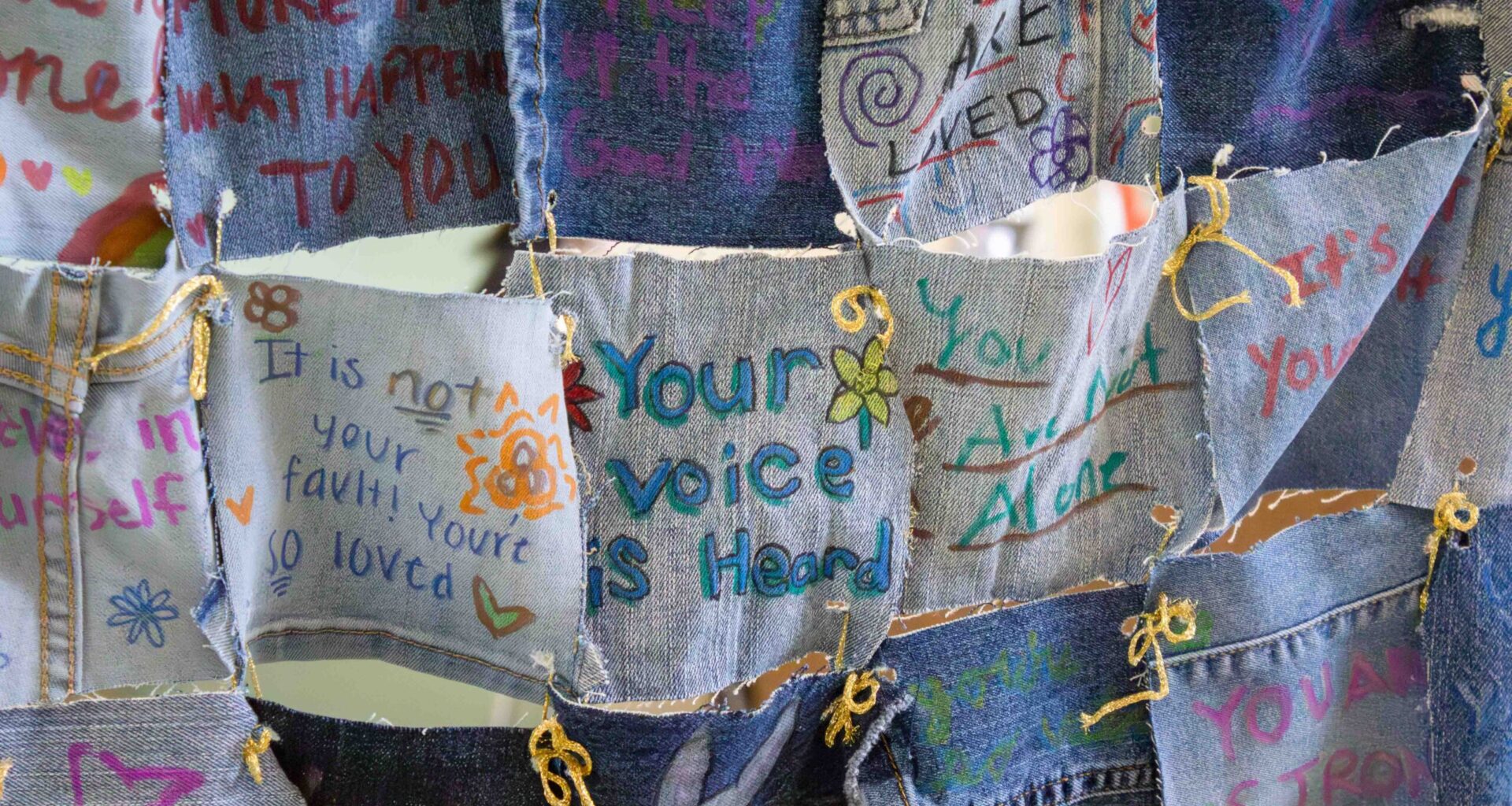
 USF’s Center for Victim Advocacy hosted a Denim Day event in the Marshall Student Center as part of a campaign for Sexual Assault Awareness Month on April 8. ORACLE PHOTO/VIOLET VASQUEZ PIMENTEL
USF and the Crisis Center of Tampa Bay have ramped up advocacy and support services for sexual assault survivors for April in light of Sexual Assault Awareness Month.
Sexual assault is any sexual act done without the victim’s consent and when the victim is incapable of consenting, according to the Office on Violence Against Women.
Since 2022, 26 sex offense crimes — which include rape and fondling — occurred at USF, with 13 in 2022, followed by four in 2023 and nine in 2024, according to the University Police’s 2024 Annual Security and Fire Safety Report.
Joni Bernbaum is the director of USF’s Center for Victim Advocacy and Violence Prevention, which provides students with a confidential resource to help support sexual assault survivors.
“Our role is not to pressure someone into a particular decision, but to provide information, options, and referrals, help reduce barriers, and support them in whatever path feels right for them,” Bernbaum said.
The department hosted a Denim Day event in the Marshall Student Center’s Atrium on April 8 to help raise awareness for sexual assault and university resources.
Denim Day was established in April 1999 to prevent and protest victim-blaming and falls on the last Wednesday of every April, according to its website.
Bernbaum said this day has become a way to help challenge victim-blaming and reinforce the message that sexual assault is not the survivor’s fault.
“Supportive responses do not happen in isolation — they are shaped by the kind of community we create together,” she said. “Small, everyday choices in how we show up for one another help shape whether people feel safe reaching out and supported when they do.”
Officials at the Crisis Center of Tampa Bay and USF said students can better support survivors by understanding consent and challenging stigmas surrounding sexual assault.
Related: USF, Crisis Center of Tampa Bay break down human trafficking signs
Clara Reynolds, the CEO of the Crisis Center of Tampa Bay, said sexual assault can be any type of nonconsensual sexual experience against another individual — even with a partner.
“Even if somebody is in a relationship, but a partner says no or is coerced into saying yes, that is also sexual assault,” Reynolds said. “Most sexual assaults happen with somebody that you know.”
More than 60% of sexual assault cases involve violence from someone known to the victim, according to Rainn, the country’s largest anti-sexual violence organization.
Out of college students, 13% of them experience some form of sexual assault, and women between 18 and 24 years old are at three times the risk of men the same age, according to Rainn.
Reynolds added that many victims experience sexual assault due to an abuse of a power dynamic that coerces them into the act.
“Sexual assault isn’t about sex, it’s about power and control,” Reynolds said. “So every step in that process, we’re working really hard to help you reestablish your own sense of power and control over your body.”
Almost half of women and one out of six men experience a form of sexual assault or violence in the U.S. in their lifetimes, according to the U.S. Centers for Disease Control and Prevention.
Reynolds said victims of sexual assault often blame themselves for their experiences after they happen. She added that this makes sexual assault more mentally damaging, as it does not often happen with other crimes.
“You have money stolen [but] you’re not blamed for it,” Reynolds said. “And yet, somehow, because of what an individual wears or where they are going, the community that they’re in, the actions that they’re taking, that they somehow have ‘asked for it.’”
Related: USF’s Student Ombuds Office expands with new adviser, larger space
On top of blaming themselves, Reynolds said stigmatized perceptions of sexual assault can cause a person to feel embarrassed or ashamed to share their stories or file a report.
She said these dynamics — from associating what a woman wears to her consent, to interpreting a man being assaulted by a woman with a higher position — create some “discrimination” when it comes to supporting survivors of sexual assault.
She added that this makes it even more important to listen to victims without judgment and give them space to share their experiences and stories of sexual assault.
“If somebody has said that they have been sexually assaulted, your job is to believe them,” Reynolds said. “It’s not to question, it’s not to go over the details. It is to believe them.”
USF offers confidential resources and appointments for sexual assault survivors, and the Crisis Center of Tampa Bay has 211, a 24-hour crisis hotline for anyone in need of support after a sexual assault experience.