
Comparing apples and oranges isn’t quite the same when it comes to Key Biscayne’s current two stormwater plan options.
There are a few similarities, at least, with the bottom line being reducing flooding in the short term while planning for other impending conditions in the long term.
At last week’s Ad Hoc Workshop, residents listened as GIT Consulting LLC founder Georgio Tachiev explained how his injection well system would benefit the Village, even tossing in a wild card — a way to expand the Zone 1 (K-8 Center area) using his six original pump stations (with directional flow and likely using much of the existing piping) to benefit more homes and more square acreage at once.
The injection well system is the preferred method suggested to municipalities by Miami-Dade County.
Following his presentation, Mike Houda with Black & Veatch engineering and consultant firm (hired to oversee the Village’s Resilient Infrastructure and Adaptation Program), offered a comparison of the GIT proposal and the more comprehensive AECOM system, a massive project of new piping and a centralized pump, pushing excess water directly to the outfalls and into Biscayne Bay.
No decision was reached Thursday.
Another Ad Hoc gathering will take place at 7 p.m., this Thursday, April 16, in the Council Chambers.
Committee members will perhaps zero in on a decision to be presented to Village Council either later this month or in May.
So, what did we all learn between what was referred to as the Centralized (AECOM) and Decentralized (GIT) systems?
Centralized vs. Decentralized Costs:
Under GIT’s “extended” plan, 217 acres could be covered by six pumps, as opposed to the standard 93 acres outlined in Zone 1. More accurately, 644 parcels would be covered under the extended plan rather than 311.
“More properties would be served and, eventually, lower costs per acre, or per person (would result),” Tachiev said. “In Zone 1, ‘extended’ is the preferred value alternative because it expands the drainage benefit using the same core six-node service.”
Tachiev said the cost estimate for Zone 1, as currently configured, would be: $45.758 million for the 93 acres and $58.592 million if extended to the larger boundary. Those come with estimated annual operational and maintenance costs of $943,798 and $1,049,153, respectively, to eliminate sediment, etc.
The cost per acre served would be $516,930 under the regular plan, but dips to $270,012 an acre in the extended plan. Similarly, the cost per parcel served would be $154,580 to stay in Zone 1, while expanding the effort would result in $90,982 per parcel.
Black & Veatch’s cost review, however, for Zone 1 as currently configured is $50,910,497.
According to Houda, there is a higher accepted accuracy rate on GIT’s estimates, but no detailed explanation was offered, other than that it was “conceptual” at this time.
Tachiev said he, along with his partners, are studying how to further reduce costs.
AECOM’s cost is estimated at $66,783,265 (compared to $50,910,497), plus FPL and water and sewer lines for the entire undergrounding project in Zone 1 adding up to $81,052,129 (with a -3% to 15% accuracy).
AECOM’s estimated annual maintenance is $554,789.
According to Houda, AECOM’s design is completed and funding is in place, with $2.99 million coming through existing grants. Other forms of funding include the $60 million in State Revolving Fund loans; $2 million from appropriations; $12 million from the General Obligation Bond; and $10 million is pending from Resilient Florida.
GIT’s proposal is conceptual at this point, Village Manager Steve Williamson said, but funding sources could be somewhat similar along with other money devoted to Biscayne Bay.
Centralized vs. Decentralized Design:
GIT’s design for Zone 1 includes six pump stations with two pumps each (total 12) linked to one new injection well per station to dispose of stormwater underground. Installation of new 24-inch pipe would take place where none currently exists or upgrading existing pipes less than 18 inches. It reuses existing stormwater pipes of 18 inches or greater.
Multiple, smaller pump/well sites mean no single failure cripples the whole system and can be installed in phases, if preferred, to see if the first pump station is doing its job before proceeding.
AECOM’s centralized system, with 3-6 pumps and a backup generator, is described as “more mature” in Honda’s analysis, and he said it is the more traditional civil engineering approach: move water fast to one place and pump it out.
The discharge is to the outfalls into Biscayne Bay, likely sending more pollutants into the bay than GIT’s concept, although further studies are needed.
This system requires a complete pipe replacement throughout the zone with pipes from 18 inches to 72 inches. It would also include complete road raising and the removal of 565 trees, which would be replaced, in many cases, with shade trees (only surface shrubbery would be impacted in GIT’s concept).
Centralized vs. Decentralized Performance:

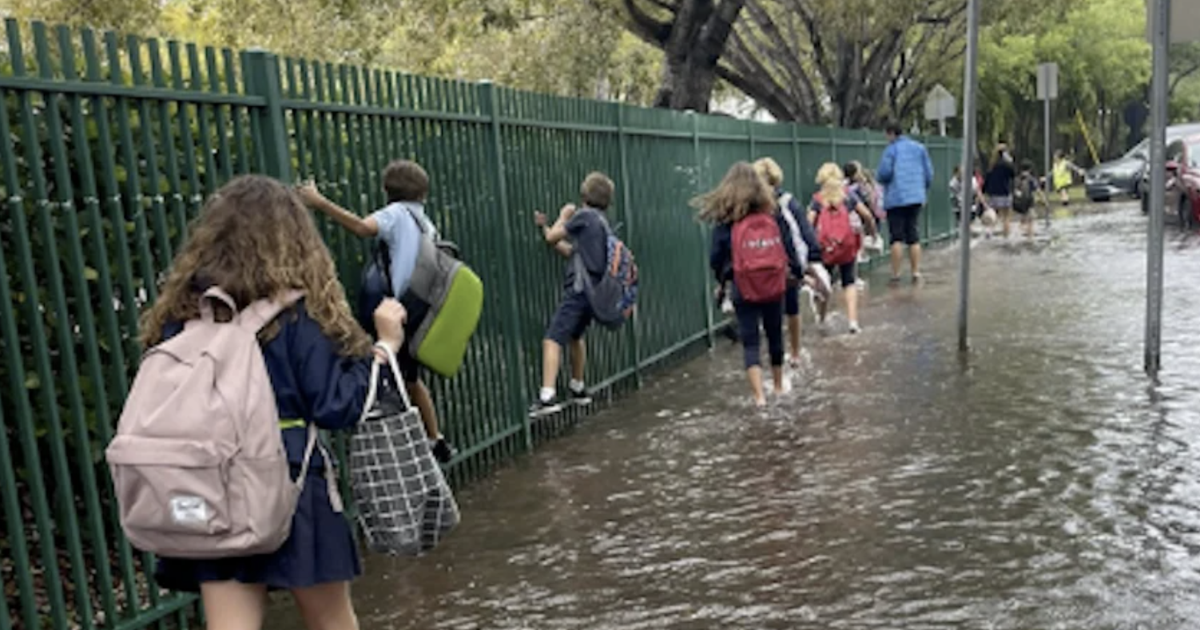
Floodwaters fill a Key Biscayne street after heavy rain, underscoring the real-world conditions both stormwater proposals are designed to address in terms of drainage capacity and response time.
Islander News archives
Both systems meet baseline service goals.
GIT’s drainage capacity is designed to eliminate 90 cfs (cubic feet per second) of water at ideal conditions. It allows emergency vehicles to pass through and enough road clearance through the 2050-time horizon for a 5-year storm and slightly lower sea level rise prediction.
GIT’s distributed capture means water is handled closer to where it falls, which often reduces localized flooding faster.
AECOM can scale to higher peak capacity (currently at 57 cfs, and can be increased to 77 cfs and up to 155 cfs), but relies heavily on pumps and long conveyance throughout the Village.
It allows emergency vehicles to pass through and road clearance through the 2060-time horizon, for a 10-year storm and slightly higher sea level rise prediction.
Additional pumps can increase capacity and multiple pumps do allow for a failure at the pump station.
Centralized vs. Decentralized Environmental Impact:
GIT’s proposal shows a significant reduction of direct discharge of stormwater to Biscayne Bay.
Water will be pre-treated at each well to reduce contaminants from seeping into the aquifer. Full landscaping impact is to be determined, but it will be less than AECOM’s plan.
AECOM’s design will treat and filter stormwater through settling tanks, inlet filters and a hydronic separator before pumping it to the bay. Existing nutrient load will be reduced, surpassing water quality standards.
This plan also will require the removal and replacement of approximately 565 trees.
Centralized vs. Decentralized Maintenance:
In GIT’s system, injection wells are expected to face a major cleaning or re-drilling every 5-10 years and pumps 20-30 years. New piping is expected to last more than 50 years, while existing piping is to be replaced as needed.
With AECOM, filter cleaning is required, as well as maintenance to a back-up generator.
Centralized vs. Decentralized Aesthetics:
In GIT’s system, pump station electrical panels will be visible in front of streets, with limited landscaping and streetscape impacts.
With AECOM’s plan, all roads, driveways and sidewalks will be impacted, causing access limitations during construction hours. Harbor Park will be used as a staging area for part of the construction. After construction, Harbor Park will be significantly reduced (by a third). It also will take time for the new shade trees to be planted and matured. New drop curbs and roads will impact the streetscape.
What the public said:
After the presentation, residents in attendance offered their opinions.
One resident called the analysis “a charade,” saying that Houda’s Black and Veatch company already aligned itself with AECOM from the start, and by using him as the arbiter between these two firms, “is an insult to our intelligence.”
Another resident said it “seems like only common sense to consider more than one company for Zone 1. All we ever heard about was AECOM …”
One resident said AECOM had three years to come up with its plan, while Tachiev has had just three months to rush through his.
Another opinion centered around just doing what is necessary to fix the existing problem in Zone 1 (by the school) and hold off on anything else.
Yet another frowned-on spending “double” for a project that could take 10 years, a plan which could be obsolete by then. “Please consider the public,” they said.