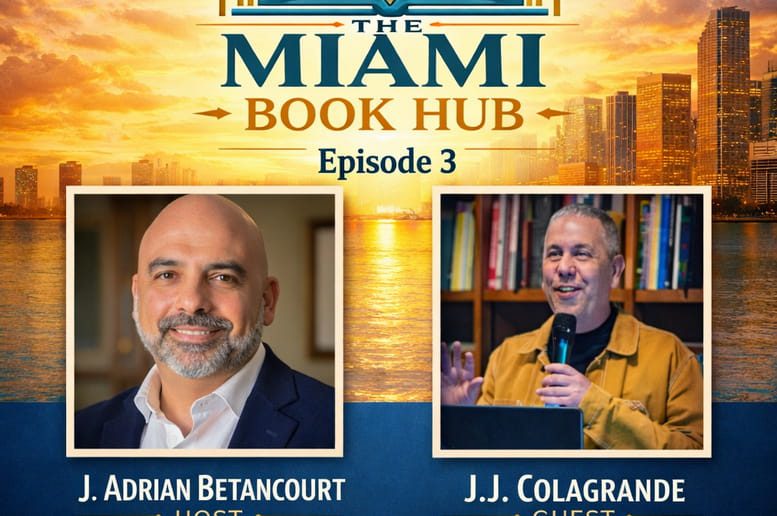
 In the third episode of my podcast, The Miami Book Hub, I had the pleasure of sitting down with one of the most multifaceted figures in our local literary scene: J.J. Colagrande — author, journalist, professor at Miami Dade College, and founder of Jitney Books.
What unfolded was more than a conversation about books. It became a broader reflection on Miami itself: who gets to tell our stories, how creative communities take shape, and why independent literary institutions matter so deeply in a city like ours.
J.J.’s story begins, fittingly enough, with the discovery that words have power. As a student at Florida International University, he wrote for the school newspaper and saw firsthand how commentary and journalism could shape public conversation. That early experience led him deeper into writing, graduate study, teaching, and publishing. Along the way, like many Miamians, he left for a time, only to find himself drawn back home.
That return-to-Miami theme resonated with me. There is something about this city — its energy, contradictions, and cultural complexity — that makes it hard to quit. Miami can frustrate you, exhaust you, and bewilder you. But it also gets into your blood. It remains, in many ways, a “rubber-band city.” People leave, but so often they come back.
For J.J., that return was not just personal. It became creative and mission driven. In 2016, he founded Jitney Books as a micro-publishing company focused specifically on South Florida writers and South Florida stories. That mission is as simple as it is important: let Miami define itself from within.
That struck me as one of the most important themes of our conversation.
Too often, Miami is described by outsiders. The version of the city that reaches the broader culture is frequently flattened into cliché: neon glamour, vice, excess, corruption, caricature. Those elements may exist at the edges, but they are hardly the whole story.
They are certainly not the story most Miamians live every day.
The real Miami is more textured than that. It is immigrant ambition, family sacrifice, grit, reinvention, language, hustle, memory, and cultural layering. It is neighborhoods with histories that rarely make it into national narratives. It is a city still young by the standards of older American metros, but already rich with conflict, character, and stories worth preserving.
That is where independent publishers like Jitney Books play such a vital role. They make space for local voices who might otherwise be overlooked by the larger publishing machinery based in New York or elsewhere. They give legitimacy to stories rooted here.
They help build a literary record of the city on the city’s own terms.
J.J. also was refreshingly candid about the realities of publishing. Traditional publishing can be difficult to access, slow-moving, and financially underwhelming even for writers who “break through.” Self-publishing offers more control, but it also demands that authors become entrepreneurs, marketers, logisticians, and project managers on top of being writers.
One of the most useful parts of our conversation was J.J.’s insistence that we speak honestly about the economics of the book business. Too many aspiring writers pursue publication without understanding the landscape they are entering. Writing may be art, but publishing is undeniably business. That does not make it less noble; it simply makes it real.
And the more openly we discuss that reality, the more empowered writers will be to make smart choices.
What I appreciated most, however, was that J.J. never spoke cynically. He spoke honestly, yes, but always from a place of love — love of writing, books, and literary community. That distinction matters. Despite all the challenges, people continue to write because they must.
They write because stories insist on being told.
Our conversation also turned, quite naturally, to Miami Dade College, where J.J. teaches creative writing and composition at the Wolfson Campus. I have said it before and I will say it again: Miami Dade College may be the single most indispensable institution in Miami-Dade County.
That is not hyperbole.
MDC has long provided access to education and opportunity for people who might otherwise be shut out of both. It has served immigrants, first-generation students, working adults, dreamers, and strivers — the very people who make Miami what it is. And beyond academics, its cultural footprint is enormous.
The Miami Book Fair alone would justify the college’s place in our civic life, but MDC’s impact extends far beyond that through film, the arts, historic preservation, and stewardship of some of the county’s most important cultural assets.
Another encouraging theme from our discussion was that Miami’s literary culture, for all its growing pains, remains unusually warm and collaborative. J.J. spoke with real admiration about Mitchell Kaplan of Books & Books and Lissette Mendez of the Miami Book Fair, both of whom encouraged him when he first launched Jitney Books. Their support was practical, generous, and rooted in a belief that Miami’s literary scene grows stronger when more people are welcomed into it.
That spirit says a great deal about this city. For all of Miami’s competitiveness in other arenas, its literary world still feels, at its best, like a community rather than a club. That openness matters. It creates pathways instead of gatekeeping and reminds us that cultural ecosystems are built not only on talent, but also on generosity.
We also touched on some of Jitney’s published books, including The Cuban American Tour of Miami by Pedro Medina León, a work that invites readers into a deeper understanding of the city. That, to me, is exactly the kind of project Miami needs more of — books that help residents and newcomers alike understand the layers beneath the surface.
If there was one takeaway from Episode 3, it is that Miami’s literary identity is real, and it is growing. But it will only continue to flourish if we support the people and institutions doing the work — the teachers, small presses, independent bookstores, local journalists, literary festivals, and writers themselves.
Because if we want Miami to be known not only for its skyline, nightlife, and spectacle, but also for its stories, then we must invest in the people telling them.
And after my conversation with J.J. Colagrande, I am more convinced than ever that those stories are already here — rich, vibrant, and unmistakably ours.
I encourage you to learn more about Jitney Books and Miami Dade College at jitneybooks.com, and www.mdc.edu, respectively.
To view this full interview and other episodes of The Miami Book Hub — Miami’s home for readers, writers and resources — visit my YouTube channel at YouTube.com/@J.AdrianBetancourt.
J. Adrian Betancourt is host of the The Miami Book Hub podcast.
ABOUT US:
For more Miami community news, look no further than Miami Community Newspapers. This Miami online group of newspapers covers a variety of topics about the local community and beyond. Miami’s Community Newspapers offers daily news, online resources, podcasts and other multimedia content to keep readers informed. With topics ranging from local news to community events, Miami’s Community Newspapers is the ideal source for staying up to date with the latest news and happenings in the area.
This family-owned media company publishes more than a dozen neighborhood publications, magazines, special sections on their websites, newsletters, as well as distributing them in print throughout Miami Dade County from Aventura, Sunny Isles Beach, Miami Beach, Coral Gables, Brickell, Coconut Grove, Pinecrest, South Miami, Kendall, Palmetto Bay, Cutler Bay and Homestead. Each online publication and print editions provide comprehensive coverage of local news, events, business updates, lifestyle features, and local initiatives within its respective community.
Additionally, the newspaper has exclusive Miami community podcasts, providing listeners with an in-depth look into Miami’s culture. Whether you’re looking for local Miami news, or podcasts, Miami’s Community Newspapers has you covered. For more information, be sure to check out: https://communitynewspapers.com.
If you have any questions, feel free to email Michael@communitynewspapers.com or Grant@communitynewspapers.com.
Connect To Your Customers & Grow Your Business