
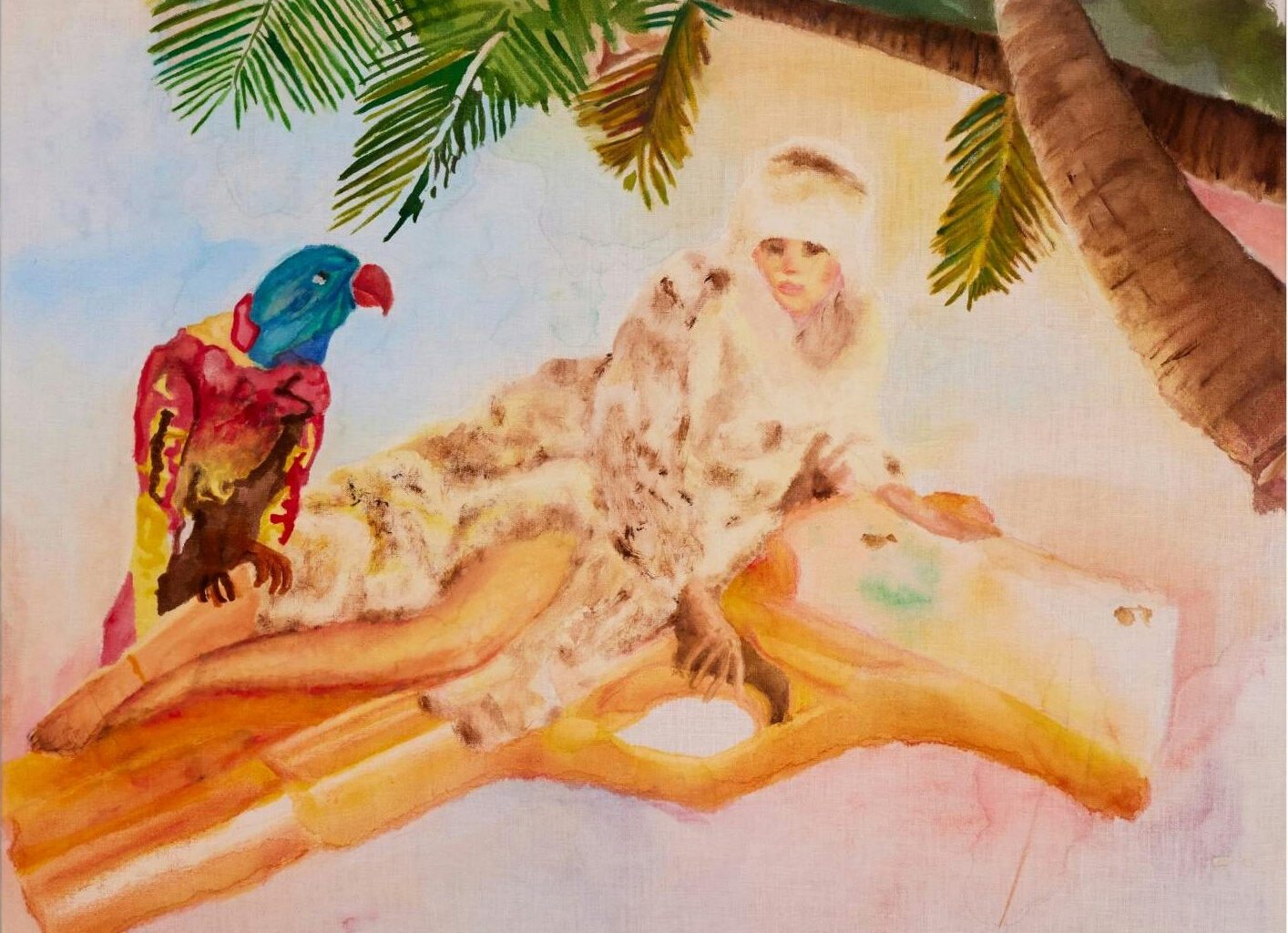
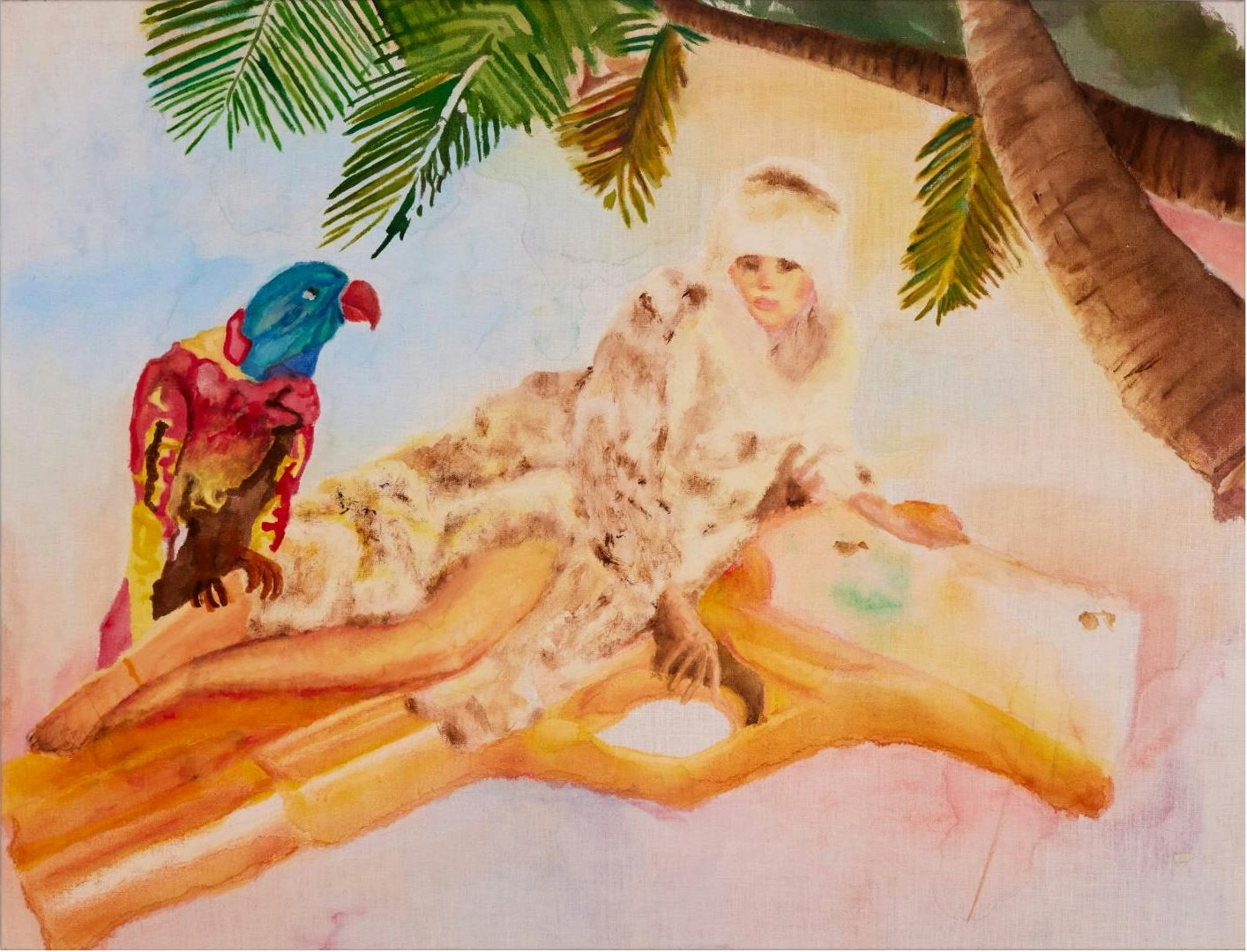
Harmony Korine, Shirley’s Temple, 2016. Watercolor on linen.
Craig Robins Collection
If Miami didn’t exist, Harmony Korine might have had to script it into existence.
The Magic City, both surreal and really real, is a cultural mélange in which the writer of the 1995 indie cult classic Kids and writer/director of such exuberant, wild, transgressive fare as Gummo (1997), Spring Breakers (2012), and The Beach Bum (2019) thrives. So much so, in fact, that Korine relocated here around fifteen years ago. And as if to showcase how the city has slowly evolved into his creative canvas, the Institute of Contemporary Art (ICA) Miami is hosting the first United States museum survey of Korine’s lesser-known yet beguiling multidisciplinary work, “from early drawings and collage to later paintings, photography, and recent digital experiments” — entitled, appropriately, Harmony Korine: Perfect Nonsense. The exhibition is on view through October 4.
“Harmony is, in his own unique way, a very astute observer of society, and a lot of his work has been preoccupied with the idea of an outsider,” ICA artistic director and Perfect Nonsense co-curator Alex Gartenfeld tells New Times. “I would say one of the throughlines in this exhibition is the idea of people who are nonconformist, who don’t exactly fit into society. And I think that one of his fascinations with Miami is the ways in which this city not only embraces the outsider but also brings together such diverse populations in close dialogue.”
For the vast majority of those who primarily know Korine as one of the most influential and consequential indie filmmakers of the last quarter century, Perfect Nonsense will undoubtedly prove a revelation. However, simply because the way Korine has melded and traversed artistic disciplines is understudied or, to some degree, unheralded, does not mean it is some bolt-from-the-blue shocking mid-career left turn.
“[Harmony’s work] moves between multiple media, and it has actually done that from the beginning,” says Gean Moreno, director of the ICA’s Art + Research Center and co-curator of the exhibit. “So, while the painting practice has come to the fore recently, the quest to make new images has been there all along. I think it will be quite interesting for viewers to trace that arc across three decades.”
Here is one example of this progression, as described in a press statement to give readers a bit of flavor: “Some of Korine’s earliest works feature childlike figures and writings, and often explore the coming-of-age genre and its complex unfoldings. These childlike and coming-of-age themes have evolved into a ghostly form he calls ‘Twitchy,’ found in paintings that are produced by combining images captured on an iPhone with painterly techniques.”
The flip side of this fluidity and interconnectedness is that Perfect Nonsense does not ignore or distance itself from Korine’s films. Quite the contrary: It nurtures a deeper, edifying experience of his popular work. “I think many people will be surprised at the extent to which Harmony’s collages and notes sometimes help form the structure of his films,” Gartenfeld says. “And vice versa: There are frames from some of his iconic films that became the starting point for artwork as well.” The exhibit, then, strives to mirror this, moving through different periods in Korine’s life, biography, and production, spotlighting symbiosis rather than siloing.
“You’ll see the development of the seamlessness with which Harmony works across medium from some of his earliest works, which are closely related to some of his earliest films,” Gartenfeld says, “to his work on black metal” — recall, Korine has a credited appearance in the controversial landmark Norwegian black metal doc Until the Light Takes Us — “and other subcultures.”
As we move closer to the present day, Perfect Nonsense tackles Korine’s recent grappling with technological augmentation. “Harmony has experimented in medium with an eye towards the forces that are so rapidly changing society,” Gartenfeld says. “His adaptation of both digital tools as well as digital image types, I think, will be new and certainly very timely for audiences.”
If that sounds like a lot, well, provocateurs are gonna provoke. It’s not exactly a quiet or sensible moment in this city, nation, or world, and it hasn’t been for some time. Amidst all of this, Korine’s sprawling, crackling Perfect Nonsense is the rare case of an event actually worthy of the Hunter S. Thompson maxim quoted typically unduly and ad nauseam: “Buy the ticket, take the ride.” Really, would any self-respecting Korine fan want it any other way?
“Harmony Korine: Perfect Nonsense.” On view April 15 through October 4, at ICA Miami, 61 NE 41st St., Miami; 305-901-5272; icamiami.org.