
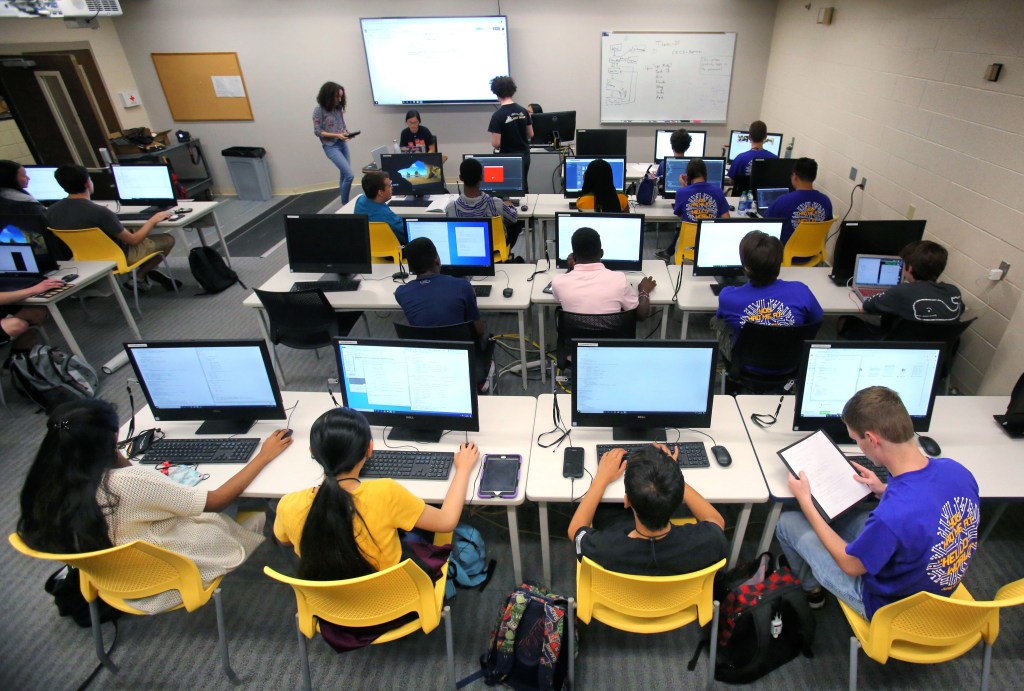
Artificial intelligence has found its way into Miami-Dade classrooms. In the third-largest school district in the country, 100,000 students are now using Google’s Gemini chatbot in the classroom.
Miami-Dade County Public Schools teachers are experimenting with AI tools to grade essays and bring their lesson plans to life by enlisting chatbots to impersonate historical figures, according to a May story in the New York Times. Central Florida school leaders are also exploring the use of AI in classrooms.
That’s both exciting and troubling. Left unchecked, AI risks opening the door to a decline in students’ critical thinking skills — giving too much power to technology rather than teachers. We understand the temptation of asking ChatGPT when a student has a question that would require a lot of research.
At a press conference this summer, Gov. Ron DeSantis wondered out loud about the ramifications. “Are students going to have artificial intelligence write their term papers? Do we even need to think?” His concerns are well-founded.
And it’s not just critical thinking that could be affected. AI doesn’t always provide correct information, increasing the risk of misinformation being accepted as truth. And yet, AI is being used more and more by teens, and not just for school work. A recent study by Common Sense Media found that approximately 72% of teens have used AI as a companion at least once, and more than half are regular users. In the same study, one in four admitted to sharing personal details with chatbots, and younger teens, ages 13 and 14, were found more likely to trust AI answers.
Florida has already seen what happens when social media is left unchecked. Parental controls weren’t enough to protect kids. Now, an anxious generation has emerged — shaped by Instagram and TikTok’s addictive algorithms. AI could be the same and much worse.
Last year, DeSantis signed into law one of the most restrictive social media bans in the country. The law stopped kids under 14 from having social media accounts and required parental permission for use by 14- and 15-year-olds. A federal judge in June blocked Florida from fully enforcing the ban on constitutional grounds, though the judge acknowledged “sincere concerns” of parents and lawmakers. The state has unsuccessfully sought to have the lawsuit dismissed.
The University of Florida has created the Florida K-12 AI Education Task Force, and they’ve developed AI guidelines for schools. That’s a step in the right direction. With over two dozen district partnerships — including Orange, Osceola, Miami-Dade and Broward school districts — the task force offers guidance on how to safely use AI in the classroom. From toolkits to training resources, its work highlights privacy and how to keep students from being overly reliant on chatbots. The group is tackling tough issues like ethical considerations for educators, students and IT professionals.
They could use some help. The University of Central Florida, which already offers degrees in artificial intelligence and a certificate program that focuses on the technology’s human impact, should consider adding classes and research into best-use principles for AI, in classrooms and beyond. He
But guidelines aren’t the same as regulation. This is a huge challenge, too. Each county shouldn’t be left on its own to decide what kind of standards to put in place. Lawmakers should use the task force’s efforts as inspiration and perhaps UCF’s research as a template. So far only two states, Ohio and Tennessee, have passed laws requiring school districts to have policies about the use of AI in schools though other states are issuing guidance on AI policy.
And AI continues to be a focus in Tallahassee: A House subcommittee on insurance and banking held a panel discussion Tuesday on the use of AI in the insurance industry. The subcommittee chairman, Rep. Brad Yeager, R-New Port Richey, told Politico the meeting was strictly “educational” for now.
This is not just up to the states. Congress has a key role, too. President Trump, though, has taken the opposite approach, pushing to remove any state laws that could be “burdensome” to developing AI technology. He is advocating for national standards, not state regulation. His goal: to make the U.S. the dominant player in AI technology.
So where does that leave Florida? AI is going to require at least as much scrutiny as social media. We’re already experiencing the consequences of allowing social media algorithms unfettered access to our children.
AI use is growing by the day. Its future is still unknown. Teaching students about it is the only responsible path. But the dangers are real. Florida shouldn’t wait for the federal government. If the state sets up guardrails now for use by students, we can lead on the use of AI in classrooms.
This Miami Herald editorial has been adapted by the Orlando Sentinel. The Sentinel sometimes reprints editorials that agree with our own positions. Send letters to insight@orlandosentinel.com.