
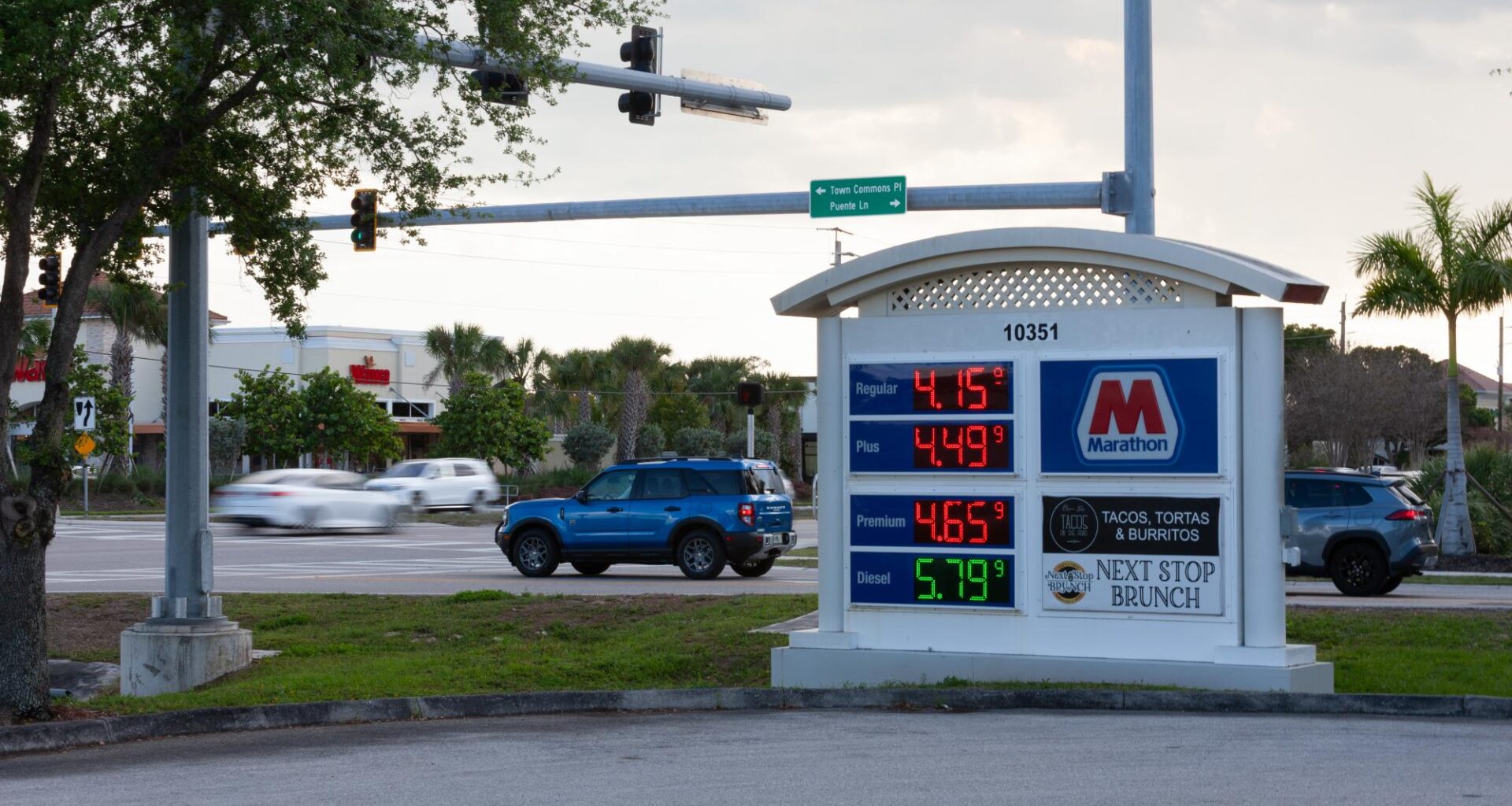
Gas prices have risen dramatically due to the closure of the Strait of Hormuz and strikes on oil infrastructure since the United States and Israel began their war against Iran. These effects have reached students at FGCU, as rising prices have forced many to rethink how they travel to and from campus and beyond.
On Feb. 6, the U.S. began a strike campaign against Iran with the stated goal of bringing revolution and overthrowing the then-sitting Ayatollah Ali Khamenei. Khamenei has since been killed in the strikes and his son, Mojtba Khamenei, has ascended as leader of Iran.
Many of the sites targeted by the U.S. have been oil facilities, as oil is Iran’s largest export according to the OEC. These strikes, in addition to Iran’s retaliatory closure of the Strait of Hormuz, have caused oil scarcity and, therefore, prices to skyrocket.
According to FGCU, a third of its 15,000-student body lives on campus, forcing the remaining 67% to commute. Due to their daily driving, they are a demographic hit hard by rising prices.
Story continues below advertisement
“Typically, what I’ll do is I’ll go off campus, get lunch or something like that, or I’ll spend that time to maybe go back home for a couple hours,” senior Giordan Dyokas said. “Now it’s getting to the point where I have to think, ‘Oh well, that’s going to cost me gas’… I’ll just spend my time on campus all day instead of going and getting food.”
Those living on campus aren’t unaffected either. According to the International Air Transportation Association, air travel fares have risen by around 20% as jet fuel prices have nearly doubled.
Marek Boltz is an FGCU sophomore currently planning a trip up to Illinois after the school year is over. The increased prices for domestic flights did not affect his upcoming flight, but gas prices will impact his other travel plans.
“Fortunately, I always buy my tickets very early in advance, so by the time the prices were raised, I had already bought my tickets,” said Boltz. “However, I do plan to drive back down to Florida and I am fully prepared to spend upwards of $600 on gas when it usually would only cost $200.”
Jay Shabat, a senior analyst at Skift Airline Weekly, warns that rising fuel costs could lead airlines to cut routes and ground less efficient aircraft.
“There might be a New York [to] Fort Myers route by one airline that’s, ‘Wow, this is just too competitive, we’re not making money, we can’t raise fares when jet fuel was $3 a gallon. No problem, we can make a buck”’, Shabat said. “If fuel is $4 dollars a gallon, then forget it, we’re going to lose money, so we’re just going to cancel it.’ You don’t see it much yet, but if fuel prices persist at the current rates, or go higher, you’re going to see a lot more of that.”
As for what can be done to mitigate prices in the short term, Shabat said he would not be surprised to see strategic reserves released and taxes lowered.
“There’s different things that a government can do, but there are also a lot of limitations on what they can do. One option to kind of help bring the oil price down is to release reserves,” Shabat said. “We have reserves of oil sitting in tanks in Louisiana, and you can release some to the market. That’s one option. You could even see state and local governments could lower some taxes.”
The suspension of the $0.38-per-gallon state gas tax could be seen in Florida, as neighboring states such as Georgia have already enacted temporary suspensions of state gas taxes to ease the impact of rising prices on consumers.
“This current war with Iran and the whole oil and gas crisis has so far impacted my daily life that it would be hard for anyone to ignore it,” said Boltz.
If the recent increase in gas prices has led to economic hardship for you or someone you know, FGCU student care services offers assistance with basic needs.