
State soccer champions

12 girls, bottom row, left to right, Coe Paisley, Jeanette White, Julie Wall, Sheryl Sampsell, Robin Del Greco, Heather Craig, Maria Suarez, Lori Shorin, Nancy Easton, Alicia Tarafa, Lisa Bramson, Terri Sampsell. Top row, coach Tony Fiorenza, Beth Kilgore, Cindy Charles, Linda Evans, Maria Suarez, Ana Busquets, Betsy Lehman, Karen Martin, Kelle Petagno, Liliane Leao, Nancy Johannsen, Heidi Coleman and Kelly Welsh.
Chamber resumes effort toward Causeway expansion
The Key Biscayne Chamber of Commerce proposed a revised plan for the expansion of Rickenbacker Causeway at the Tuesday meeting of the County Commission.
The new plan, presented by former chamber president Dick Vernon, calls for construction of a new, four-lane bridge from the present flyover to the drawbridge. This bridge would handle traffic heading off the Key. Vernon said the project would cost approximately $1.5 million.
A more elaborate, $2.2 million Causeway expansion proposal was rejected by the Commission in February. The Commission did not take any action Tuesday on the new plan, but instructed the County Manager’s office and the Public Works Department to present more information on the project at a later meeting. The Chamber of Commerce supported the earlier, defeated proposal, which was opposed by the Key Biscayne Property Taxpayers Association. KBPTAI President Toni Reinhardt wouldn’t say what she thought of the revised plan. Vernon told the Commission that on weekends the Causeway “has just become unbearable. The beach is not accessible to the public like it once was.”
Vernon said the increased traffic has made it too difficult for the people of Dade County to get onto the Key. He added that he didn’t think a new bridge from the drawbridge to the flyover was a complete solution.
“We’ve got to start somewhere,” he said. “The problem is not going to go away.”
The new proposal was drawn up by engineer Windy Crowder, a Key Biscayner, and Walter Herndon of the Public Works Department. Crowder said the main difference between the two plans is that the revised version concentrates on getting people off the Island more quickly, not onto it. Some of the Commissioners remained skeptical.
“I don’t think the people of Key Biscayne are going to be any happier with this than they were with the previous proposal,” said Beverly Phillips.
Other Commissioners, including Mayor Steve Clark, seemed more receptive to the new plan.
“Something should be done,” said Clark. “I’ve gotten stuck over there myself.”
Welcome Rotary Club of Key Biscayne
Charter Members. Front row, left to right: Dr. George Vous, Bruce Beattie, Robert Bartholomew, John Burton, Reid Hatfield, Norman Roberts, Ralph Trites, Robert Lowman, James Eraso; back row, left to right: Dr. Ronald Sampsell, Jeffery MacFarland, Robert Newell, Thomas Kimen, Walter Strothman, Thomas Butler, Thomas Collens, Norman Bouchard, Arthur Smith, Kenneth Lancaster, Edward London, Thomas Herzfeld, John Mackie. Not pictured: Wilfredo Borroto, John Conover, Frank De Laurier, Thomas Gunning, William Kieldsen, Michael Ross, Harold Rustin, John Snyder.
Anyone want a used helipad?
What to do with a used helipad?
That question is proving difficult for Uncle Sam to answer. The federal government’s General Services Administration still hasn’t decided how to get rid of the 150 square foot helipad that sits in Biscayne Bay at the end of Bay Lane, built when former President Nixon lived on that street.
Quincy Culpepper of the GA’s regional office said the top brass in Washington haven’t decided what to do with the $418,000 helipad, which has been declared “excess property” by the defense department. Culpepper said the helipad will probably be offered to various governmental units. If they’re not interested, it could go on sale to the general public.
Culpepper said that if the two Nixon homes are sold, the helipad could be part of the deal, but no such sale appears in the works. A naval officer stationed in the Bahamas inquired, but backed out when he realized the solid concrete structure would be hard to tow across to the Bahamas.
Athletic equipment
Archie Stone presents a $2,000 check to Ed Easton, president of the Key Biscayne Athletic Club as KBAC Treasurer Tom Kimen looks on. The money from the Stone Foundation will be used to purchase athletic equipment.
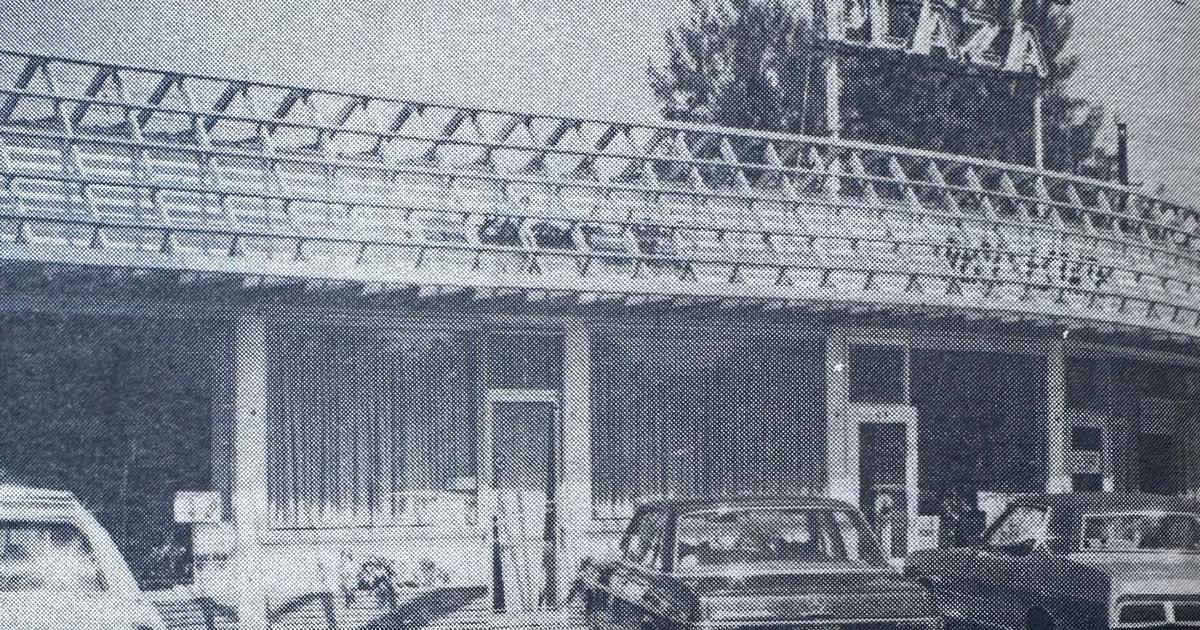
Harbor Plaza
Construction is underway to improve the appearance of the Harbor Plaza Shopping Center. New facings on the building will be completed soon.
Tuesday Rains Cause Blackout
Heavy rains caused a power blackout for much of the west side of Key Biscayne Tuesday morning. The electricity went off at 8:55 a.m., and came back on at 11:20 a.m. A spokesman for Florida Power and Light Company said the area affected was from Seaview to Harbor Drive from Crandon Blvd to the bay. He said the blackout was caused by a damaged feeder line. The line carries electricity from a sub-station into a neighborhood.
If you don’t like your neighbors, anchors aweigh
For many house boaters, Cape Florida Park’s No-Name Harbor is a part-time home.
In many ways, the Nicola and the Lowell families are typical Key Biscayners.
The Nicolas own a business up north but are spending the winter months down here. John Lowell is retired. He is planning on taking a trip to the Bahamas with his wife, two children, cat and dog.
Like many Key Biscayners, the two families own their own homes, but there’s a twist … these homes float.
The Nicola and Lowell families are among those who live on their boats in Cape Florida Park’s No-Name Harbor. Although they enjoy their unusual lifestyle, it does present some peculiar problems. Especially this time of year.
“I’ve been working on my income tax returns all day,” said John Lowell last week. “It’s a confusing year for me. They can’t believe that I don’t have a permanent address.”
Another problem is mail. Since the Key’s letter carriers aren’t equipped with fins or wings.
No-Name Harbor is basically a stopover point for boaters on their way to the Bahamas and other islands south of Florida. Not all the sailors are from the eastern seaboard. One of the sailboats currently staying at Cape Florida has come all the way from Hawaii.
What kind of person lives on a boat?
“You’d find as much variety among these people as you would anywhere else,” said Lowell, but he would probably agree with George Nicola’s assessment that, “It takes someone with a little get-up-and-go.” Although the Lowells and Nicolas enjoy the freedom that boat-living offers, Lowell emphasized that it is not a completely carefree existence.
Sonesta Questioned on House Rentals
Charging zoning violations and neighborhood disruption, Dade County and an Atlantic Road resident have requested the Circuit Court to prohibit the Sonesta Beach Hotel from renting out houses on Atlantic Road. The hotel correctly uses five houses on the street for rental purposes.
“We have taken the position that they are not permitted to use the houses for hotel use,” said Stanley Price, an assistant county attorney
The county, and co-plaintiff Mrs. Helen White, claims Sonesta is violating zoning regulations and disturbing the neighborhood. They say the homes are under a zoning category that prohibits hotel usage. Mrs. White says hotel guests in the houses have caused “Quite a few problems. You never know what to expect. There’ve been wild parties. It’s caused a general breakdown of the neighborhood.”
The Sonesta’s Steve Sonnabend says the hotel’s security force keeps the area well-patrolled to make sure there are no disturbances. He added that the houses are only rented out to families, which tends to cut down on partying.
Fernwood Road Access Hearing Postponed Until May
At the request of an attorney representing major Crandon Boulevard property owners, the Metro Commission Tuesday deferred discussion on whether it should lift restrictions on commercial access to Fernwood Road. John Fletcher convinced the Commissioners they should postpone discussion until they receive transcripts of the February Zoning Appeals Board meeting at which the ZAB approved the commercial restrictions. In 1974 the west side of Crandon was rezoned from BU-2 (Special Business) to BU-1 (Neighborhood Business). At that time the restrictions were inadvertently omitted, so the county had to request a correction.
Fletcher also said the upcoming discussion should consider whether the entire west side of Crandon should be re-zoned back to BU-2. The county attorney disagreed with this assessment, but the question will probably come up again when the Commission discusses the matter at its May meeting.
For the last Islander Throwback, click here.