
Two recent events share a connection that many Floridians might not recognize.
The first happened on Friday evening, as people across Central Florida held their breaths through the longest six minutes of 2026. They were waiting (and praying) to hear whether the Orion capsule had protected the four-person crew of the Artemis II mission as it re-entered the Earth’s atmosphere. Many were also reliving the memory of two other space flights that ended in tragedy.
The second dropped mid-afternoon on Monday, as phones pinged with a news update: Gov. Ron DeSantis had just scrawled his approval of eight new specialty license plates, including some that had almost nothing to do with Florida. People said “that’s stupid,” or merely “huh,” and went back to whatever it was they were doing.
The two events share a history — one that illustrates just how the plate program has become picayune, politicized and potentially hazardous to public safety.
It started out with heartfelt intentions, and better-than-expected success. Florida’s first specialty license plate was introduced in 1987, meant to be a time-limited memorial to the Challenger space shuttle, which exploded 73 seconds after takeoff in January 1986. But the plate’s popularity exceeded all expectations — and opened the floodgates. Later that year, lawmakers authorized specialty plates for Florida’s then-nine state universities. In 1989, it added a plate honoring veterans, and the University of Miami became the first private school to get a plate. People who wanted the plates paid an extra $15-25, with the money used to support nonprofit organizations.
So far, so good: All these plates were popular and completely values-neutral. Over the next few years, Florida adopted plates for environmental initiatives, including efforts to save manatees and the Florida panther. A plate was created to support the Special Olympics. Every sale generated revenue for causes that almost every Floridian could agree with; for example, the veterans plate created in 1989 helped fund nursing homes for aging service members.
Over the next few years, lawmakers authorized new plates for a variety of causes: Protecting sea turtles and dolphins, supporting scouting, keeping kids drug free and rescuing the Indian River Lagoon. In 1995, the state, for the first time, included plates acknowledging private businesses — 10 of the state’s pro sports franchises. It’s unfortunate that 1995 was one of the few years that Florida was home to an arena football franchise known as the Miami Hooters. (The plate would be discontinued two years later, after the team moved and changed its name.)
Right about that time, Florida lawmakers began hearing from law enforcement, who had one simple plea: Stop. This is becoming too much. The ever-increasing variety of license plate designs was likely to make it more difficult for police officers or eyewitnesses to accidents or traffic infractions to correctly identify plates, they said.
But lawmakers just had to keep going. The next big divergence came in 1999, when the GOP-dominated Legislature authorized a “Choose Life” plate with revenue directed toward so-called “pregnancy crisis centers” that sometimes used misleading information to talk women out of abortions. Among the 12 plates introduced in 2004 were two plates with similar titles and questionable goals: “Family First” directed funding toward the national organization of the same name — which the Southern Poverty Law Center has designated as an anti-LGBTQ hate group. “Family Values” sent money to Sheridan House in South Florida, which describes itself as a ministry providing spiritual guidance to families, with an emphasis on single mothers.
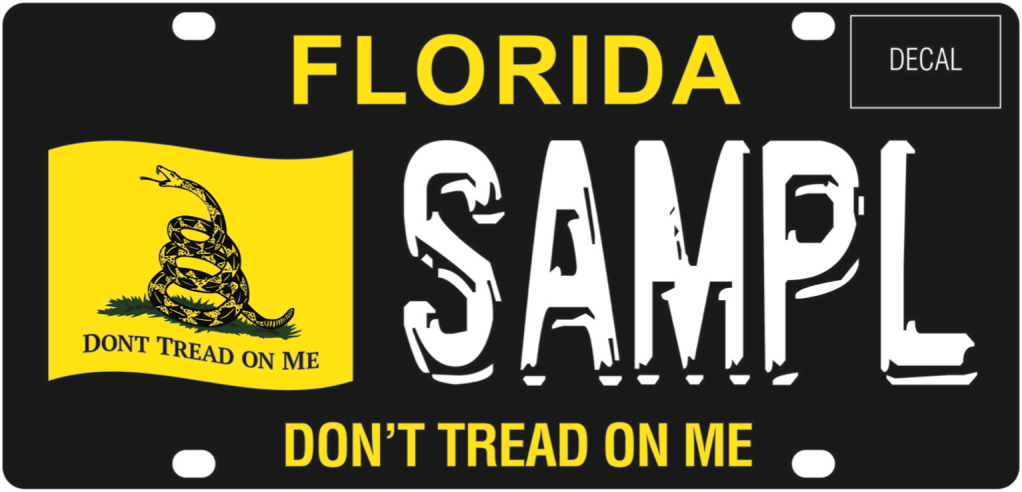
The Legislature did start culling license plates, eliminating those that didn’t sell well. And it implemented a presale process which required the sale of vouchers to people who wanted the plates, with the release of the new plates conditioned on the presale of at least 1,000 vouchers (the law now requires 3,000 presales). But that barely stemmed the tide. In 2008, with more than 100 specialty plate designs approved, lawmakers instituted a partial moratorium on new license plates — and added four more new designs, followed by 10 more over the next two years. A second “no, we’re serious” moratorium was passed in 2014, but by 2020 lawmakers were back at it — creating 12 new plates including one designed around the Gadsden Flag, also known as “Don’t Tread On Me” — a symbol that is increasingly associated with the radical far right.
In 2024, the Legislature approved a “Florida Stands With Israel” plate, though it has yet to get the required number of presales.
The plates authorized in 2026 aren’t nearly as radical. But Florida has picked up a bizarre habit of issuing plates honoring universities in other states (or, well, state: The two chosen so far both commemorate the University of Alabama and Auburn University).
This recent legislation brought yet another wrinkle. The bill DeSantis signed includes license plates supporting the Ultimate Fighting Championship, and, oddly, two historic South Florida high schools. Here’s the problem with that: Florida has dozens, maybe hundreds of high schools that could be considered historic. Do they all get plates?
That should demonstrate how trivial the plate pursuit has become. Florida has more specialty licence plates than any other state, with more than 120 currently in circulation. This proliferation still draws protests from law enforcement.
If Florida lawmakers can’t break themselves of this addiction, they can at least raise the bar for participation —- requiring at least 5,000 or more sales each year to keep a particular plate active. But the better course might be to allow the state to go back to a single, simple plate design — one that avoids the fiscal entanglements and ideological biases of the current program.
The Orlando Sentinel Editorial Board consists of Opinion Editor Krys Fluker, Executive Editor Roger Simmons and Viewpoints Editor Jay Reddick. Use insight@orlandosentinel.com to contact us.