
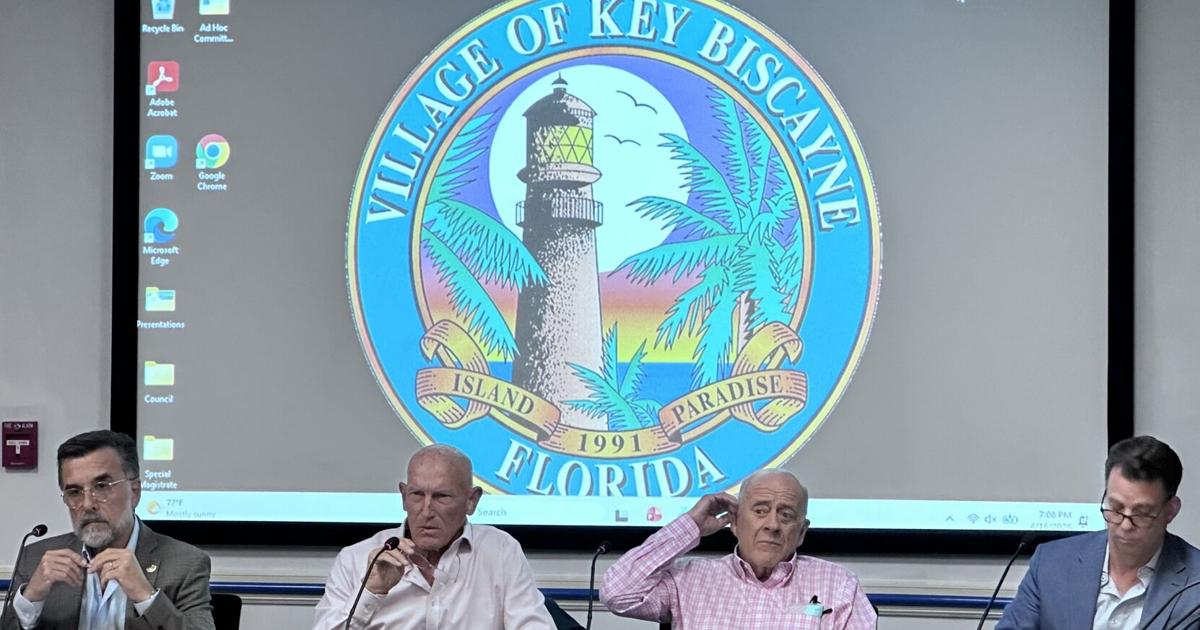
Although it took a dozen months of deliberations, meetings, analysis — and sometimes fireworks – less than 15 minutes were needed Thursday night, when Key Biscayne’s Ad Hoc Committee unanimously recommended an alternative solution to mend the Village’s current stormwater issues while also planning for the future.
“I hope this is a new step in resiliency in South Florida,” said Councilman Fernando Vazquez, who decided to go with GIT Consulting LLC’s way of thinking with a concept that includes an extended-area injection well system that would do less to pollute Biscayne Bay in the long run, as opposed to AECOM’s centralized pumping system that would push excess water directly to the outfalls and into the bay.
Committee Chair Michael Bracken and Councilman Ed London made it a quick 3-0 vote.
Now, that recommendation goes to a full Council vote next Wednesday night (6 p.m., April 22) at a special meeting to seek one more “yes” vote among the other four members, a decision described by some as being perhaps the most important vote since the incorporation of the Village 35 years ago.
Asked by Islander News on Friday if he felt the Ad Hoc Committee served its purpose, London replied: “I think we did. I think we could have done this quicker, but everybody seems to be onboard now and that matters.”
London chuckled when asked if the trio would be getting a front-row seat on the new Village float at the Fourth of July Parade, but did explain that he thought they were the most qualified among the Council members to sit on the committee, selected by Mayor Joe Rasco.
Now, Village officials will sit and wait for a possible final decision.
“We are methodically preparing and looking forward to the important discussion with the full Council (on April 22),” Village Manager Steve Williamson told Islander News. “It’s essential that those not involved in the Ad Hoc Committee get the chance to understand and deliberate the options.”
London: Trees not the ultimate decision
During public comments Thursday night, resident Dr. Josie Valdes-Hurtado asked the committee members when they had first heard that AECOM’s Centralized Plan would remove 565 trees (which actually help soak in excess rainfall) and then be replaced by mostly shade trees, which would take time to grow.
All three said it was the first time they heard that, when Black & Veatch’s Mike Houda provided his comparable analysis during the previous week’s Ad Hoc meeting.
“That should be taken into consideration,” said Hurtado, who was then told that was indeed included in their evaluation.
London said Friday that the elimination of the trees, he felt, was not the deciding factor, but it would have been a big loss to the beauty of the local environment.
“If we had known that earlier, it would have killed the (AECOM) deal a long time ago,” he said.
Back in 2022, the National Arbor Foundation even honored Key Biscayne by bestowing the Tree City USA honor to the Village, the 165th city in Florida to earn that distinction.
Instead, London felt that the tipping point was “When Fernando came around to the environmental thing. When he was the city engineer at Miami Beach, he was against dumping dirty water into the bay; it’s always something he’s been against.”
Thursday night, Vazquez read from a prepared statement, thanking his fellow committee workers for their hard work.
“It was a privilege to serve with you; we debated very hard but collaboratively worked toward a clear understanding (of long-term resiliency and important environmental efforts),” he said, even noting his love of the environment when he was a child.
GIT’s ‘extended’ plan covers more
So, what’s next? A possible decisive Council vote will be on the table on April 22.
If GIT’s concept is accepted, the company’s founder, Giorgio Tachiev, will need to come up with a more detailed hard-nosed design-build plan and the Village will go back to the drawing board to see how to assume the funding for the project (AECOM’s was already in place).
It was unclear if the GIT project would begin in the Garden District (as previously mentioned by Village officials, who were attempting to bury the FPL lines alongside a stormwater project) or simply go full steam ahead with the Zone 1 extended plan to start reducing current flood patterns near the K-8 Center school.
Under GIT’s “extended” plan, 217 acres could be covered by six pumps, as opposed to the standard 93 acres outlined in Zone 1. More accurately, 644 parcels would be covered under the extended plan rather than 311.
“More properties would be served and, eventually, lower costs per acre, or per person,” would result, Tachiev told Council members earlier this month. “In Zone 1, ‘extended’ is the preferred value alternative because it expands the drainage benefit using the same core six-node service.”
His cost estimate for Zone 1, as currently configured, would be: $45.758 million for the 93 acres and $58.592 million if extended to the larger boundary. Those come with estimated annual operational and maintenance costs of $943,798 and $1,049,153, respectively, to eliminate sediment, etc. that has been filtered in to maintain the system in peak condition.
The cost per acre served would be $516,930 under GIT’s regular plan, but dips to $270,012 an acre in the extended plan. Similarly, the cost per parcel served would be $154,580 to stay in Zone 1, while expanding the effort would result in $90,982 per parcel.
Black & Veatch’s cost review, however, for Zone 1 (as currently configured) is $50,910,497 with an accepted range of $25,455,248 all the way up to $101,820,994.
On the other hand, AECOM’s costs for its centralized system of new stormwater pipes, pumps and a backup generator was estimated at $66,783,265, plus FPL and water and sewer lines for the entire undergrounding project in Zone 1 adding up to $81,052,129 (with a -3% to 15% accuracy). AECOM’s estimated annual maintenance was $554,789.
GIT’s drainage capacity is designed to eliminate 90 cfs (cubic feet per second) of water at ideal conditions. It allows emergency vehicles to pass through and enough road clearance through the 2050 time horizon, for a 5-year storm and slightly lower sea level rise prediction.
The distributed type of capture in GIT’s concept means water is handled closer to where it falls, which often reduces localized flooding faster.
Tachiev’s system also can be done in phases to see if the downhill gradients are effective.
GIT’s proposal shows a significant reduction of direct discharge of stormwater to Biscayne Bay, according to Houda’s analysis. Tachiev said in this type of discharge, it would take maybe 20-30 years to reach the bay.
The chances are “remote” if that water, flowing horizontally after being injected 120 feet down, even makes it as far as the bay, London said Friday.
Water will be pre-treated at each well to reduce contaminants from seeping into the aquifer. GIT’s method will impact mostly just the local landscaping at the pump station locations and not the barrage of lost mature trees.
When loud grumblings from residents resulted after AECOM initially listed its estimated costs for the Zone 1 project, Mayor Rasco decided in mid-February of 2025 to put an Ad Hoc Committee in place to try and find a better — and, hopefully, less expensive — alternative.
A month later, when speaking to the Rotary Club of Key Biscayne, Councilman London highlighted that the Village had spent $6.3 million with AECOM and another $2 million with Black & Veatch as a consultant.
“This could be an $8.3 million mistake,” London warned then.
London told Islander News on Friday that, looking back, “it was a mistake, that’s how I feel about it; (but it was) a learning experience.” He also wished the Village would have stopped adding money to that plan at some point, something he argued time and again.
Some of that money, at least, can be used from the surveying studies, he said.
GIT’s analysis, a contract signed in October 2025, was approved at a cost not to exceed $240,810.