
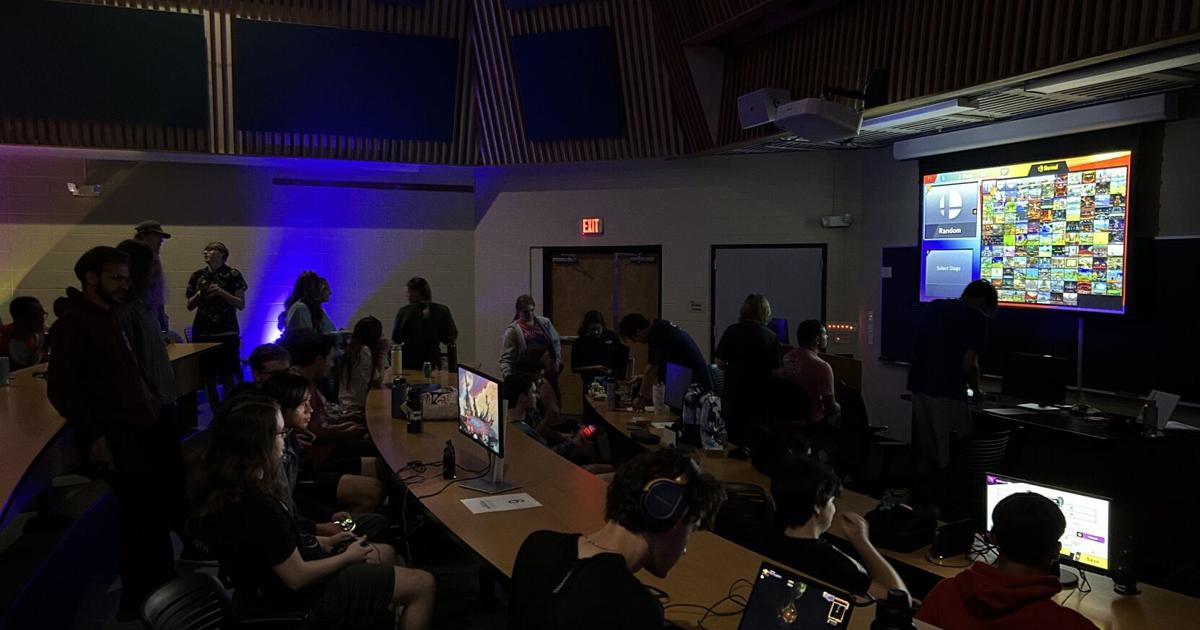
Eckerd College’s first esports tournament drew more than 60 attendees in ES100 on March 27, signaling strong interest in competitive gaming and its potential on campus.
Hosted by Campus Recreation and the Eckerd Video Game Club, the event featured a competitive “Super Smash Bros. Ultimate” bracket and brought together both experienced players and casual participants. The turnout exceeded expectations and created a high-energy environment that stood out to those involved.
“It was definitely a larger thing than I was expecting,” said Aiden Valkema, a senior in marine science.
Despite the competitive format, participants emphasized the inclusive nature of the event.
“There’s no bad feelings or anything about losing,” said Joshua Imig, a senior in marine science. “Everyone’s really cool.”
That balance between competition and accessibility was central to the event’s success. For organizers, the goal was to create a space that appealed to a wide range of students.
“We wanted it to be as inclusive and as accommodating as possible,” said Jack Dias, student engagement and programming specialist. “But also have that competitive edge.”
The tournament was developed in collaboration with the Video Game Club, which played a key role in organizing and running the bracket system. Joel Andersen, senior in humanities and co-president of the club, said the event helped expand the club’s reach.
“We could elevate our events and involve more people,” Andersen said. “Seeing the crowd and people getting excited, especially during the final matches, was amazing.”
The strong turnout and engagement have added momentum to ongoing discussions about esports at Eckerd. While the college does not currently offer esports as a varsity or club sport under the Athletics department, the idea has been under consideration for several years.
“Eight or nine of our conference schools have esports in some form,” said Tom Ryan, director of Athletics. “So it’s been something we’ve talked about.”
Ryan said interest from students is a key factor in evaluating whether esports could become a formal program. Events like this provide tangible evidence that demand exists on campus.
“I think there’s a market for esports,” Ryan said. “It could attract students to Eckerd.”
However, significant challenges remain. Ryan noted that space and cost are the primary barriers to implementation. Establishing a program would require a dedicated facility, specialized equipment and additional staffing.
“You can’t just put it in a classroom,” Ryan said. “It has to be built the right way.”
Startup costs for equipment alone could reach around $90,000, with further investment needed to create a competitive environment comparable to other schools. In addition, limited campus space makes it difficult to allocate a permanent location without impacting existing academic facilities.
Andersen said a formal program could eventually expand beyond campus, giving students opportunities to compete in larger settings.
“We could have people train and go out to different venues and see where esports exists beyond Eckerd,” Andersen said.
Even with those constraints, the success of the tournament has shifted esports from a conceptual idea to a visible area of student interest. For organizers, this event serves as a starting point.
“This was more of a trial,” Dias said. “We’ll take what we learned and build from there.”
With strong attendance and continued conversations at both the student and administrative levels, esports is beginning to establish a presence at Eckerd—one that could expand in the years ahead.