
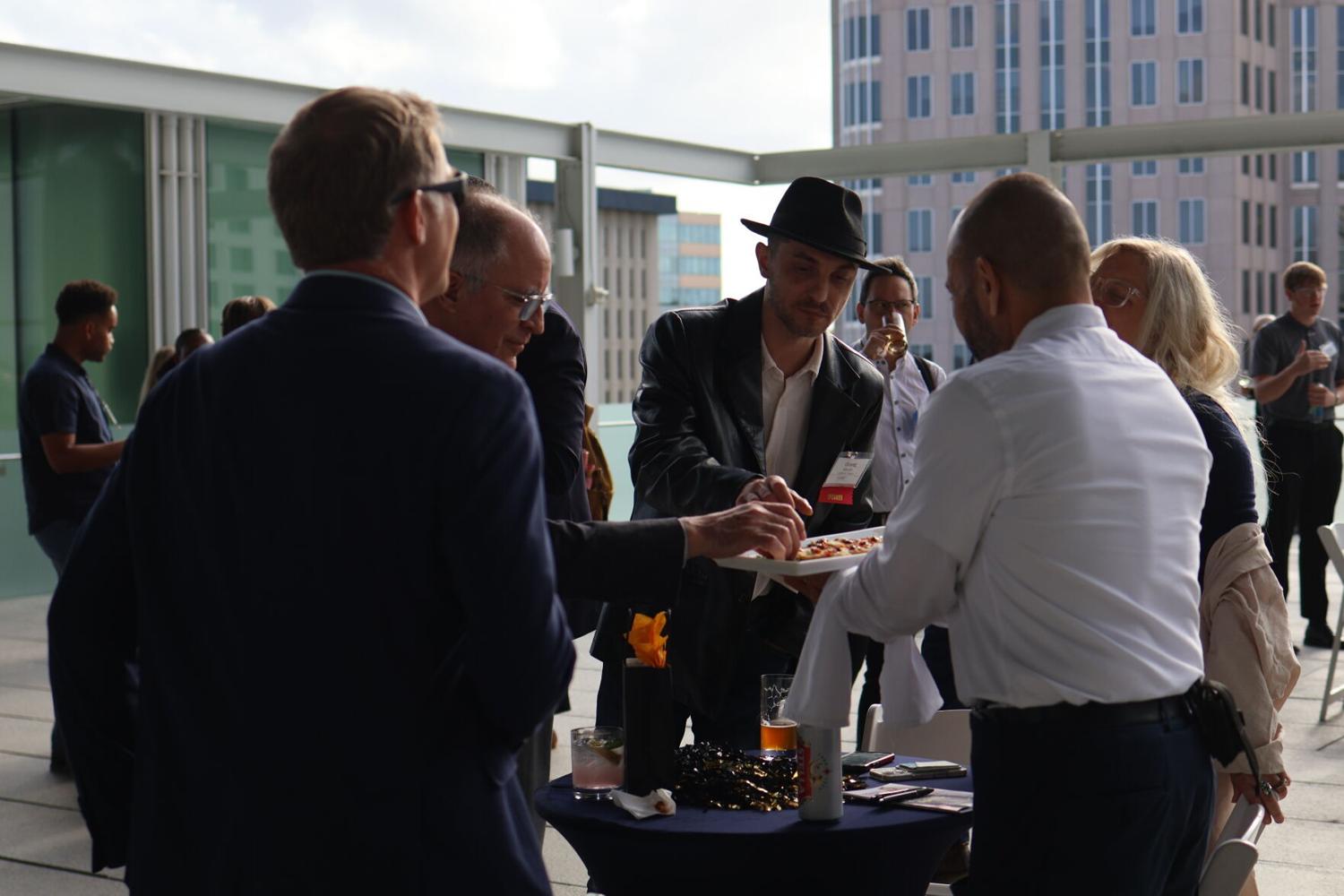

Grant Blaisdell, co-founder of Copernic Space, enjoys the open bar and complimentary appetizers served by the Dr. Phillips Center during the terrace reception after the FinTech Summit 2026 on April 10th.
Anne McGrath
Students and event speakers exited a third-floor elevator, greeted by a table lined with printed name tags at UCF’s FinTech 2026 Summit — a professional networking event that welcomed about 120 attendees.
The event, hosted by the College of Business in collaboration with the VoLo Foundation, promoted the finance and technology, or FinTech, master’s degree program April 10 at the Dr. Phillips Center for the Performing Arts.
This year’s summit included keynote speakers and panel guests from a variety of STEM and finance backgrounds, as well as a networking reception following the event atop the center’s rooftop terrace.
“Some events leave you with more questions than answers in the best possible way,” Michael Azzi, a FinTech master’s student and intern at Equifax, said in a LinkedIn post. “Being a student at this moment in financial history feels like a genuine privilege. The opportunity ahead of us is enormous.”
Azzi attended the event in hopes of furthering the pursuits of his career and to support his classmate Daria Krainova, one of the keynote speakers.
The master’s FinTech degree program forges a new path in interdisciplinary education and contributes to research, specifically in finance, computer science and management, to teach the skills needed for the growing industry, according to the College of Business.
On Tuesday, the College of Business received its largest-to-date philanthropic commitment in history, with a single donation of $50 million being invested into UCF’s new Barry S. Miller College of Business.
The investment will support a multiphase strategy designed to position UCF as the destination for business and technology education, including furthering the future of the FinTech master’s program, according to UCF Today.
The summit’s main event schedule covered several topics, including but not limited to artificial intelligence in academic research, the decentralization of finance, human intuition and intent in programming and the tokenization of consumer assets within the space economy.
The event’s first panel of the day was a moderated discussion by assistant professor of business finance Yafei Zhang, following the reinvention of financial services and the current state of the FinTech program at UCF.
Alejandro Rodriguez, FinTech master’s 2025 graduate, spoke alongside fellow panelists, describing the current and future integration of AI in the workplace. Rodriguez was a graduate teaching assistant for the College of Business and specializes in the programming language Python and data visualization tools like Matplotlib, according to his LinkedIn.
“The average person is not engaging with AI,” Rodriguez said. “Therefore, they are falling behind: You have to engage with it as soon as possible, because if not, the knowledge gap will get further and further away.”
Matt Cannon, vice president of enterprise AI for Fairwinds Credit Union, discussed the subtle integration of AI in the future for helping people accomplish tedious and unnecessary tasks. Cannon, a Certified Information Systems Security Professional in the College of Business, specializes in developing network infrastructure and large AI language models for different organizations.
Knightro made an appearance during the social networking reception after the FinTech Summit 2026 at 5:30 p.m. atop the Dr. Phillips Center’s terrace and posed with students, keynote speakers and other event attendees.
Anne McGrath
“[AI] is kind of like electricity or plumbing,” Cannon said. “When it disappears, that’s when you know it was there. It’s leading towards a future where it will be in the background of our everyday lives.”
Liam Hudson, senior business finance major, attended the summit with classmates and discussed becoming involved with the FinTech program after his expected Fall 2026 graduation.
“I have a data science internship this summer with the Bank of New York Mellon Corporation, and I’m looking forward to that,” Hudson said. “As a finance major, it’s kind of unconventional to have that kind of opportunity; It’s my first stepping stone into the FinTech space.”
Grant Blaisdell, co-founder and chief executive of Copernic Space, returned to the summit this year to discuss tokenization and blockchain monetization of assets in outer space as a third-generation space entrepreneur.
Copernic Space is an internet marketplace platform that allows consumers to invest and view space as an asset instead of as an out-of-reach frontier, according to the company’s LinkedIn.
“Most people do not understand the space market for what it actually is,” Blaisdell said. “[Space] is a $600 billion market already, and 78% of that is commercial…we’re building an infrastructure to work in a democratized public market.”
Following the conclusion of the summit’s main events, a social networking reception was held atop the center’s rooftop terrace, boasting an open bar and complimentary appetizers.
“[The summit] definitely exceeded what I thought I was going to get out of it,” Hudson said. “I thought it was very cool, just the sheer qualification and prestige that was in the room with how much knowledge was being imparted.”