
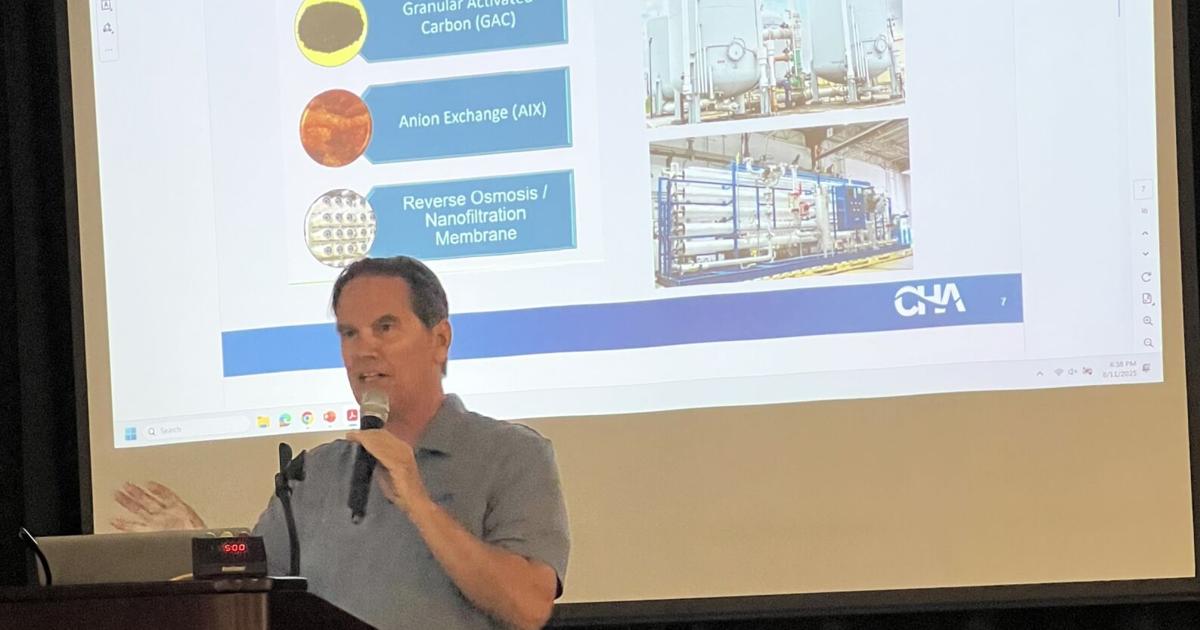
TEMPLE TERRACE — Residents could finally get answers next month to questions about the city’s water that have lingered for nearly a year.
According to City Manager Carlos Baia, a presentation is planned for the May 19 City Council meeting that will reveal the long-awaited report by CHA Consulting on the city’s water study and how to address the issue of PFAS chemicals in the drinking water.
That meeting will be followed by a tentatively scheduled town hall the following week on May 26.
CHA Consulting was hired to do a study on the city’s water supply last summer, after it was discovered that the city’s levels of PFAS and PFOA — “forever chemicals” that resist breaking down — exceeded the limits established by the Environmental Protection Agency in 2024 and going into effect in 2031.
PFAS are manmade chemicals found in a variety of products like nonstick cookware, microwave popcorn bags and fast food wrappers. They have been used in products since the 1940s, are tough to remove and are linked to health effects like cancer.
Temple Terrace is just one of hundreds of cities looking for PFAS solutions. The widespread issue has also prompted dozens of lawsuits across the country against manufacturers like 3M and DuPont, the largest users of the synthetic chemicals.
According to a University of Florida study, researchers discovered the presence of PFAS in more than 60% of the freshwater springs in Florida that it sampled.
“Most of the contaminants in the processed material are dumped back into our waterways,” said John A. Bowden, a trained chemist and professor at UF. “If our drinking water comes from these sources, it will often contain PFAS. What should be alarming for all Floridians is that in the springs, which are often destined for use as drinking water, PFAS are present.”
Temple Terrace revealed high levels of PFAS in March 2025, creating health concerns among residents. CHA Consulting, which was already working on a water and sewer plan for the city, was tasked with expanding those efforts to confront the PFAS dilemma.
“The good news is we have relatively low levels, and it is treatable,” CHA Consulting project manager Ed Talton told a large crowd at a town hall last August. “The bad news is, it is not cheap to treat.”
Residents could get a look at that bill next month.