
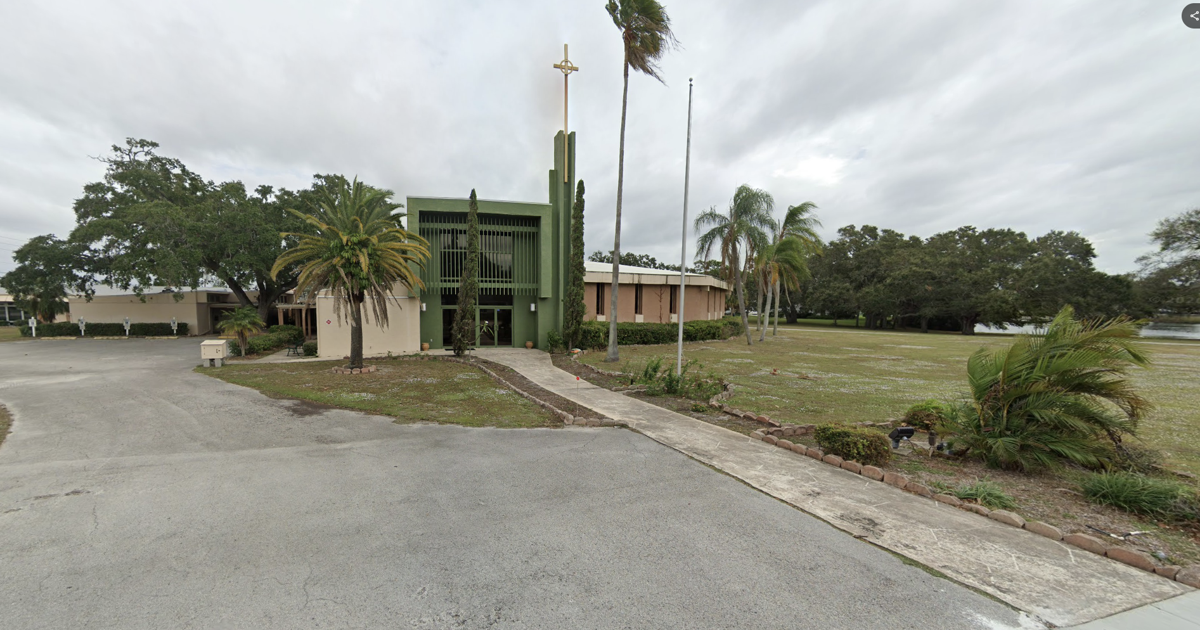
SEMINOLE — Habitat for Humanity wants to tear down the aging Lake Seminole Presbyterian Church and replace it with a smaller house of worship and 18 affordable cottages for residents 55 and older.
The Seminole City Council gave unanimous consensus April 14 to authorize City Manager Ann Toney-Deal to negotiate a development agreement for the project at 11250 86th Ave., a 3.82-acre site at the corner of 86th Avenue and 113th Street on the city’s western border.
The arrangement is essentially a land swap. Habitat for Humanity Tampa Bay Gulfside would demolish the church’s two existing buildings, constructed in 1964 and 1965, and build a new 4,600-square-foot church on a 1.4-acre lot. In exchange, the church would donate the remaining 2.4 acres to Habitat for construction of the cottages.
It is the first time Habitat has structured a project as a land swap with a church, said Mike Sutton, president and CEO of Habitat Tampa Bay Gulfside, calling it a unique partnership that we hope to replicate.”
“This is about probably three years in the making of building a relationship with our friends at Lake Seminole Presbyterian,” Sutton said. “There’s some synergy between the two organizations, and we really feel like we can help them accomplish their goal of a new worship center and also be able to provide some affordable homeownership opportunities for 55-plus residents here in the city of Seminole.”
The cottages would be spread across seven buildings — four triplexes and three duplexes — with two-bedroom units of roughly 1,050 square feet each. Residents would own their units under a zero-percent interest Habitat mortgage with no down payment, paying approximately $850 a month plus taxes and insurance. A homeowners association would manage common areas and exterior maintenance.
The project is currently funded through private donations and Habitat’s business model, in which completed mortgage notes are sold to partner banks to fund the next round of construction. Sutton said the organization may evaluate the need to pursue government subsidies later but none are involved at this stage.
The property is zoned public/semi-public, which permits residential development as a conditional use at up to 12.5 units per acre. The proposed density of 7.5 units per acre is well below that ceiling and significantly lower than the neighboring Seminole Garden Apartments, the large 55-and-older co-op complex immediately to the east.
Community Development Director Wesley Wright told the council the development agreement is needed because the church is requesting 80 parking spaces — 19 more than the 61 required by code. The residential component could have proceeded through a standard conditional use permit on its own, Wright said, but the combination of requests makes the development agreement the appropriate path.
“Does the city want to negotiate with Habitat for Humanity and work with High Point Engineering to discuss this development agreement to allow for more parking than what’s required and to allow for a residential component to the church project?” Wright said in framing the question for council.
Florida’s “Yes in God’s Backyard” law, passed last year as part of Senate Bill 1730, gives cities the option to approve affordable housing on church-owned land regardless of zoning. But the city of Seminole has not adopted the provision. Sutton said the project would qualify regardless because Habitat’s homeownership model requires conveying individual lots to buyers, which is incompatible with the church retaining land ownership as the law envisions.
Kody Glazer, chief legal and policy director at the Florida Housing Coalition, said the statute could have applied if the deal had been structured differently, such as through a ground lease, but noted that only three local governments in Florida have adopted the optional provision so far.
The Rev. Stephanie Maddox-Hill, who became the church’s part-time pastor three years ago, said the congregation closed the main sanctuary two years ago and moved services into the original fellowship hall. Average Sunday attendance runs about 55, up from 30 when she arrived.
“Anybody who has driven past the church knows that that church is rough,” Maddox-Hill said. “It came down to, do we spend a whole bunch of money on this building, or do we use our money to continue doing the mission of the church?”
She said the church is financially secure and plans to maintain the new building for the long term. The congregation looked at several options before settling on the Habitat partnership.
“They started thinking, how can we use this land in a way that fits in with the ministry and the mission of this congregation?” she said.
The church building is used heavily beyond Sunday services, housing Meals on Wheels, a theater group, two homeless ministries and Girl Scout troops. Maddox-Hill said she hopes the congregation can remain in the current fellowship hall while the new church is built.
Sutton said Habitat hopes to begin construction on the church by Jan. 1, 2027, with the timeline dependent on completing the development agreement with the city. Habitat would not release estimated construction costs or a projected purchase price for the cottage units, saying those details would be worked out during negotiations.
Sutton said Habitat would conduct targeted recruitment within the church congregation and the city of Seminole before opening applications more broadly across Pinellas County. Buyers must earn between 30 and 80% of the area median income — up to about $84,000 a year for a family of four.
He said Habitat operates on a roughly $40 million budget with more than 70 staff members and built 91 homes last year. The organization has completed more than 1,050 homes across its service area covering Pinellas, western Pasco and Hernando counties. It has had seven foreclosures in its history and just one in the last 15 years.
“The misconception is that Habitat builds homes, gives them away, and the folks that are receiving the homes are unemployed or not contributing to the tax base,” Sutton said. “That couldn’t be further from the truth.”
About half the families currently in the Habitat pipeline work in health care, he said, and the organization is also serving about 15 school teachers and a number of public service employees.
Vice Mayor Chris Burke pressed Sutton on how the 55-and-older restriction would be enforced, noting the council had been “burned before when people promised us only veterans would live somewhere and then poof, it wasn’t only veterans anymore.”
Sutton said the property would carry a deed restriction and buyers would be required to homestead the unit. He acknowledged Habitat would not serve as a landlord and that day-to-day enforcement would fall to the HOA. Habitat would maintain a nonvoting seat on the HOA board for the first five years to provide guidance, he said.
Toney-Deal said she would ask the city attorney’s office to examine whether additional enforcement provisions could be written into the development agreement.
Council member Al Shields asked whether Habitat or the church had spoken with residents of Seminole Garden Apartments about the project. Sutton said they had not.
“It would probably be a good idea,” Shields said. “Good neighbor kind of thing. Take care of the objections before it comes.”
Sutton said Habitat’s team would be reaching out to the complex soon.
Wright said the next step would be two public hearings, scheduled roughly 30 days apart after negotiations with Habitat are concluded. All property owners within 300 feet will receive mailed notice as required by the land development code.
He noted that about 40% of the units in Seminole Garden Apartments are homesteaded, meaning many of the complex’s actual residents are tenants who would not receive formal notice. As of last week, Wright said the city had not received any public comment or inquiries about the project since the workshop.
Toney-Deal said she was not concerned about word getting out.
“Trust me, everybody will know,” she said. “They have a wonderful community newsletter.”
The new church would be built by commercial contractors. Habitat would build the cottages using its standard model of volunteers and homeowner participation.
The project was designed by Tampa-based High Point Engineering, led by principal engineer Braulio Grajales. The landscape plan by Dark Moss of Tampa calls for heavy native plantings including live oaks, slash pines, bald cypress and silver buttonwood.
The site includes a 25-foot wetland buffer along the southern boundary and two stormwater detention ponds shared by both lots. The property sits in FEMA flood zone X, which carries no special flood hazard designation. Wright said the project would require a tree assessment of the approximately 71 trees on the heavily wooded site, with potential tree mitigation costs depending on how many are removed.