
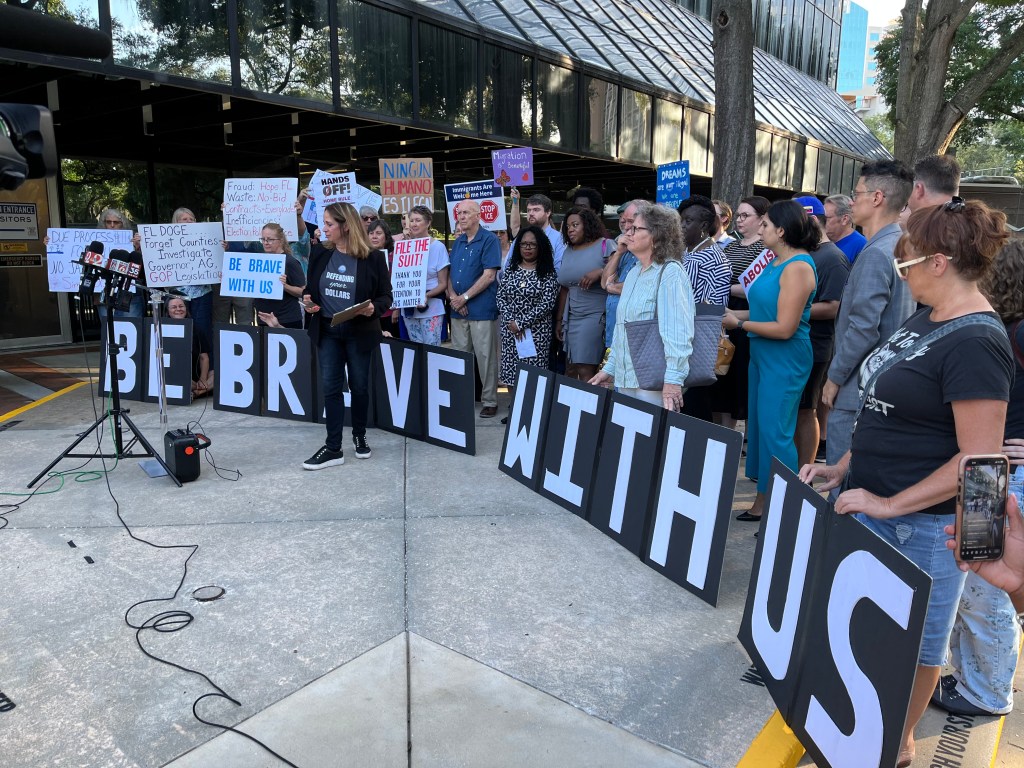
Orange County commissioners unanimously decided Tuesday to further restrict Immigration and Customs Enforcement’s use of the Orange County jail – likely restricting the number of people detained there without criminal charges and also shortening their stay.
The decision drew cheers and applause from advocates, who had been calling for the action for roughly a year.
However, the vote doesn’t kick ICE out of the jail altogether – Florida law still requires all county jails to have a detention agreement with the federal agency. But commissioners said there is another, more limited deal to strike with ICE, and it is the superior one.
“We’re rectifying some of the financial ills that have occurred to our community and appease as best we can some of the requests that have been coming here for the last year,” said Commissioner Kelly Martinez Semrad.
The county’s existing agreement with the federal government allows any federal law enforcement agency to house inmates at the jail. That includes people arrested on all kinds of criminal charges as they await trial at the federal courthouse in Downtown Orlando, ranging from money laundering to possession of child pornography to drug trafficking and murder. That arrangement has been in place since the 1980s.
In 2011, the agreement was amended to include ICE.
Now the county intends to remove ICE from the deal, while still allowing other law enforcement agencies to continue to use the 33rd Street facility. That Intergovernmental Support Agreement, or IGSA, calls for detainees and inmates to be held for up to 72 hours after local criminal charges are resolved, and for the county to be reimbursed at $88 per day.
Since August, the county has been renegotiating that rate, which it claims is far less than the cost of holding an immigrant detainee. It is expected to be increased to $125 per day, still below the county’s $180 goal.
But as the county removes ICE from the IGSA, it will need to simultaneously enter into a Basic Ordering Agreement with the agency to comply with Florida law. Under that document, ICE can house a detainee for up to 48 hours, 24 hours less than current practice. The new agreement comes with a smaller federal reimbursement at $50 per detainee, but also includes as much as $150 per detainee from a state grant.
Under the IGSA, the county hasn’t been willing to release a detainee if their 72-hour clock expires without a court order. Under the BOA, the agreement states a person can be released after 48 hours if ICE hasn’t either picked them up or filed a form in court to extend their stay.
“Services end when ICE personnel remove the individual, issue a new Form I-203, or after 48 hours of detention, whichever comes first,” it reads.
Commissioner Nicole Wilson said the decision – which she voted in favor of – doesn’t go as far as she’d like, but she said it was the closest option presented to her goals.
“I want ICE out of Orange County, I want them out of our jail, I want them out of our neighborhoods,” she said.
But County Attorney Jeff Newton advised board members that running afoul of state law regarding cooperation with ICE could result in swift removal by the governor.
Roughly 50 speakers called on county commissioners to end its IGSA with ICE for a host of reasons, including that it’s led to some detainees being held on 33rd Street without criminal charges. The BOA gives the county authority to refuse to hold immigrant detainees without criminal charges.
In board discussions last March, county attorneys told commissioners that under the IGSA agreement, if ICE didn’t pick up a detainee within 72 hours after their criminal charges were settled, that they would be released. But months later, attorneys said the county didn’t actually have the authority to do so without a court order because a detainee was considered a federal inmate.
“They went from assuring you that the county wouldn’t hold someone from beyond 72 hours, to now saying they cannot release individuals after 72 hours and they may hold people for indefinite periods of time because they’re not sure what their obligations are under state law,” said Ella Wood, an organizer with the hotel and restaurant workers union Unite Here.
Former State Sen. Victor Torres, seeking a seat on the board in this year’s election, said prior surges of detainees have strained county resources and medical personnel in the jail.
“When are we going to stop this abuse? It’s like a revolving door,” he said. “Today is your day. Stand up and fight back.”
Moments before the vote, Commissioner Mike Scott said he thought the path was clear.
“You’ve had folks miss their boyfriends, girlfriends, husbands, wives, brothers and sisters, people they love,” he said. “A lot of folks will say ‘alien or immigrant,’ but at the end of the day, they’re a family member of a neighbor. I’m happy we got to this point.”