
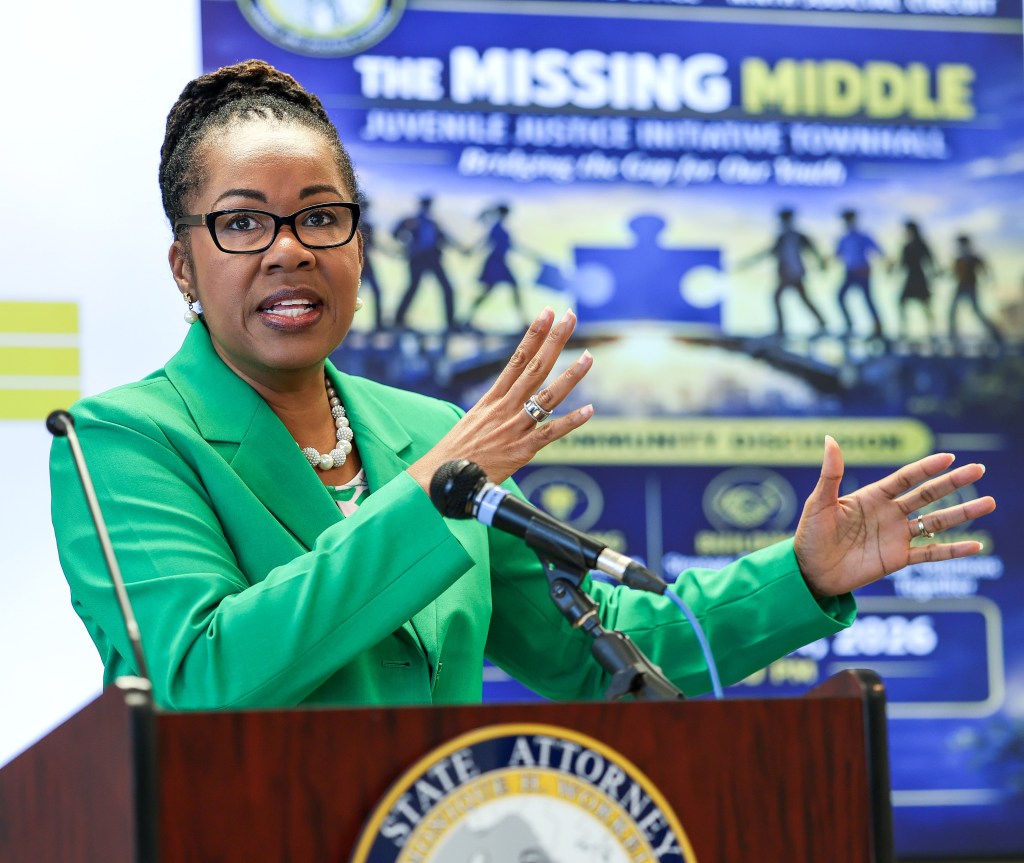
A new task force to tackle youth violence was announced Tuesday by Orange-Osceola State Attorney Monique Worrell amid recent cases involving teens accused of deadly incidents.
Called “The Missing Middle,” the task force will be comprised of law enforcement, school officials, prosecutors and community advocates working in neighborhoods hardest hit by youth violence, Worrell told reporters.
It comes after what she called in an uptick in youth violence in Orange and Osceola counties as well as across the state. Recent arrests of teens in her circuit include a 16-year-old charged as an adult after allegedly shooting another teen in the head near downtown Orlando and another teen charged with killing a woman babysitting a child in west Orlando.
The task force’s mission will be to explore legislative solutions as well as community programming for at-risk youth.
“We are going to where they are to meet them, so we can deal with them before they get to me,” Worrell said. “By the time they get to me, it’s generally too late, and now I have to make a decision.”
Over the last 15 years, Worrell said felony cases involving youth suspects have not dropped as steeply as the overall number of cases. About 1,000 such felonies were forwarded to the State Attorney’s Office in 2025 compared to 1,300 in 2010, a much smaller drop than the 61% decrease in total felonies.
In addition, while youth felony arrests in the Ninth Judicial Circuit in Orange and Osceola dropped last year compared to the one before, it also saw a 20% increase in cases involving murder and attempted murder, according to the latest data published to a Florida Department of Juvenile Justice dashboard.
The Missing Middle initiative comes from what Worrell and others believe is a gap between how youth offenders are handled in the juvenile justice system versus the adult prisons, where the focus is more on incarceration rather than rehabilitation.
When deciding how to charge a young offender, Worrell says her prosecutors are “presented a difficult choice between two inadequate options.”
“If rehabilitation isn’t a goal and we send them away for 10, 15, 20 or 25 years, they’re still coming home and they’re going to be pretty young when they get back into our community,” she said. “What is that going to look like when the prison has raised them? These are the problems that I’m our task force will find solutions to.”
Worrell has made violent crimes, especially by youth, a cornerstone of her second term as state attorney, launching early on what’s known as the “Your Future, Your Choice” initiative, which educates teens on the criminal justice system while offering summer internships to high schoolers. Fifty students took part in the internship last year, she said, with another 70 applications awaiting review for this summer.