
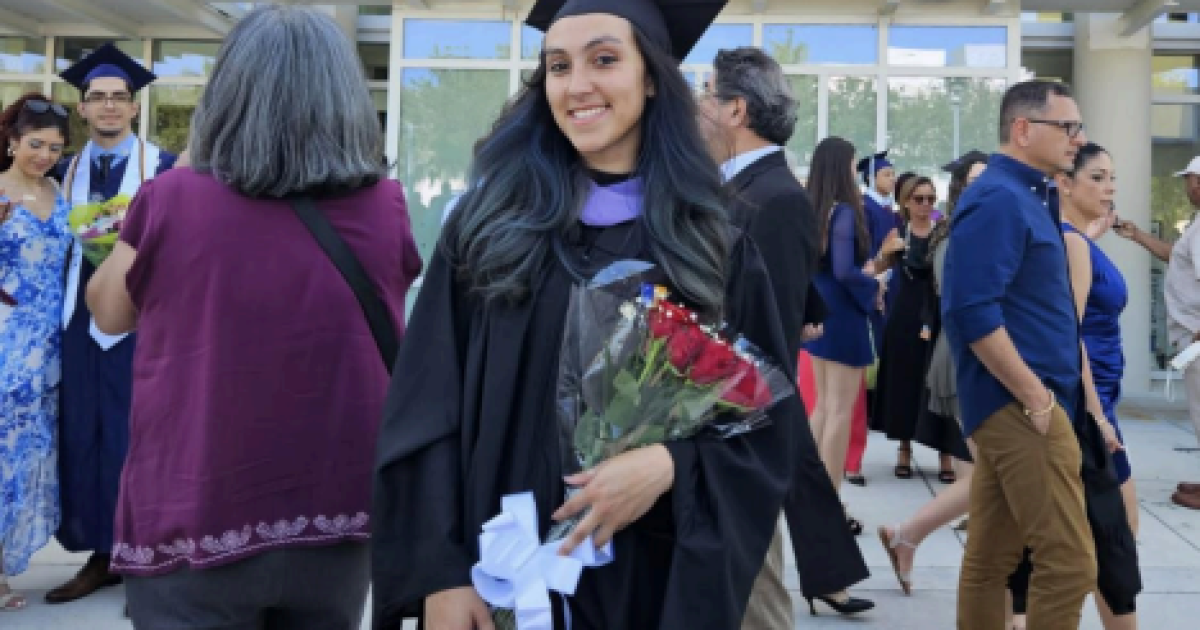
After earning her master’s degree in architecture from Florida International University in 2025, Alexandra Lacayo expected the next step to be clear: apply, interview, and begin her career. Instead, she found herself stuck in a cycle of applications and silence.
“I have definitely applied to over 50 jobs, and approximately only five have gotten back to me,” she said. “I knew it was a competitive field, but I figured I would at least get responses from companies… I wasn’t expecting to never hear anything back.”
In some cases, the silence turned into something worse. “I never expected the lack of professionalism,” she said. “I was even ghosted by a firm.”
Now, Lacayo works part-time as a counselor at Kid’s Architecture Program, and offers tutoring sessions to current architectural students. But at age 24, she remains living with her parents, unable to afford her own place.
Her situation reflects a frustrating contradiction. After being told she is “too qualified” for roles at places like Home Depot and Starbucks, she is still unable to secure a full-time position in her field.
“It feels impossible,” she said. “I’m somehow both overqualified and underqualified at the same time.”
Her experience is a clear example of what many young job seekers describe as the “experience trap,” where entry-level roles require prior experience, but gaining that experience is difficult without being hired. The result is a cycle in which candidates meet educational requirements but are repeatedly passed over for lacking hands-on experience.
Lacayo’s story also highlights a broader shift in the labor market that statistics alone do not fully capture.
National unemployment remains just above 4%, but young workers face higher rates, around 5.7%, according to the Federal Reserve Bank of New York. At the same time, 42.5% of recent graduates are underemployed, working in positions that do not require a college degree.
Unemployment refers to individuals actively seeking work but are unable to find it. Underemployment, however, captures a more subtle reality, where graduates are employed, but not in roles that match their education or earning potential. For many, like Lacayo, the issue is not whether they can find work, but whether they can find the right work.
Even locally, Miami-Dade County reported a 2.5% unemployment rate in December 2025, but those numbers mask how difficult it can be to break into professional fields for the first time.
According to David Andolfatto, Chair of the Economics Department at the Miami Herbert Business School at the University of Miami, the issue is not a lack of jobs, but how the market is functioning.
“If the labor market is tight, employers can afford to be more selective,” he said.
He explains that broader economic factors, including policy uncertainty, tariffs, and even the housing market, influence hiring decisions. When companies face rising costs or unclear economic conditions, they often slow hiring or prioritize candidates who can contribute immediately.
“There’s always going to be some mismatch between the skills employers are looking for and the skills workers have,” Andolfatto said, noting that recent graduates often experience that gap most directly.
As the labor market becomes more selective, the burden increasingly shifts to candidates to stand out earlier and more strategically.
Ruth Pacheco, executive director for integrated partnerships and career readiness at FIU, says expectations for students have shifted significantly in recent years, particularly when it comes to experience.
She explained that employers are now placing far greater emphasis on hands-on involvement and a candidate’s ability to connect those experiences to the role.
“What’s shifted is that students didn’t have to rely as much on these experiences before, and now employers are very interested in those who are doing internships, volunteering, or undergraduate research, and who can articulate how those experiences help them stand out and align with employer needs.”
Pacheco also noted that the hiring process itself has changed, with many candidates being evaluated long before a recruiter reviews their application. Many companies now use applicant tracking systems (ATS), a form of AI-driven software that scans resumes for keywords and qualifications before determining whether an application moves forward.
She pointed to the importance of tailoring applications to meet employer expectations from the outset.
“Whatever students can do to align their application with that job description— how can you tell your story in a way that the employer can see it in 5–6 seconds?”
Pacheco also encourages applicants to use AI tools as a resource when building resumes and preparing applications, particularly to help refine language and better align with job descriptions, while still ensuring the final product reflects their own voice and experience.
To help students and alumni adapt, FIU has expanded access to career resources, including workshops, employer events, and networking opportunities.
Pacheco emphasized that repetition and exposure are key to building confidence and connections.
For Lacayo, these expectations collide with both financial reality and family pressure.
Living at home provides stability, but it also carries an unspoken weight tied to the time, effort, and money invested in her education.
“I would like to take a job that is related to my field,” she said, “but at this rate, I’m open to anything.”
Her father, Martin Lacayo, sees that tension up close. As both a parent and a professional who completes hiring processes within his role as a senior director at Visa, he views the situation through both a personal and employer lens.
“We didn’t pay $80,000 [college tuition] for her to go work at Burger King,” he said.
For him, the statement reflects a clear expectation that higher education should translate into career opportunities within a chosen field. From his perspective, the jobs exist, but candidates must position themselves competitively to secure them, particularly in a market where employers are selective about whom they bring in.
“Your presence, your energy… that’s what stands out,” he said. “The rest you can learn.” Still, experts emphasize that this is not simply a matter of effort or mindset.
The transition from college to career has become more complex, shaped by economic uncertainty, evolving hiring practices, and increased competition. Graduates are navigating a system where education is only one piece of a much larger equation.
For Lacayo, that reality is still unfolding.
She continues applying, adjusting, and searching for an opportunity that matches the effort she has already invested.
“I knew it was competitive,” she said. “I just didn’t expect it to be this hard.”
In a job market that demands more, earlier, and often without clear direction, her experience reflects a generation learning to navigate not just how to find work, but how to build a path where one is no longer clearly defined.
The story was originally published by Caplin News, a publication of FIU’s Lee Caplin School of Journalism & Media, as part of an editorial content partnership with the WLRN newsroom.