
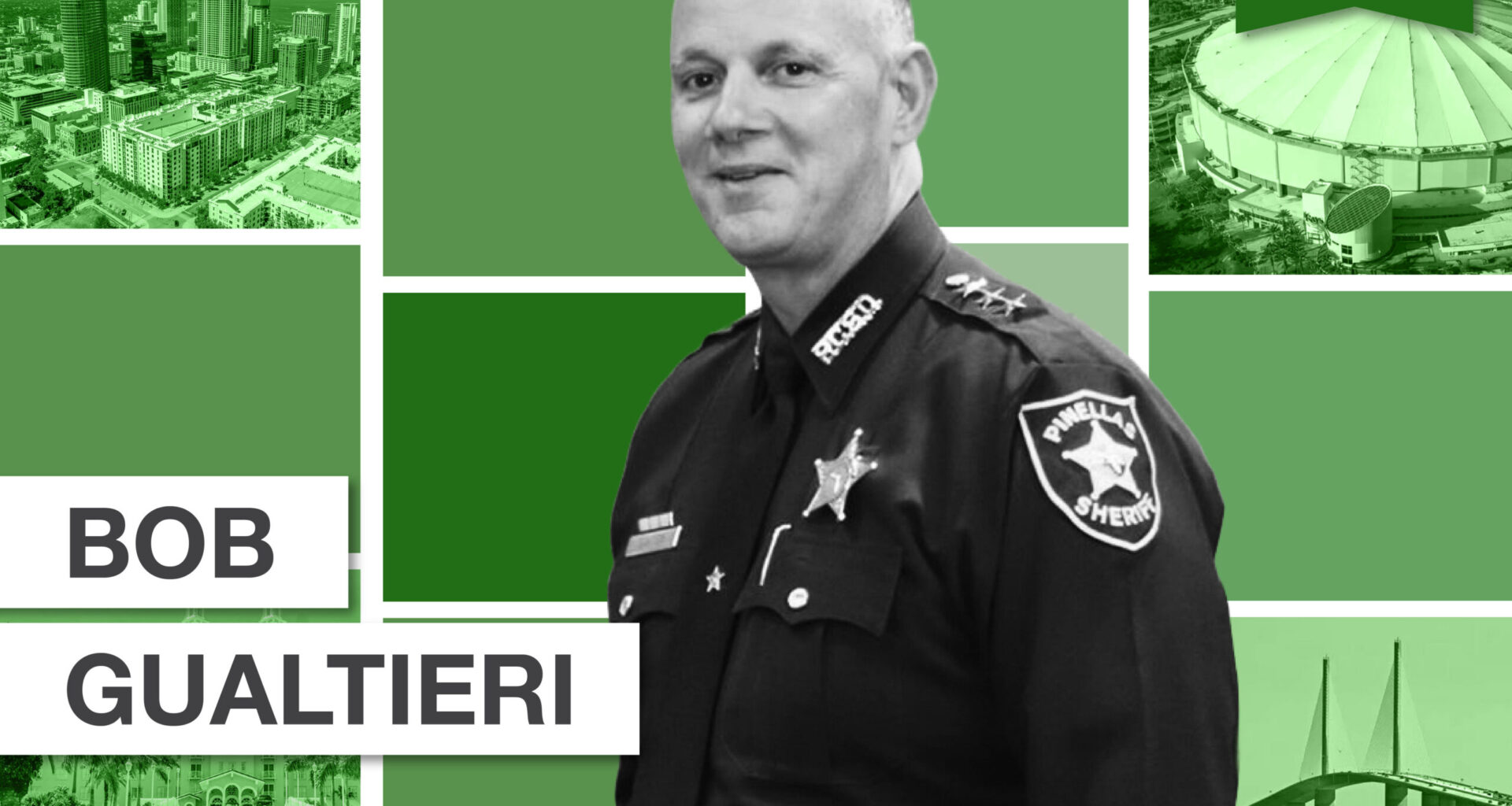
There are few people in Tampa Bay area politics who command as much universal respect as Pinellas County Sheriff Bob Gualtieri.
The Republican law enforcement leader is unafraid to stand up to what he sees as legislative overreach affecting public safety and is unwavering in his commitment to rule of law, even when pushback is significant.
Gualtieri consistently finds himself among the most powerful elected officials in the region, this year landing at No. 11 on Florida Politics’ list of Tampa Bay’s Most Powerful Politicians. That’s down two spots from last year when he cracked the top 10.
Now the President of the Major County Sheriffs Association of America, Gualtieri not only leads county law enforcement in Pinellas County, but advocacy for Sheriffs of large counties across the U.S. representing more than a third of the U.S. population. The Association includes Sheriff’s Offices in counties with populations of 400,000 or more that employ at least 700 personnel.
Gualtieri’s own Sheriff’s Office protects a county of nearly 950,000 residents and he oversees more than 2,600 employees in both sworn and civilian positions, including the county corrections department.

“When policymakers need a law enforcement perspective, there’s a reason they go to Sheriff Bob Gualtieri. He uses data, paired with his extensive experience and common sense, to find solutions to solve systemic public safety issues. He is thoughtful, compassionate, and intellectual — we’re incredibly fortunate to have him as our Sheriff,” Pinellas County Commissioner Kathleen Peters said.
Gualtieri was named to his most recent leadership post in February. He accepted the post by noting that with other Sheriffs, “we can solve complex issues and accomplish so much more.”
It’s not the first time Gualtieri has been tapped to lead a large association of law enforcement leaders. He previously served as President of the Florida Sheriffs Association and led the Marjory Stoneman Douglas Public Safety Commission in the aftermath of the deadly attack in Parkland.
In the age of politics dominated by Donald Trump’s priorities, Gualtieri has stood out as both an ally and independent thinker.
Gualtieri entered into federal 287(g) agreements deputizing local law enforcement to undertake some U.S. Immigration and Customs Enforcement responsibilities, but he did so under legal obligation. Gualtieri also cautioned local Police Chiefs that they too must sign onto the agreement under threat of removal by Gov. Ron DeSantis.

That nearly all of Pinellas County’s 10 local Police Departments signed onto the agreement after his words of caution punctuates Gualtieri’s influence and staying power, even if the move was unpopular among some.
In fact, Gualtieri is often seen as a definitive voice on law enforcement policy. After an appeals court ruled last year that Florida’s ban on open carry was unconstitutional, Gualtieri spoke out. He argued open carry was, at least for a short window, still not permitted in Florida because a 15-day window allowed the state to seek a rehearing
Gualtieri’s comments at the time struck some as odd, because even though he was technically correct, it was well understood that the state would not seek a rehearing. But again, Gualtieri’s assertion further showed his alignment with the law, not partisanship.
And Gualtieri has been a top expert for lawmakers as they seek public safety policy, including last year when Gualtieri worked with Sen. Nick DiCeglie to shore up unintended consequences in a controversial program issuing citations to drivers not stopping for school buses through the use of cameras mounted on the buses’ stop arms.
Gualtieri was blunt in his opposition to the law that allows camera ticketing in the first place, telling Florida Politics it was “red light camera 2.0,” a program he also opposed. He said the school zone program should be entirely reevaluated because drivers shouldn’t be confronted with citations “so that some company can make a gazillion dollars,” referring to vendors who operate the camera programs.
As a testament to Gualtieri’s support on the political right, last year Senate President Ben Albritton, appointed Gualtieri, along with Polk County Sheriff Grady Judd, to the new State Immigration Enforcement Council. That group was created through a sweeping immigration measure signed by DeSantis that was meant to align state policy with Trump’s immigration crackdown priorities.
While that puts Gualtieri in a position to carry out those priorities, it doesn’t mean Gualtieri always aligns with the extreme right. He’s a Republican, to be sure, but he makes choices he feels are best for his community and in the best interest of public safety, even if that means going against some in his party.
For example, last year Gualtieri publicly supported Pinellas County School Board member Laura Hine in her re-election campaign, which pit her against a Moms for Liberty-aligned candidate backed by DeSantis. School Board races in Pinellas County, and in much of the state, are nonpartisan, but Hine is a registered independent. Still, she earned considerable support from Democrats, progressives, and groups aligned with both.
So his endorsement was a departure from his party. For some politicians, that could be problematic, but for Gualtieri, it didn’t leave so much as a scratch.
First appointed by then-Gov. Rick Scott in 2011, Gualtieri was subsequently elected in 2012 and then re-elected in 2016, 2020 and 2024. In 2024, the same cycle he bucked support for a Moms for Liberty School Board candidate, Gualtieri was re-elected without opposition, an easily quantifiable sign of an official’s influence in power among their electorate.
Gualtieri’s law enforcement service goes back decades. After moving to St. Pete with his parents as a young adult, Gualtieri began working for the Sheriff’s Office as a detention deputy, later becoming a patrol officer, then a detective.
He later attended Eckerd College’s now-defunct Program for Experienced Learners program, graduating with a degree in American Studies and going on to earn a law degree from Stetson University College of Law. For a time, he served both as Pinellas County Sheriff and as the agency’s legal counsel.
In all, Gualtieri’s service dates back to 1982. He left for a stint with the Dunedin Police Department, but otherwise has been a Pinellas County Sheriff’s Office staple, including as an investigator for domestic and international drug trafficking cases as part of a Drug Enforcement Administration task force.
___
As for methodology, the Tampa Bay region is defined as Pinellas, Hillsborough and Pasco counties, with Hernando, Polk and Sarasota included when their elected officials impact Pinellas or Hillsborough.
A politician is defined as someone currently in office or actively running for office.
Panelists ranked their Top 25, with a first-place vote earning 25 points, second place earning 24, and so on down to 1 point for 25th. Those totals were combined to produce the final list.
We also want to thank our experienced and knowledgeable panelists, who were essential to developing the 2026 list: Vinik Family Office Chief of Staff Christina Barker; former St. Petersburg City Council member Robert Blackmon; Mercury Public Affairs Managing Director Ashley Bauman; Michael Corcoran and Matt Blair of Corcoran Partners; former Sen. Jeff Brandes; Stephanie Cardozo of The Southern Group; Shumaker, Loop & Kendrick managing partner Ron Christaldi; political consultant/strategist Barry Edwards; Vicidial Group President Matt Florell; Sunrise Consulting Group President Shawn Foster; businessman Michael Griffin; St. Pete Catalyst Publisher Joe Hamilton; Clay Hollis of Tucker/Hall; Natalie King of RSA Consulting Group; Moffitt Cancer Center VP of Public Affairs and Communications Merritt Martin; political consultant Chris Mitchell; Mike Moore of The Southern Group; RSA President and CEO Ron Pierce; Tucker/Hall CEO Darren Richards; political consultant Jim Rimes; political consultant Preston Rudie of Catalyst Communications Group; TECO Vice President of State and Regional Affairs Stephanie Smith; lobbyist Alan Suskey of Shumaker Advisors; and Michelle and Peter Schorsch, publishers of Florida Politics.