

The celebrations hadn’t even begun yet for Andrew Barnes’ new position as chairman of the Poynter Institute in 1988 when he received a phone call that threatened to ruin everything.
On the phone was a Texas businessman who said he and other investors had purchased a substantial share of the voting stock of the St. Petersburg Times, the independent newspaper that Poynter owned. Barnes, who was just days away from taking control of the Times, was in his words “totally unprepared” for the news.
“Emotionally it was immensely difficult,” Barnes later said, recounting the phone call. “I felt it was crucial that we not fail, and in order to keep the organization functioning I had to display confidence and underplay peril, at the same time I was truly afraid that we might not bring this off.”
But he did bring it off. And in doing so, Barnes secured the Poynter Institute’s ownership of the Times and his own legacy.
Barnes died Thursday at the age of 86. The cause of death was not disclosed. He leaves behind a wife, Molly, and three children, Chris, Ben and Elizabeth. The family is planning memorial arrangements.
During the more than 50 years Barnes worked in journalism, he helped lead the Times, now the Tampa Bay Times, to multiple Pulitzer Prizes and greatly expanded and modernized the Poynter Institute. But perhaps his most significant contribution was shepherding the institute through an attempted hostile takeover of the Times, ensuring that the paper would remain independently owned.
“The effort not only preserved the paper’s independence and local control, but helped solidify the very concept of non-profit ownership that is a vital component of today’s news landscape,” said Neil Brown, the current president and chairman of the Poynter Institute.
Barnes joined the Times in 1973, recruited away from The Washington Post by the legendary journalist Eugene Patterson. There, he worked his way up, becoming editor and president of the Times in 1984 and later the CEO of Times Publishing Co. and chair of the Poynter Institute in 1988. In climbing the ranks, Barnes was following in the footsteps of his mentor, Patterson, who in turn had succeeded Nelson Poynter.
Before his death, Poynter had envisioned an ownership structure that would protect the Times from suffering the same fate as newspapers owned by large, corporate chains. As a result, he created the institute — then known as the Modern Media Institute — and willed his majority stake of Times Publishing to the organization upon his death in 1978.
For 10 years, Poynter’s dream was preserved. But in 1988, Texan financier Robert Bass jeopardized that dream when he called Barnes to inform him that he’d purchased the 40% of Times voting stock that had wound up in the hands of Poynter’s nieces.
The news was so shocking that the rival Tampa Tribune scooped it before the Times had a chance to publish its own story. Over the next two years, Bass fought to gain control of the Times, at one point suing over the company’s decision to reinvest the money it earned into the paper and the Poynter Institute instead of paying out bigger dividends.
That period, Barnes later recounted, turned his hair white. But he never wavered in his decision to fight the takeover, even when he was told that selling the paper would make him very wealthy.
“In facing the Bass challenge, we knew from the first we must never do anything that might make it seem we would sell the Times. We didn’t hire investment bankers, though many said we should. We never allowed ourselves to speak publicly about the dollar value of the company,” Barnes later wrote in an op-ed. “We were determined not to be in play. For us, there simply was no alternative to preserving the independence of the newspaper.”
It was a scary moment for the Times because it was the first challenge to the company’s “sense of impregnable independence,” said Paul Tash, who would later succeed Barnes as head of the Times, Times Publishing and the Poynter Institute. But Barnes led with “calm and resolve,” believing that a solution would come if they worked hard enough to find one — a mindset Tash would later seek to emulate when he led the Times and the Poynter Institute through the Great Recession and the COVID-19 pandemic.
“That is something about Barnes that was always impressive,” Tash said. “His view was, if we don’t see a solution here, it’s just because we haven’t thought hard enough yet. We have to keep thinking and we’ll find a way.”
In August 1990, Times Publishing and Bass reached a settlement. The fight had taken $50 million, and it would take the Times another nine years to pay out its debt. But in a December 1999 letter to readers, Barnes triumphantly announced, “Now the debt is paid. The Poynter Institute owns all the stock. That stage is done.”
With the matter of ownership of the Times settled, the Poynter Institute under Barnes was able to focus on growing in size and establishing its presence nationally. The Poynter website launched during Barnes’ tenure, and he leveraged his connections throughout the industry to expand the institute’s board of trustees. He helped select James Naughton as president of the institute in 1996 and then in 2003, Karen Dunlap, the first woman and person of color to serve in the role.
“Andy was thoughtful and eloquent in urging that journalists improve their rigor and craft,” Brown said. “He was passionate but not scolding about our obligation to do the work better.”
Born in Torrington, Connecticut, on May 15, 1939, Barnes’ first exposure to journalism was through his father, a foreign correspondent for the New York Herald Tribune and editor of the New York Star.
His first journalism job was at the Providence Journal, where he worked after earning a degree in history. Barnes didn’t stay at the Journal for long, first serving a two-year stint in the U.S. Army before joining The Washington Post. There, he met Patterson, who later brought him to the Times as an assistant managing editor and metropolitan editor.
In some ways, Barnes, a Harvard-educated Northerner, stood out in the Times newsroom. Some of his colleagues made fun of his broad vocabulary, which he regularly deployed at meetings, said Poynter Institute senior scholar Roy Peter Clark. He recalled once having to whisper to a colleague the definition of “eleemosynary” (meaning “charitable”) after Barnes used it in a meeting.
Barnes’ intellect and keen interest in history were evident whenever he visited the Poynter Institute library, said former librarian David Shedden. Despite being one of the smartest people Shedden had ever met, he was also very informal and could talk about almost anything. Later, Barnes donated part of his collection of 19th and 20th century journalism books, some of which had belonged to his father, to the institute.
“His book collection continues to serve as a literary legacy that helps preserve and share the history of journalism for future generations,” Shedden said.
During Barnes’ tenure as Times chairman, the Times won three Pulitzer Prizes. He would later go on to serve as the chair of the Pulitzer Prize Board, the Newspaper Association of America and the American Society of Newspaper Editors Ethics Committee.
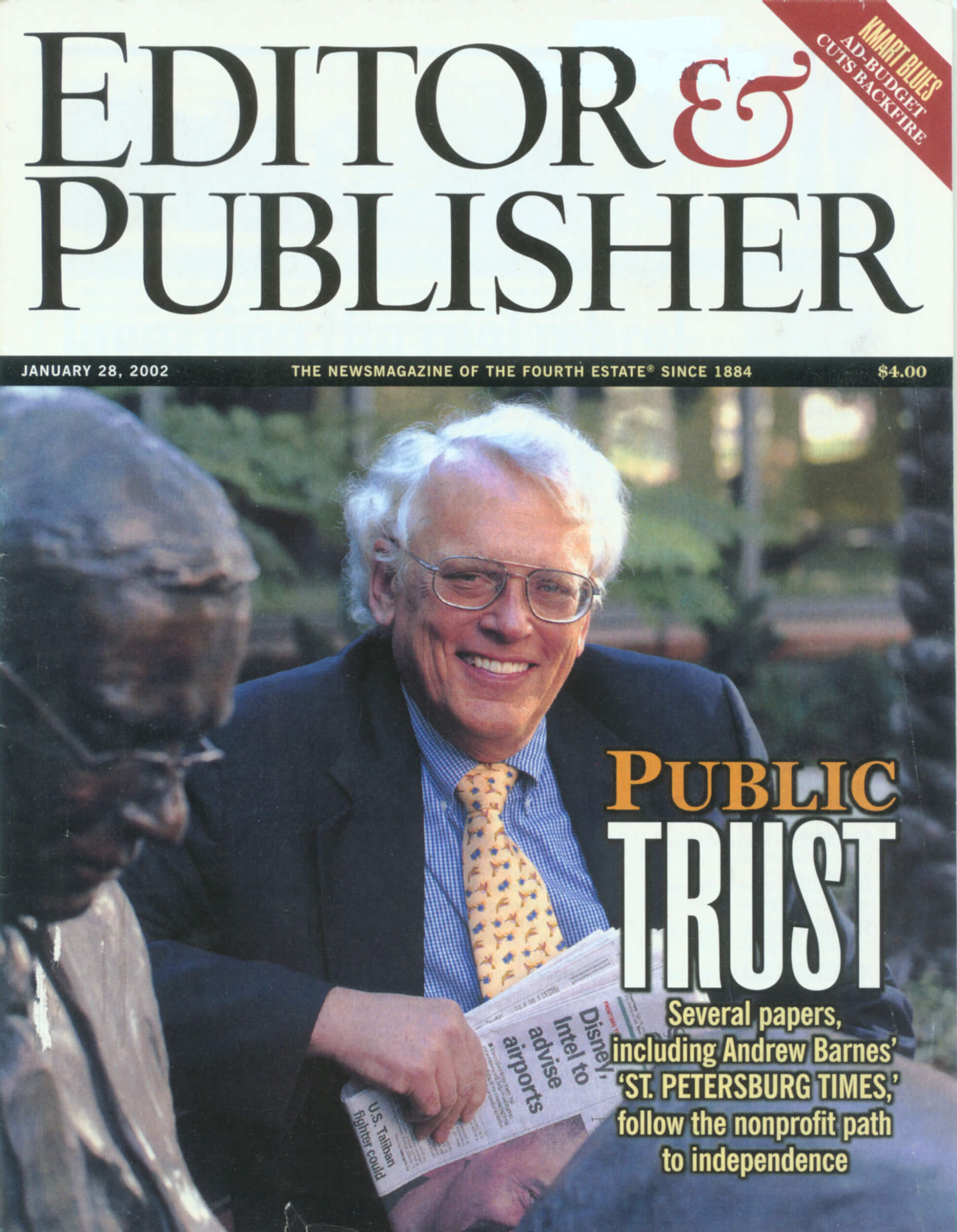
Andrew Barnes, the former chairman of the Poynter Institute, on a January 2002 cover of Editor & Publisher (Poynter files)
In the Times newsroom, Barnes was known for being very approachable, with an interest in helping younger journalists. His nickname was “Uncle Andy,” Tash said.
“Sometimes he was your rich uncle. Sometimes he was your Dutch uncle. Sometimes, often, he was your favorite uncle.”
Tash was a mentee of Barnes’ — succeeding him in many roles including that of Poynter Institute chairman and Times CEO, chairman and editor.
Before all of that, however, Tash was a 28-year-old city editor at the Times who had just spiked a column by the new metro columnist who was a friend and contemporary of Patterson, the then-CEO and chairman of the company. The columnist was upset, but Barnes went to Tash’s desk and sat down next to him.
“I will support whatever damn fool thing you’ve done,” Barnes told Tash. “Now, tell me what you’ve done.”
It was a moment that showed the almost “familial” support Barnes could provide as “Uncle Andy,” Tash said. As an editor, Barnes made it safe for people “to try to do their best” while also helping them get better.
Years later, when Tash and Barnes worked more closely together as top leaders of the Times, Barnes would send Tash more minor tasks that he didn’t care to deal with or were less important with the note “as you think best” handwritten across the top.
By Barnes’ retirement from the Times in 2004, Tash was already editor and president of the paper. Yet that moment felt “really different.”
“As central a role as I had, I knew that one of the great things was that I had somebody playing behind me on defense, and if something got over my head, he was likely there to catch it,” Tash said.
He told Barnes then that if he came across a difficult decision, he would imagine Barnes’ handwriting across the top and the confidence that came with seeing those four words: “as you think best.”