
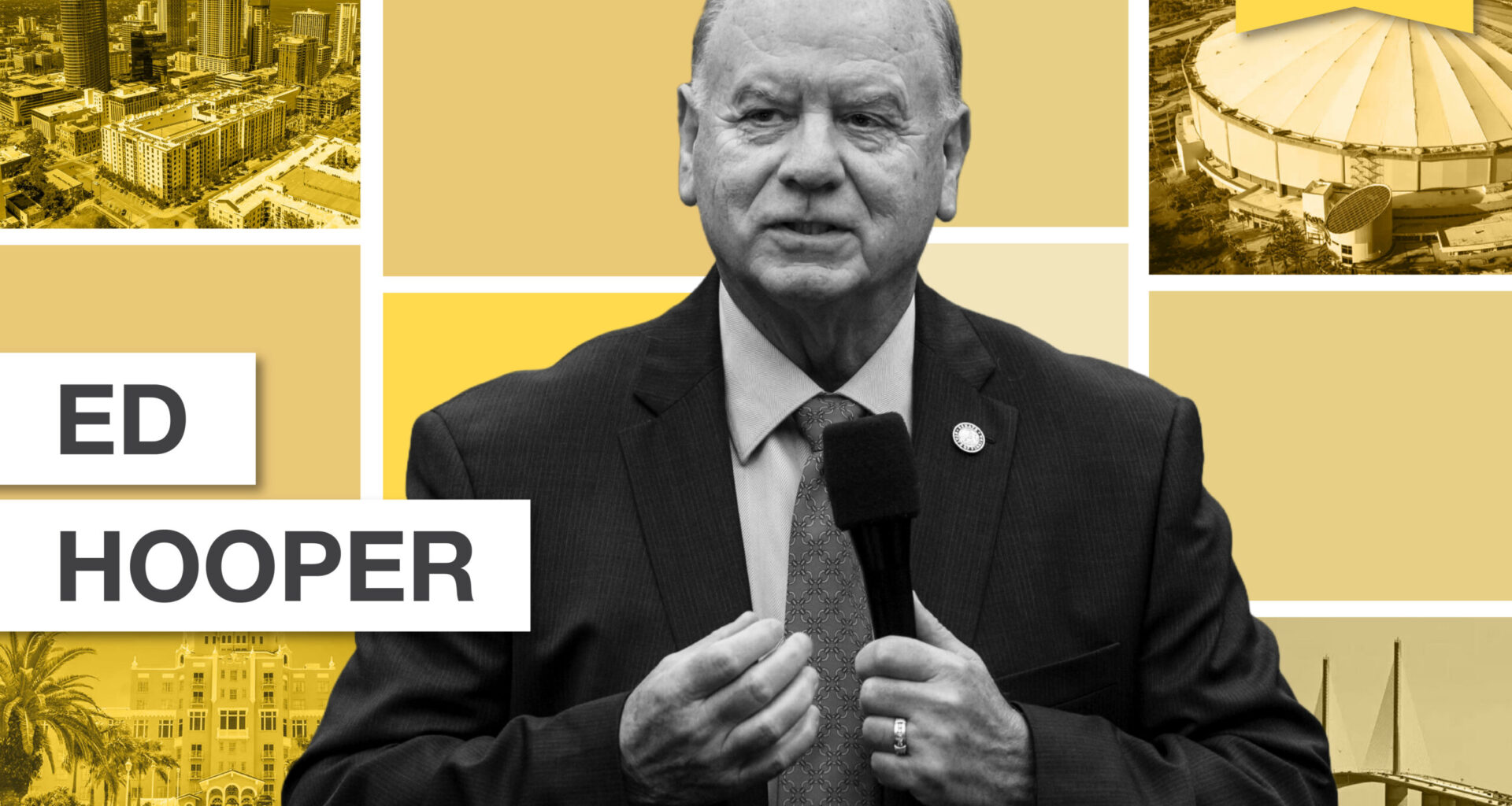
He’s fought fires. He served in the House. He earned election to the state’s upper legislative chamber. Now he’s one of the Senate’s top leaders, serving as the chief budget negotiator for his second and final year as term limits approach.
So it’s not surprising that Sen. Ed Hooper — lovingly known as Hoop by those close to him — has cracked the Top 5 on the list of Tampa Bay’s Most Powerful Politicians for the second year in a row, both times landing at No. 4.
As the Senate Appropriations Committee Chair, Hooper quite literally is controlling the purse strings, and that’s great news for his home community in northern Pinellas County and Pasco County.
But it’s also great news for fiscal hawks who might not be quite as hawkish as the House. Hooper, under the leadership of Senate President Ben Albritton, helped pass the Senate’s $115 billion spending plan, which came in at about $1.4 million more than the House’s more austere $113.6 billion budget.
“Ed Hooper leads with integrity, puts people first, and has earned deep respect through his steady, common-sense approach,” said Matthew Blair, Managing Partner for Corcoran Partners.

Hooper has faced the ultimate tests as budget chief, leading the budget process during the contentious 2025 Session that saw the Legislative Session drag on for weeks beyond its prescribed 60 days. Strife between the House and Senate over disagreements about how best to cut taxes led to Albritton’s priority “Rural Renaissance” package dying, despite efforts among leadership to keep it alive. Portions were folded into a health care bill (HB 1427), but Gov. Ron DeSantis killed it, saying in a veto message that his problem was the level of bureaucracy that comes along with it.
This year’s Legislative Session wasn’t much better, with leadership gaveling out without passing a budget, the Legislature’s only constitutionally mandated duty. Typically, Hooper’s work as a lawmaker, and as the chief budget negotiator in the Senate, would have been mostly done at the end of Session — the litany of farewell addresses being a testament to that.
But instead of spending his final months as a lawmaker finishing business and helping constituents, Hooper is preparing for yet another Special Session to finish the budget and address several priorities of DeSantis. Those include mid-decade congressional redistricting, the AI bill of rights, and a “medical freedom” package that would, among other things, allow parents to opt out of childhood vaccinations over “conscience-based objections.”
Yet through it all, Hooper has remained the same affable leader, with a southern charm that can easily turn foe to friend — though he might have been a bit tired. And who could blame him?
As just one example of the many political minefields Hooper has had to navigate over the past couple years, he seemed to be victim to some House trolling. In February, as the chambers expected to release budgets, Hooper announced his chamber would not be releasing its budget yet, citing the House version being unready. Just hours later, the House rolled out its budget, prompting the Senate to follow suit the next day.

But if Hooper was frustrated, he didn’t show it. And that’s just how he is.
“With decades of experience and a deep understanding of the process, Ed Hooper quietly drives results where it matters most. He’s not looking for credit — he’s focused on delivering for the people he serves,” said Shawn Foster, owner and founder of Sunrise Consulting.
Responding to general sentiment among the majority party, Hooper was quick to agree to steep spending cuts, a deemed necessity as future budget outlooks showed shortfalls. Early in the budget process, both Hooper and his House counterpart, Lawrence McClure, vowed budget cuts of anywhere from $1 billion to $4 billion down from the current fiscal year budget.
“There’s no federal COVID money coming into the coffers,” Hooper reminded at the time. “We’re now adjusting our expectations back to 2018/2019 numbers.”
Ultimately, the Senate budget came in only about $100,000 less than what lawmakers approved in 2025, at $115 billion, and was more than the actual budget after DeSantis’ vetoes, which came to $114.8 billion.
But Hooper acknowledged, along with his House counterparts, that “limiting the size and scope of government helps keep Florida affordable.” He called for lawmakers to maintain “a healthy savings account” and to “preserve the permanent, meaningful, broad-based tax relief that families and businesses plan for and count on.”
“Ed Hooper continues to be one of the Legislature’s most reliable hands. In the last year, his leadership as Senate Appropriations Chair has put him at the center of the budget decisions that define what Florida can actually deliver,” RSA President and CEO Ron Pierce said.
Hooper’s experience in politics is robust. He was first elected in 1996 to the Clearwater City Council. After a six-year hiatus from elected service, Hooper was elected to the House in 2006, where he served until 2014.
He was then elected to the Senate in 2018. In between, Hooper had run for Pinellas County Commission, but lost to former County Commissioner Pat Gerard, whose victory that year handed Democrats a majority.
That loss is less of a reflection on Hooper — he’s otherwise undefeated — than it is on the partisan winds of change. Pinellas County, like most of the state in the 2022 Midterms, saw a massive red wave, which continued again in 2024. When Hooper ran in 2014, Democrats in the county were surging.
Hooper is widely regarded among his peers — on both sides of the aisle — as an affable guy whose southern charm is infectious. And as a retired firefighter, he’s widely respected as a critical advocate for first responders.
While Hooper’s budget leadership kept him away from the bill-sponsoring process for the most part, previous years have shown his commitment.
Hooper introduced 20 bills in the 2024 Legislative Session, before he was leading budget negotiations, and co-introduced another 16. Of those, more than a dozen were successful.
Many of those were related to public safety.
He sponsored a successful measure honoring the 80th anniversary of the Florida Professional Firefighters Association, which cleared with bipartisan support and without much fanfare.
Hooper also successfully ushered through legislation (SB 718) establishing a new felony for anyone age 18 or older who “in the course of unlawfully possessing dangerous fentanyl or fentanyl analogs, recklessly exposes a first responder” to the drug and it results in “an overdose or serious bodily injury.”
He successfully sponsored another measure (SB 184) establishing a misdemeanor against anyone who impedes, threatens or harasses a first responder.
Should Hooper decide to continue his elected service after he faces term limits this year, he might find an easy path ahead, if past is prologue.
Hooper secured re-election to his Senate District 21 seat last year, easily defeating Democratic challenger Doris Carroll with nearly 60% of the vote.
___
As for methodology, the Tampa Bay region is defined as Pinellas, Hillsborough and Pasco counties, with Hernando, Polk and Sarasota included when their elected officials impact Pinellas or Hillsborough.
A politician is defined as someone currently in office or actively running for office.
Panelists ranked their Top 25, with a first-place vote earning 25 points, second place earning 24, and so on down to 1 point for 25th. Those totals were combined to produce the final list.
We also want to thank our experienced and knowledgeable panelists, who were essential to developing the 2026 list: Vinik Family Office Chief of Staff Christina Barker; Mercury Public Affairs Managing Director Ashley Bauman; Michael Corcoran and Matt Blair of Corcoran Partners; former Sen. Jeff Brandes; Stephanie Cardozo of The Southern Group; Shumaker, Loop & Kendrick managing partner Ron Christaldi; political consultant/strategist Barry Edwards; Vicidial Group President Matt Florell; Sunrise Consulting Group President Shawn Foster; businessman Michael Griffin; St. Pete Catalyst Publisher Joe Hamilton; Clay Hollis of Tucker/Hall; Natalie King of RSA Consulting Group; Moffitt Cancer Center VP of Public Affairs and Communications Merritt Martin; political consultant Chris Mitchell; Mike Moore of The Southern Group; RSA President and CEO Ron Pierce; Tucker/Hall CEO Darren Richards; political consultant Jim Rimes; political consultant Preston Rudie of Catalyst Communications Group; TECO Vice President of State and Regional Affairs Stephanie Smith; lobbyist Alan Suskey of Shumaker Advisors; and Michelle and Peter Schorsch, publishers of Florida Politics.