
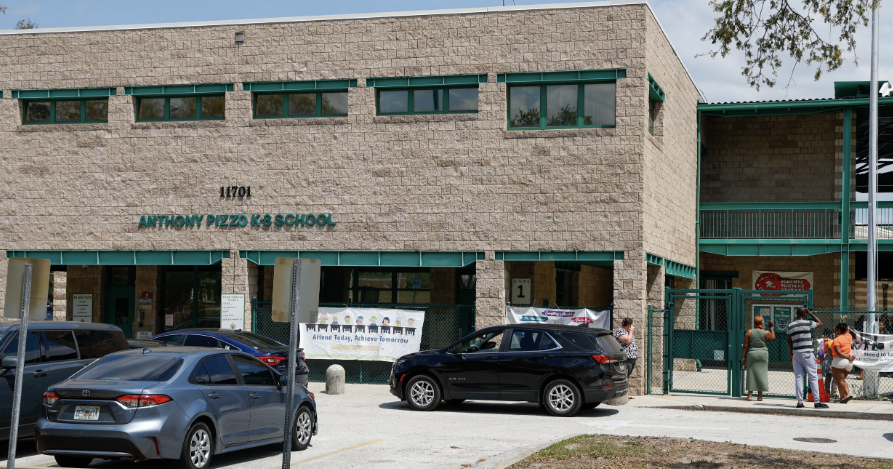
Teachers at Pizzo K-8 had a message for the Hillsborough County School Board during its first meeting since the board voted to shutter the school in 2027 due to climbing costs.
“We are still not done with those conversations,” Angela Colonello, a teacher at the school told the board April 21. “We really are trying to ask that everyone keeps an open mind. Get back in the playground. Get back in the sandbox.”
At a meeting in early April, students, teachers, parents and alumni pleaded with the board to keep the school open, citing the University of South Florida’s decision to raise rent on its campus nearly tenfold. Community members asked the district to ask USF to reconsider, or at least keep the school together and moved to another district property.
The district did not recommend that, and instead proposed that students be split up between surrounding elementary and middle schools. Community members left in tears.
But since then, they’ve launched an initiative dubbed Project Pizzo, a Hail Mary effort to save the school in the year before it is scheduled to close.
The group has independently reached out to schedule a meeting with USF’s new president, Moez Limayem, but is waiting for confirmation.
“Several university leaders plan to meet with two Pizzo Elementary teachers next month, at the request of the teachers,” Althea Johnson, a spokesperson for the university said. “Keep in mind, USF does not make any decisions regarding the closure of Pizzo. That responsibility remains with the Hillsborough County School Board.”
Johnson said the university and district had discussions for three years prior to the lease change, but that raising rental rates for Pizzo to remain on campus did not reflect “the significant increase in comparable land value throughout the Tampa Bay region.”
Johnson added that the 30-year-old building was in need of significant repairs and that the district opted to demolish the building at the end of the lease rather than take on those costs.
USF and the school district have “a responsibility to the students of that community,” Colonello said. “It takes a village, and I hear everyone up here talking about how important it is to make sure that we are lifting up the students. So I’m asking that we keep that open.”
Colonello said she reached out to teachers at some of the schools that Pizzo students are expected to be transferred to and heard concerns over the number of special needs students and growing class sizes.
Anita Bloom, another Pizzo teacher, shared concerns about tearing apart the tight-knit community.
“Pizzo is not just a place our students learn,” she said. “It’s where they grow up together. It’s where siblings walk down hallways, where teachers know children by name, where children who do not have stability outside the school find it inside our walls every single day.”
Almost 80% of Pizzo students are considered economically disadvantaged, she said.
“It is consistency, it is safety, it is belonging,” she said. “And when we talk about closing Pizzo, we are not just talking about moving students. We’re talking about separating children from the relationships that ground them. We’re talking about breaking apart a community that has been carefully built over years. You cannot simply relocate that kind of connection.”
Bloom warned the board that the move may disenfranchise more students from the public school system and could “accelerate the decline” of schools that students are pushed into.
“Our children are not numbers to balance enrollment sheets,” she said. “We understand that change is something necessary, but what we’re asking is simple and reasonable, to slow this process down.
“Give us time to bring all stakeholders to the table: families, educators and local businesses,” she continued. “Give us time to explore solutions that keep our students together at another site without dismantling the community that makes them successful. Give us time to be part of the solution, not just recipients of a decision, because once the school is closed, there is no undo button for this.”