
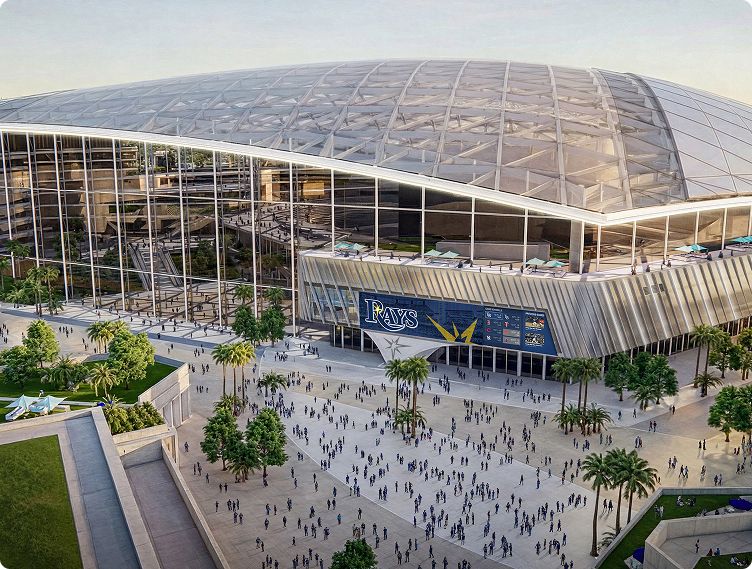
The Tampa Bay Rays are warning that time is running short to finalize a stadium deal in Tampa, responding after Hillsborough County raised concerns it may not meet key deadlines tied to public funding decisions.
In a detailed reply to a county memo sent to the team, the Rays doubled down on a June 1 target to agree to public funding so that plans to play the 2029 season in Tampa remain on schedule. The Rays’ lease at Tropicana Field runs through the end of the 2028 season, and the team aims to open 2029 in a new ballpark in Tampa or potentially outside of the region.
The exchange follows a public county meeting where officials expressed concern about funding proposals on the table that reveal a funding shortfall for the project.
“We understand the government parties’ concern regarding the timeline for completing the project agreements. At the same time, maintaining momentum is essential to keeping the project on track to open for the 2029 season, which is critical for the success of the project in Tampa Bay,” the team wrote in a response to the county memo sent Friday.
“Accordingly, we would like to continue working together toward a May vote on the MOU, with the shared goal of completing the definitive agreements as soon as reasonably possible thereafter. Based on in-depth discussions with potential ballpark contractors, we remain confident that the project schedule can be maintained if the Parties are able to finalize the definitive agreements as soon as possible in order to meet the 2029 season.”

The exchange reflects growing tension over the proposed $2.3 billion ballpark and mixed-use district proposed on the Hillsborough College Dale Mabry campus. County officials have recently raised concern about a funding shortfall that could send Hillsborough looking between “the couch cushions” for funds, according to staff.
If a public funding agreement is not reached by June 1, the Rays would need to negotiate an extension at Tropicana Field or find an alternative site to play the 2029 season. Relocating to another Florida city, or another state altogether, remains an option until a deal to stay in Tampa Bay long-term is inked.
Meanwhile, the Rays’ rebuttal not only shows that the team and the county are still far apart on funding, but that the Rays balked at any workaround that allows bonds to lose tax exempt status would result in an increase in the Rays’ rent payment obligation.
The Rays have requested county bond issuances to frontload public ballpark funding, but do not agree to county proposals that increase borrowing power that result in the loss of tax-exempt status. The less the county can bond upfront the more funds would need to come from existing revenue sources, such as cash reserves or other funding options, reflecting the balancing act local officials are working through to identify public funds for the project.
“More importantly, the Rays believe the financing should be structured in a manner that preserves the ability for the CIT bonds to remain tax-exempt. As discussed below, and subject to further work with the Parties and financing professionals, the Rays believe there is a viable framework to achieve that result, which would eliminate that additional $60 million shortfall, leaving the Parties to identify a path to bridge the pre-existing $75 million funding gap,” the team wrote.

Although not explicitly stated, the team also indicated that the price of the facility’s roof is a relatively small negotiation point. The team said the new Kansas City Royals ballpark is projected to cost $1.9 billion — slightly less than the Ray’s $2.3 billion proposal — and it comes without a roof.
The Rays also said the team would not agree to pay for shortfalls if Community Investment Tax revenues — which are a major share of the proposal — do not meet projections. That means the county and other participating governments would need to foot the bill from other revenue sources if the CIT tax does not generate enough dollars.
The Rays did propose a structure where the team creates a $20 million contingency reserve to help mitigate the risk of tax revenue shortfalls, payable in 2041 and 2042, rather than agreeing to cover the cost of public revenue shortfalls.
The county also informed the Rays that it still needs to evaluate conveyance of land from Hillsborough College to the county. The county is also pushing for a license and use agreement, rather than a lease, and also aims to evaluate the conveyance of land from the college to the Rays, records show. In response, the Rays indicated the team intends to sign a ground lease for the entirety of the Hillsborough College site for the stadium and mixed-use development “for a term of no less than 100 years.”
The team indicated that upon completion of the stadium, the ground lease would terminate as to the stadium parcel, the stadium site would be conveyed by Hillsborough College to the county in fee simple terms, and the License and Use Agreement between the county and the Rays would become effective. The mixed-use portions of the site would remain subject to the long-term ground lease with Hillsborough College. The state Cabinet has already approved the overall structure, according to the Rays.
The team also indicated that ownership of the stadium would transfer to the county in fee simple terms upon completion of the stadium, concurrent with the License and Use Agreement. The Rays would procure stadium construction through a competitive procurement process, and Hillsborough College would own the land throughout the construction period. The Rays said mixed-use portions of the project would be owned by the college but remain under team control.
“The mixed-use development property is currently intended to remain under the Rays-controlled ground leasehold interests, with Hillsborough College retaining fee ownership. The county would have the benefit of various easements and related rights associated with the stadium site, as set forth in the CC&Rs currently being negotiated with Hillsborough College,” the team wrote in the response.
Records also show a sharp divide on procurement. The county insists the ballpark project must adhere to public procurement requirements, while the Rays doubled down on a stance that the team has the right to offer contracts as a private procurement — arguing that government requirements would only apply if the county were the entity offering the contract under its own name.
The Rays are also not able to comply with county requests to ensure that mixed-use phases of the project are guaranteed on a prescribed schedule or to meet specific valuation thresholds. The team did indicate that mixed-use components are a priority for the team as well, and that the organization is on the hook for rent obligations until the district is fully up and running.
“The Rays are unable to commit to an absolute obligation … as a direct covenant under the MOU or the definitive agreements. Notwithstanding these constraints, the Rays have agreed to pay the CRA Variable Rent, to the extent the anticipated mixed-use development or corresponding taxable value is delayed, thereby aligning our interests with the success of the mixed-use development and the financial objectives of the government entities,” the team responded.
The team also indicated it does not intend to provide a separate guarantee that phase two or three of the mixed-use portions of the project are ever built out, other than rent owed — even though ad valorem revenue growth from the development is pivotal toward the county’s chances to ever regaining public funding spent on the project.
“The Rays’ commitments to the government parties are centered on delivering the stadium project, which serves as an anchor for the broader district. The mixed-use development is a related but distinct development program and should not be treated as an independent guaranteed valuation covenant to the government parties,” the team wrote.