
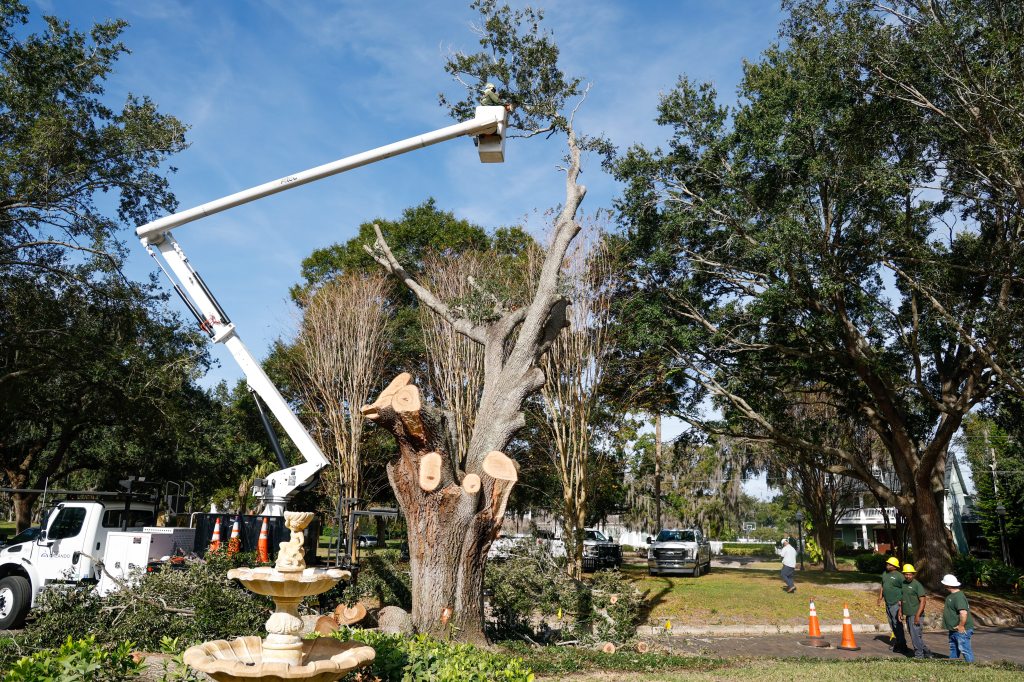
Arbor Day is one of these holidays that almost everybody can get behind. In a warming world, trees are one of the most foolproof defenses — taking greenhouse gases out of the atmosphere and providing shade that can lower air conditioning bills. Across Central Florida this week, many local governments and nonprofits are hugging trees with all their might. Arbor Day celebrations — which often include tree giveaways — are part of that, but many local cities and counties have hired full-time arborists in an effort to increase local tree canopies at every opportunity.
But planting a tree is just the first step in a long journey — if you’re lucky. It starts with choosing the right tree, for the right place, then giving it the care and support it needs to grow tall and healthy. And even trees raised with all the love and care in the world can fall victim to parasites, infections, inadequate care — or simply years.
That last threat is an issue of particular concern in Central Florida because this area is full of homes built in one of the region’s biggest land booms — the 1960s through 1970s, where hundreds of single-family homes were constructed each month in sprawling subdivisions that used to be orange groves, pastures, pine plantation or scrub. The smart developers realized that trees — even small, spindly ones — could add curb appeal to the suburban 3/2 cinderblock home that was the standard of the day. Among the favorites were species known to grow fast, such as laurel oaks and water oaks, which could become beautiful shade trees within a decade.
These oak varieties are native species, which certainly makes them better than some of the exotic trees developers used, including fast-spreading Chinese tallows and Brazilian peppers that have infested local wetlands. But unlike live oaks that can live for centuries, the faster-growing oaks have a down side: They grow tall but often die young. The lifespan of a laurel oak is about 50 to 80 years — or sooner when stormy weather hits. Match that up with one of Central Florida’s hungriest growth cycles in the 1970s and 1980s, when families were moving for here for a shot at a job in the space industry or Disney — and you see why these trees have become a real problem over the past few years. Many of them are still outwardly gorgeous, soaring as tall as 100 feet with a canopies of 70 feet or more. But both laurel and water oaks are notoriously weak, especially in storms. Often, they show no signs of distress (at least, not to amateur eyes) until they are shredded by hurricanes or succumb to internal diseases.
Over the next decade or so, many of these trees will be coming down — landing across roads, snapping power lines, crushing cars and demolishing roofs, racking up hundreds of millions of dollars in insured claims.
It doesn’t always have to be that way. Longwood arborist Forrest McCullough, whose advice is often sought by local governments and garden societies, says homeowners have a lot more control than they think when it comes to determining the health of their trees. That starts with choosing the right place to plant and choosing the right species for that space. Next comes pruning — which usually should start when a tree is about five years old. With care and occasional assessments by tree experts, even short-lived trees can be very beneficial, he says.
But many developers, homeowners and businesses don’t know how to properly take care of their trees. That’s where public policy should come in. Some local governments already provide tree-assessment services for property owners — this is an effort that deserves replicating, with the potential for smaller governments who can’t afford professional foresters to contract with private businesses, or pool their resources for a shared service.
Getting an assessment from someone who has no profit motive is important. Local officials, along with reputable arborists like McCullough, decry the tactics of some tree services that will go door-to-door in neighborhoods, trying to convince homeowners to chop down trees that could probably be saved.
Local governments should also work with area businesses to make sure residents who purchase trees know what they are buying. It’s still possible to buy problematic species — including laurel and water oaks — at most Central Florida garden supply businesses. Would property owners be as quick to buy them if they knew they might be saddling their grandchildren with 20-ton time bombs?
As time goes on and temperatures rise, trees will be increasingly important in efforts to keep life in Central Florida bearable. Planting them is just the beginning, and it’s worth effort from private businesses and public officials to maximize the benefits of tall trunks and green leaves.
The Orlando Sentinel Editorial Board consists of Opinion Editor Krys Fluker, Executive Editor Roger Simmons and Viewpoints Editor Jay Reddick. Use insight@orlandosentinel.com to contact us.