
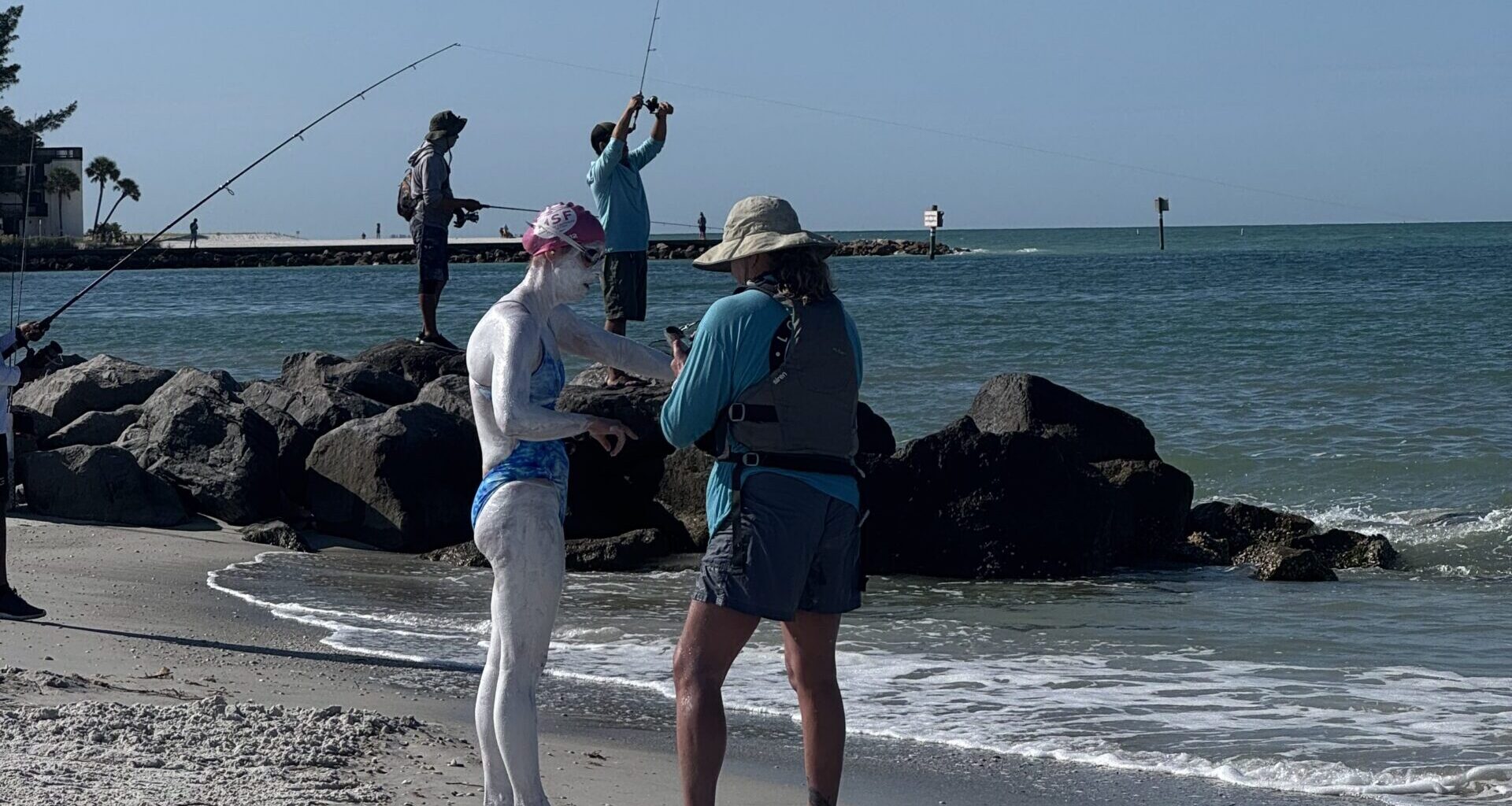
Ultraswimmer Jessica Kieras waded into the Gulf at 10 a.m. April 23, as spectators lined the shore, clapping and raising cameras while she slowly submerged. “There were a dozen dolphins in the water. It was a gorgeous morning in John’s Pass,” spectator and swim fan Amber Brinkly said.
As a sailboat rounded the jetty, a kayak launched from its side to greet Kieras in the water, escorting her as her first breaststroke started the clock on what was planned as a 24-hour ultraswim.
The Oregon-based endurance swimmer set out to swim north along Florida’s Gulf Coast for as long as she could within 24 hours under Marathon Swimmers Federation rules — no touching the support boat, no flotation devices and no rest. The swim was also a fundraiser for Save the Manatee Club, a nonprofit focused on protecting manatees and their aquatic habitat through rescue, rehabilitation, research and advocacy.
Kieras said she chose the organization because of its longstanding conservation work and because the challenge aligned with her desire to use endurance swimming for a larger purpose.
But about 13 hours into the effort, an unexpected visitor in the water brought the swim to an early end.
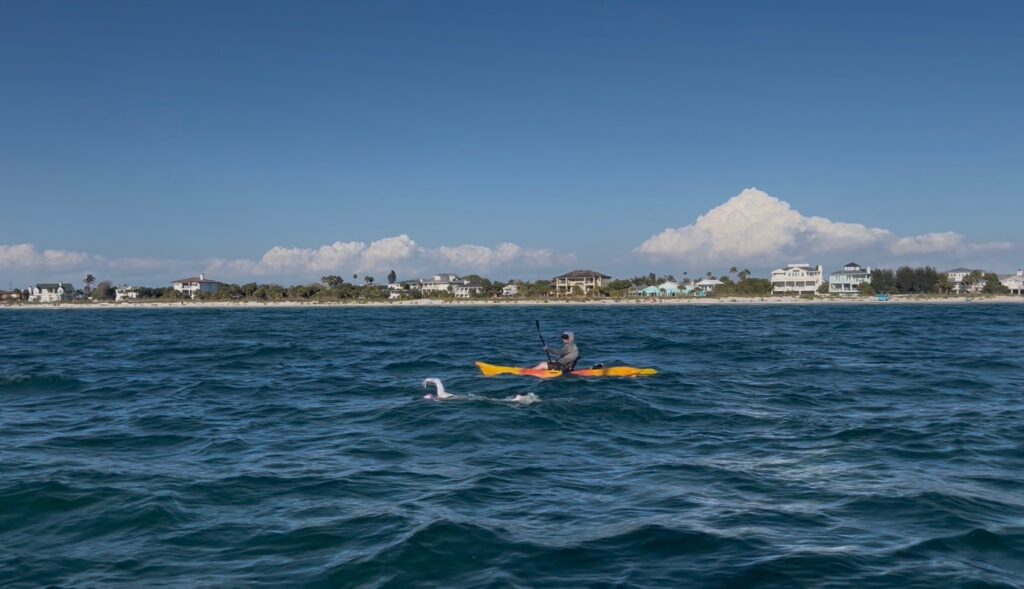
A curious shark began circling near the support boat after a “shark shield” device meant to deter sharks failed, Kieras said. “The shark was very interested,” she said.
Calling off the swim was difficult, particularly because she still felt strong physically.“I wanted to finish the swim so badly. My arms weren’t even sore,” Kieras said. “But I also promised my husband that if something like that happened, I would get out of the water.”
The decision was reinforced by her support team, including a kayaker who had recently tended a major shark bite during an ultraswim off Catalina Island.
“Everyone was really uncomfortable with me continuing,” she added.
Kieras exited the water near Honeymoon Island after covering about 20.5 miles in roughly 13 hours – still a formidable feat, even if short of the original goal and what would have been a potentially record-setting effort along Florida’s Gulf Coast.
She said the abrupt ending was disappointing not just because she wanted to finish, but because the swim was meant to draw attention and donations to manatee protection. Manatees remain listed as threatened, and Kieras said support for organizations working on their behalf remains urgent.
Even so, she said the mission continues. Donations tied to the swim are still being accepted, and she hopes the attempt, even shortened, brings visibility to the cause.
For Brinkly and others who gathered at the beach that morning, the launch still carried a sense of wonder – dolphins in the pass, calm water and a swimmer heading into the Gulf with an open-ended goal.
Kieras said she would attempt another long-distance swim in the future.
“I’d be bummed if it happened the same way,” she said, “but I’d definitely do it again.”