
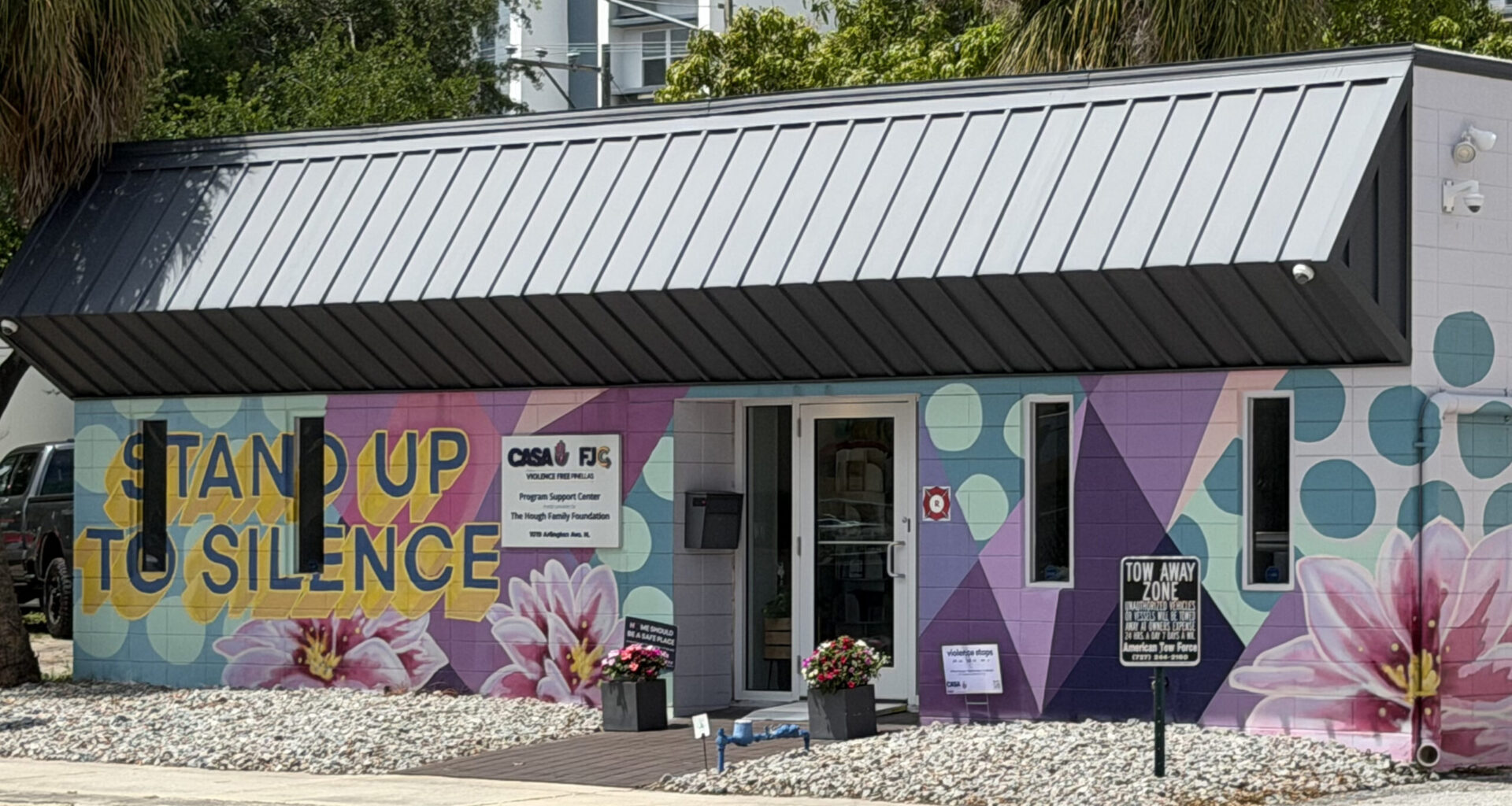

CASA of Pinellas Program Support Center. Photo by Daria Mironova/WMNF.
For many survivors of domestic violence, getting help isn’t just about asking—it’s about being able to get there.
Last week in St. Petersburg, national organizations, local officials, and community advocates came together to celebrate Hope Rides’ expansion into Florida. The initiative focuses on removing one of the biggest challenges for survivors of domestic violence: transportation. Uber, along with Alliance for HOPE International and CASA Family Justice Center, leads the program by offering free rides to survivors who need life-saving services.
Community united
The event brought together nonprofit leaders, elected officials, law enforcement, and victim advocates. U.S. Congresswoman Kathy Castor, St. Pete Mayor Ken Welch, and leaders from CASA Family Justice and Alliance for HOPE International were among those present.
Lacking transportation often determines whether a survivor can get help or remain in danger. The growing partnership removes that barrier. Kathy Castor not only highlighted the program’s benefits but also explained how some difficult situations start. “A lot of stressors in people’s lives—like the soul-crushing cost of living—unfortunately impact families. Sometimes that leads to acting out in the wrong, violent, or abusive way,” she said.
Ken Welch called the Hope Rides program a model. He said cities can use leadership, new ideas, and partnerships to meet urgent needs. The mayor shared a unique story. Back in the days, as county commission chair, Welch took an unusual step to better understand the community that he served: he drove for Uber. Between 2018 and 2019, he completed more than 1,000 rides. He maintained a 4.97 rating.
Welch noted that the experience offered a perspective that public office alone could not. Instead of policy debates or political opinions, conversations in the car tended to center on daily life—getting to doctor’s appointments, making it to work, or ensuring children arrived at school on time.
“Over those 1,000 rides, no one was talking politics,” he said. “They were talking about how to take care of their families and get where they needed to go.”
That same everyday need—simply getting from Point A to Point B —is what Hope Rides is designed to address.
Breaking down barriers to safety
Since its national launch in 2025, the Hope Rides program has provided over 2,000 rides across 12 states. It covered more than 21,000 miles.
In the past year, CASA of Pinellas helped over 3,000 people. Many of them struggled to get the services they needed. Hope Rides has already provided 310 rides in Pinellas County, connecting survivors directly to safety and support. Each ride has helped individuals reach shelters, attend legal appointments, or access critical resources.
During the meeting, Lariana Forsythe, CEO of CASA Pinellas and Marion Counties, discussed the real challenges they work with every day.“Transportation is one of the biggest barriers our survivors face. When that barrier is removed, we see immediate impact—people show up, they get help, and they begin to rebuild.”
The process starts by calling the organization’s 24-hour hotline. From there, trained specialists work to understand the situation and determine the best way to help.
“Callers connect with an advocate who can either provide a ride right away or invite them into the Family Justice Center. There, they can talk through their needs,” Forsythe said.
The goal is to make it as easy as possible for people to reach safety and support services without added obstacles.
A one-stop support center
Community Action Stops Abuse (CASA) is the official certified domestic violence center based in Pinellas County, FL. Their 24/7 domestic violence hotline is: 727-895-4912
CASA’s Family Justice Center serves as a central place for survivor support in Pinellas and Marion Counties. The center offers many services in one place. These include legal help, counseling, mental wellness support, and case management. The center also provides collaboration with law enforcement, housing resources, and childcare. This all-in-one approach means survivors do not have to face complicated systems alone during a crisis.
If you or someone you know is in need, please contact your local Domestic and Sexual Violence Center now for help.