
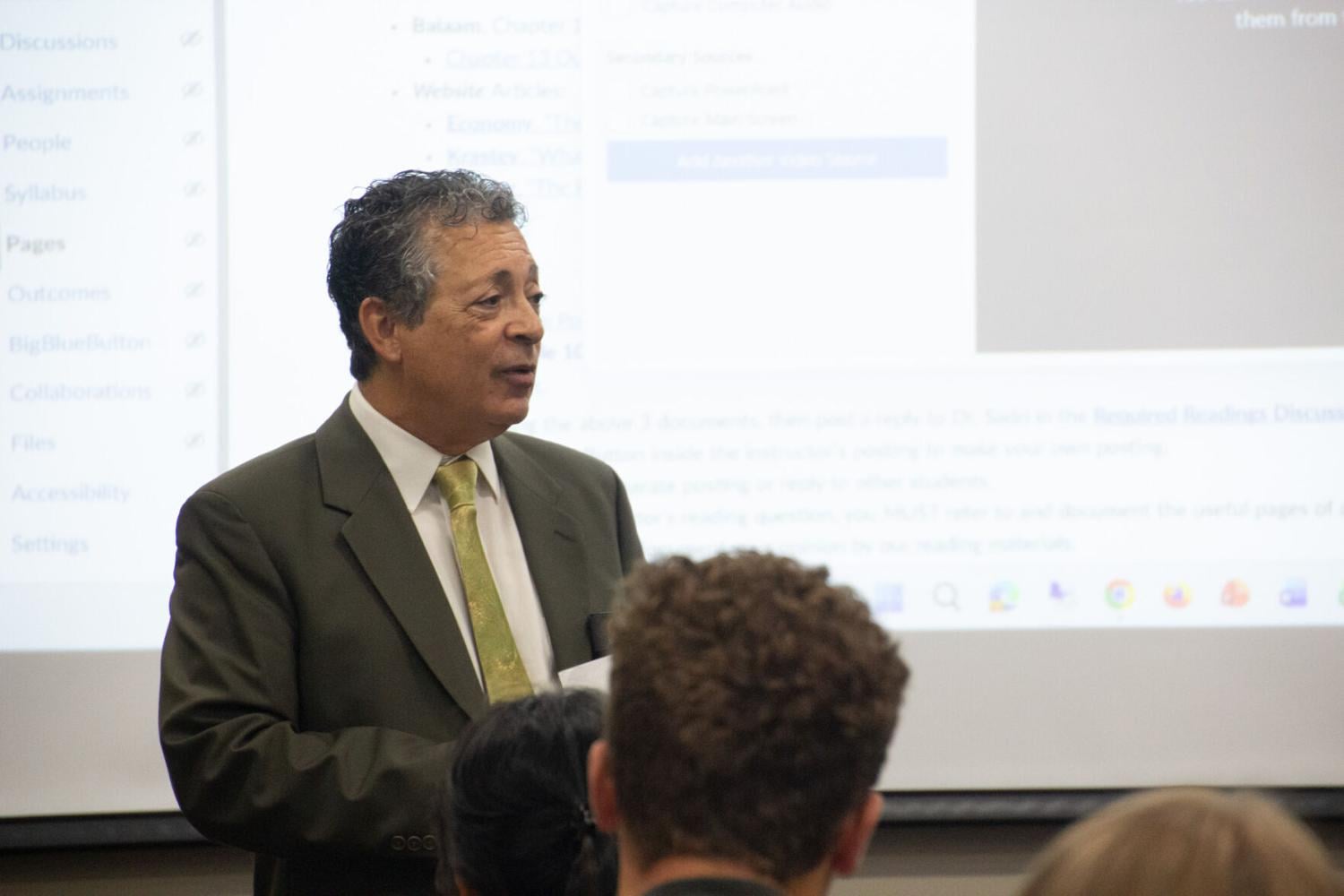

Dr. Houman Sadri, professor of international relations at UCF, has taught at the university for over 30 years. Having worked in many sectors and being globally recognized by leaders in academia, Sadri said that, before any opportunities or accolades, he’s most proud of his UCF students.
Minaal Arain
At 17, Dr. Houman Sadri and his family immigrated to the desert state of Arizona, which had a climate not unlike his home country of Iran.
Yet, coming under political asylum, Sadri was worlds away, bringing only a few things with him: his integrity, his education, pictures of relatives who had died and his mother’s wedding ring.
That experience brought Sadri to the field of politics.
Sadri, a professor of international relations at UCF for more than 30 years, wanted to know how Iran and the United States went from being friends to foes. He was curious about what started the 1979 revolution in Iran — the reason his family immigrated — and how political tensions increased.
“My passion is actually peace studies, because I don’t think wars solve all problems,” Sadri said. “In the long run, you need to bring people together, to work together, to make a difference.”
However, after studying the relationship between the U.S. and Iran for decades, Sadri warns that repairing that friendship will be very difficult. This comes nearly two months after the United States and Israel began military attacks on Iran.
Sadri began studying the Iranian revolution and international relations while completing his dissertation at the University of Virginia. Around that time, Sadri’s first research book got published and received stellar reviews in a leading political science publication, the American Political Science Review.
Along the way, Sadri found a passion for teaching while working as a teaching assistant at the University of Arizona, where he got his master’s degree.
Sadri also discovered more freedom in traveling as a professor than as a government consultant. Since his career in international relations, he has traveled to over 130 countries, believing it’s important to visit each country he studies.
After his time at UVA and a fellowship at the Hoover Institution at Stanford University, Sadri came to UCF. Sadri thought going to a more established university would make him a small part of a big machine.
“I said if I come right here, it’s a nice school and has a good future and everything else,” Sadri said. “I could put my stamp on it.”
Starting at UCF in 1995, Sadri was the faculty advisor who helped start the Model United Nations program.
Sultana Ali, a UCF alum from 2003 and the former director of marketing and communications for the College of Sciences, was one of the earlier members of the club. As a student, she worked with Sadri to organize a conference that had around 30 attendees during Ali’s time and now has around 600, she said.
“[Sadri] has a lot of acumen and knowledge about international relations, and so he really brought that not only to the classroom to his students, but also to us in the club,” Ali said. “There’s a lot of students who get to benefit from the work that happened decades ago.”
But more than that, Sadri became a mentor to many students, class after class.
Dr. Justin de Leon, a professor of ethnic studies at Chapman University and a master’s student of Sadri, said he was one of the students who became a mentee. As a professor himself, de Leon said he knows that mentorship and helping students feel seen in academic spaces are often overlooked.
“That’s the type of stuff that obviously imprints upon young people,” de Leon said. “It’s also the reason why some 20 years later, [myself] and others are willing to say, ‘yeah, let’s spend an hour talking about the impact of his mentorship and approach to teaching.’”
Alicia Koutsoulieris, a country specialist for the Occupied Palestinian Territories and Israel with Amnesty International U.S.A., and a student of Sadri’s from 2009, conveyed a similar sentiment. As a woman, Koutsoulieris was often discouraged from pursuing a career in politics, but she said she didn’t get that from Sadri.
“He was always very interested in what I was doing. I could reach out to him, even not as a current student of his, but just as a former student,” said Koutsoulieris. “He has always had this open-door policy where, if I’m doing something in the community, I can reach out to him. And for me, as a female political scientist, that was a breath of fresh air.”
Henrique Rudá, a student of Sadri’s from 2015, expanded on how Sadri gave his full attention to his students and how he’s taken that into his career, despite not working in academics.
“He would still take the time to talk to his students, and it was never [in] a rush, it was always very rich conversation,” Rudá said. “That also kind of helped me [in] my career giving people that type of attention that everyone deserves.”
Not only did Sadri give people his attention, but Rudá also said Sadri would take the time to understand their culture, a key factor in the politics, diplomacy, and decision-making process of many countries.
Sadri continued to briefly consult with various businesses and government agencies. From aiding Disney in intercultural communications to working with various government agency teams, Sadri found it important to both learn academic concepts and to apply them in the real world.
On April 8, Dr. Houman Sadri, international relations professor (left), worked with UCF Global to bring former U.S. Senator Tim Hutchinson (R-Ark., center) and former Fla. Rep. Val Demings (D-10, right) to his international political economy class. Through this opportunity, students could ask the politicians how Sadri’s lessons are applied in the real world.
Minaal Arain
“A lot of our students nowadays, they are very practically oriented,” Sadri said. “They want to say, ‘Okay, how does this help me to get a job?’ So I also kept one foot in academia, one foot in government [and corporations] with consulting.”
Since his time with the government, however, Sadri found that many of his efforts have been dismantled. Having worked with the administration of President Barack Obama on a plan of action with Iran, Sadri, along with a team of other professionals, created a plan to build trust between the two countries. However, with U.S. politics changing every four years, the plan was difficult to maintain. Still, Sadri said it is one of the proudest moments in his career.
“I was so happy that, okay, maybe we can resolve this issue in a peaceful fashion, as opposed to getting engaged in wars or something, you know?” Sadri said. “Because in wars, yes, some soldiers die, but also, a bunch of innocent people usually die.”
Currently, with continued United States and Israeli military presence in Iran, Sadri warns that rebuilding trust will not be easy.
Although changes in the regime have occurred, Sadri said this is not the outcome the U.S. or the Iranian people hoped for. Despite many senior Iranian government officials having died from the strikes, the current officials are much harder to negotiate with, Sadri said.
“[The President is] saying [the] regime is changing, […] and maybe this layer is better to negotiate with,” Sadri said. “Very frankly, I don’t think so. I think the hard-notched people, they’re left, and all the easy-going ones are dead. And right now, the revolutionary guard is more in charge of the country, and that was the group we were trying to avoid.”
Regardless of his own various accomplishments, Sadri said he is most proud to have worked with his students, with everything else falling behind that.
Despite his hour-long commute, that’s what motivates him to make his way out to UCF every week, twice a week.
“I love face-to-face classes,” Sadri said. “I can’t stand up in one place, and I have an interactive teaching style, and I love the questions coming from the students, and building a lecture based on that.”
After teaching at UCF for over 31 years, Sadri is looking forward to retiring next year. He passed along MUN to another faculty member a few years ago; however, his work for UCF and the international relations community continues.
Sadri aims to publish more research books until his retirement, and plans to release textbooks long after.
Outside of teaching, international relations professor Dr. Houman Sadri has published numerous acclaimed research books on a variety of topics in his field. After he retires in Spring 2027, Sadri plans to create a scholarship and write textbooks, continuing to help UCF students, although he will no longer be in the classroom.
Minaal Arain
“One of the challenges right now in academia is because the political environment is so polarized … when you look at the books, you see very clearly, ‘pro this, pro that,’” Sadri said. “I don’t think that’s fair for the undergraduates.”
Part of this motivation derives from how Sadri’s mentors at UVA used to tell him, “your students are entitled to their own opinion, they’re not entitled to their own facts.”
However, Sadri has already incorporated it into his classes, according to his students. Noah Alford, sophomore political science student on the international relations and comparative politics track, is a current student of Sadri’s and has taken his classes in the past. Alford noted how he could rely on Sadri for his neutral politics.
“He’s super nonpartisan in any of his teaching,” Alford said. “So it’s been great learning from him, and I’m able to kind of lean on him for different research.”
Sadri also plans to create a scholarship for UCF students from the royalties of his research books before he retires. It would be open to students from any program involved with international relations, particularly peace studies.
Sadri reiterated that, every night, he hopes his legacy is that he made a difference in his students’ lives.
“If this is my last night … I hope I made some small, little changes in somebody’s life,” he said.