
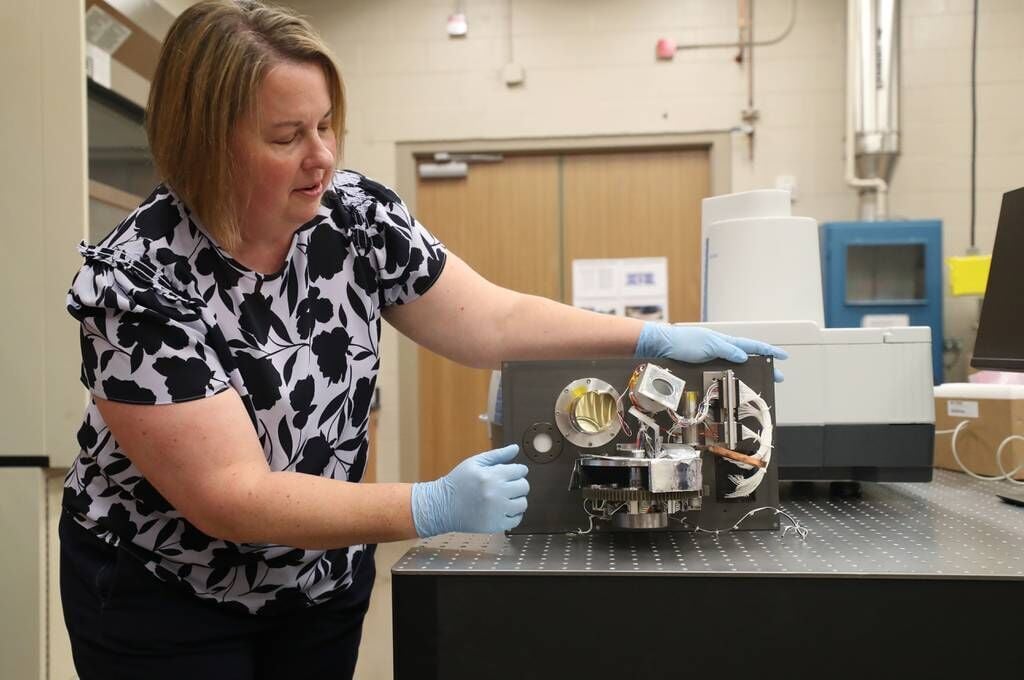

Dr. Kerri Donaldson Hanna showcases parts of a spectrometer at her lab in the UCF Physical Sciences Building. The spectrometer will analyze lunar dirt to determine its composition and further our understanding of the moon’s formation.
Courtesy of UCF Planetary Sciences Group
In her years as an undergraduate at Florida Institute of Technology, Professor Dr. Kerri Donaldson Hanna took a flight on NASA’s infamous Vomit Comet.
This is just one of Donaldson Hanna’s experiences on her way to UCF.
“The pilot that we had was new, and so, they left him to test it out on us,” Donaldson Hanna said. “He had not done that before, and so he was actually doing it too aggressively. Instead of getting zero gravity, we were getting negative gravity, which means we were all plastered to the roof of the plane.”
An expert in planetary science with a doctorate in geological sciences, she found her interest in planetary science during an undergraduate internship at the University of Arizona. When she found that she could study planets in such a tangible way using spectroscopy, she knew she had found her interest.
“It’s kind of a fun research space to be in,” Donaldson Hanna said. “Because planetary science in general speak, is just like studying the planets in our solar system or studying planets around other stars.”
Spectroscopy is the study of energy broken up by wavelength, said Donaldson Hanna. Looking at a rainbow is spectroscopy because you have light that’s broken up into the individual colors.
After Donaldson Hanna got her doctorate at Brown University, she spent the next five-and-a-half years at the University of Oxford in England as a postdoctoral research fellow. She had come from England to the United States, looking for a permanent place for research.
“After you get your Ph.D. and you’ve done a postdoc, you want that permanent, you know, place that you can go and start teaching and advising your own students and having your own research group,” Donaldson Hanna said. “So, I interviewed here at UCF.”
Angelina Minocha, second-year graduate student, is working on her doctoral degree in physics on the planetary science track, and Donaldson Hanna is her advisor.
Minocha said she wants to be a professor in planetary sciences, and Donaldson Hanna has been the model of the kind of instructor she wants to become. Minocha said Hanna’s experience researching in another country has helped her as an international student from India. Certain experiences come from living in a foreign country that teach you how to interact with people who have had different experiences than you have had, Minocha said.
“So, when she would talk to me about her time at Oxford and engaging with researchers that have very different point of views on how research should be done, I think that has been something I’ve learned from,” Minocha said. Minocha said that the most impactful part of her experiences has been the confidence from what she is learning.
“I’m learning enough that I see myself on that path that I’ve seen other graduate students on,” Minocha said. “That’s just because I’ve had a good balance of, like, I get to do things on my own, but I also feel a level of comfort in asking her questions.”
Donaldson Hanna was happy to see how excited the students at UCF were for space and how eager they were to begin research. UCF quickly became her first choice.
“I also really liked how pro-space, you know, the university was,” Donaldson Hanna said. “It is kind of fun to be in this environment where, you know, people love space, people love doing all aspects of space research. And so I definitely liked that about UCF.”
Donaldson Hanna has been on multiple lunar missions, including a Lunar Reconnaissance Orbiter that was launched in 2009, before she came to UCF, and is still collecting and transmitting data today. She also worked on a mission in 2025 called Lunar Trailblazer.
The team sadly lost communication with Lunar Trailblazer shortly after launch. Future missions she is working on are going to the South Pole and North Pole of the moon in 2027, but what her eyes are set on now is Lunar VISE.
Lunar VISE is a mission approved in 2022, where Donaldson Hanna and Dr. Adrienne Dove, along with a team of graduate students at UCF, are sending a lander and rover to the surface of the moon. The goal is to land on Mons Gruithuisen Gamma, a region between two craters on the moon.
Donaldson Hanna said the purpose of this mission is to analyze lunar dirt, known as regolith, to gain a better understanding of how the moon formed and why the surface of the moon looks the way it does now.
Using lunar regolith stored in the Exolith lab at UCF, Donaldson Hanna and her graduate students can analyze with spectroscopy the differences between lunar regolith and Earth rock.
The Lunar VISE team will have the rover on the moon to collect data and the infrared fingerprint of the rocks, Donaldson Hanna said. Then they will take the lunar dirt and put it in their chambers in the lab to build a library of data to compare what is measured in the lab and what is seen in space.
The next steps for the team will be to ship out their instruments to be put on the lander and the rover, with the launch date set for 2028.
“All of our instruments are coming along, and so we’re excited because, like, yeah, the next step will be for them, for us to ship our instruments,” Donaldson Hanna said. “They will launch in July of 2028.”