
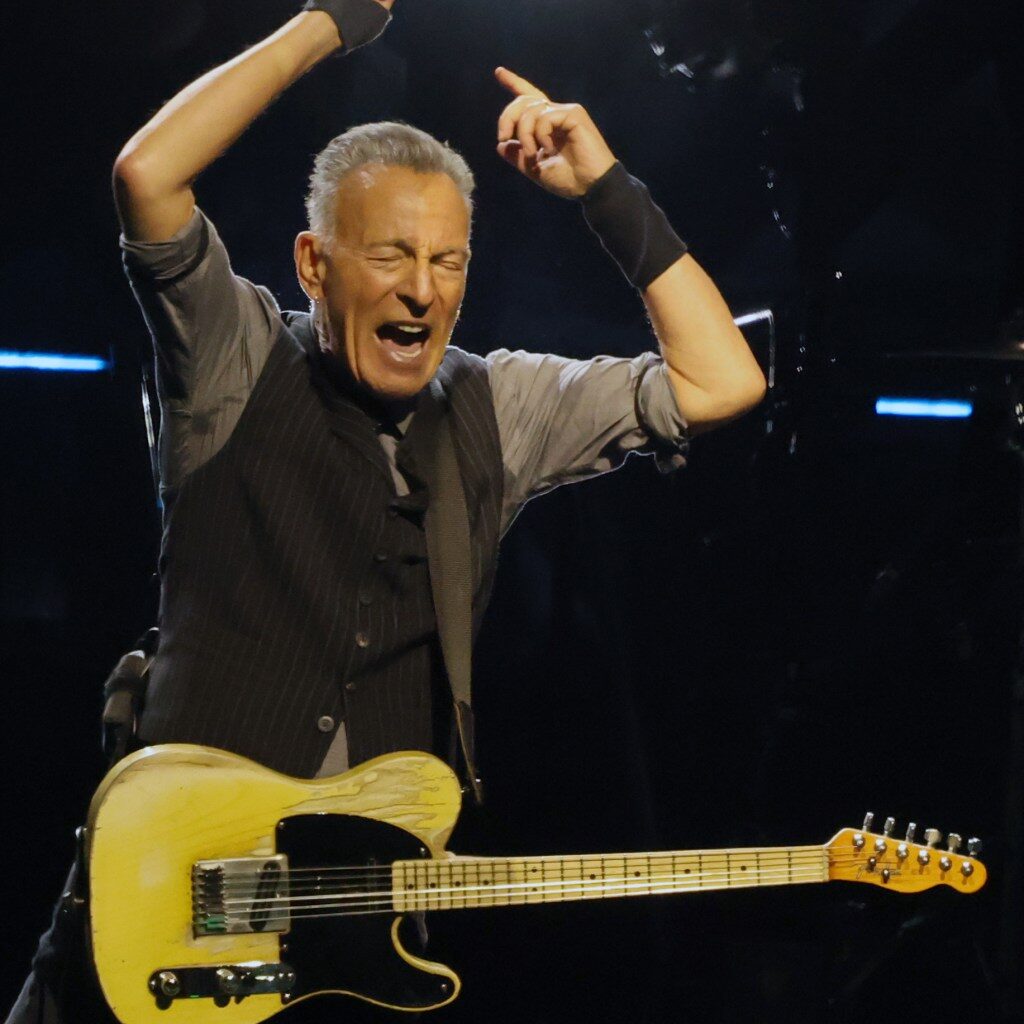
Bruce Springsteen returned to the Sunshine State last week for a concert in Sunrise as part of his “Land of Hope and Dreams” tour.
For nearly three hours, he performed many of his old hits as well as a new one protesting the ICE crackdown in Minneapolis. His stamina (a hallmark of his performances) was impressive for a 76-year-old who has been touring for more than 50 years.
Springsteen’s last appearance in Orlando was in 2023 at what’s now known as Kia Center. A young 27-year-old Springsteen made his first tour stop in Orlando on March 5, 1977, still riding a wave of enthusiasm for his album, “Born to Run,” which was released in 1975.
He performed at the old Orlando-Seminole Jai-Alai Fronton in Casselberry to a sell-out crowd of 3,500.
Here’s staff writer Harry Wessell’s 1977 review of Springsteen’s Orlando show, which appeared in the Sentinel Star a few days later:
Bruce Springsteen brought his E Street Band “from Asbury Park, N.J., to Orlando, Fla.” Saturday night and gave the standing-room only Jai-Alai Fronton crowd as good a hard rock performance as they are likely to attend.
With the brilliant saxophonist Clarence Clemmons leading the five-member E Street Band (plus a four-man horn section), Springsteen belted out each high energy song in his distinctively raw and powerful voice.
Despite the complex, stream-of-consciousness lyrics, hundreds of mouths could be seen contorting word-for-word with Springsteen’s, giving the show an intimate, local bar atmosphere.
“Every once in a while something happens, things click,” said Springsteen after the concert to Randy Molnar, a WORJ-FM staffer. The concert was produced by the rock station, along with Orlando promoter Joe Lambusta. Springsteen called it the best show of his current tour, according to Molnar.
One had to marvel at Springsteen’s stamina. He romped and danced non stop for the entire two hours he was on stage. Like the the singer he often mimicked/parodied – James Brown – the clean-shaven, street-tough Springsteen made every song sound as though it were the last he would ever sing.
As a tongue-in-cheek tribute to Brown, Springsteen interrupted his second of three encores by dramatically collapsing onto a stretcher borne by two stage hands who carried him off. He then rushed back to the microphone, laughing, “It’s a miracle, I’ve recovered,” to scream out the song’s last bars.
The volume was loud – at least one listener’s ears were ringing four hours after the concert ended – but Springsteen’s is one of the few rock acts whose music literally demands such auditory excess (most groups use volume to mask mediocrity). When Springsteen’s and 3,500 other voices shouted, “Tramps like us, baby we were born to run,” there was no room for moderation.
Springsteen’s roots as an Asbury Park, N.J., street punk are authentic, a fact that gives emotion and power to his often autobiographical songs. But if his audience can identify with his wrong-side-of-the-tracks background, they can also revel in his triumph.
Want more Orlando history? Buy a copy of the Orlando Sentinel’s 150th anniversary book with 150 front pages from our 150 years. Get it OrlandoSentinel.com/150book.