
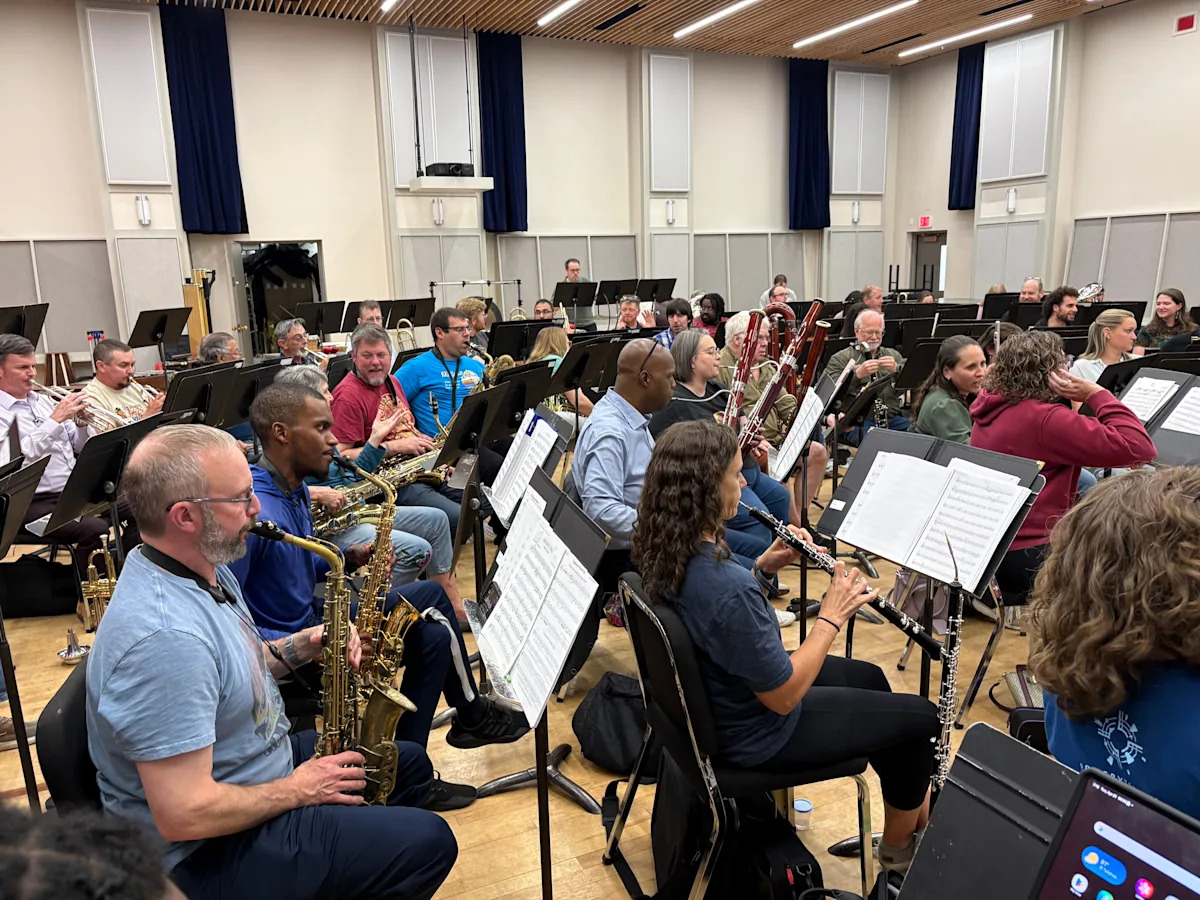
Under the direction of Drs. Patrick Dunnigan (FSU Professor of Music and Director of Bands) and David Plack (FSU Director of Athletic Bands), Tallahassee Winds will complete its 2025-2026 season with a concert in Opperman Music Hall at 7:30 p.m. on Tuesday, April 28. Admission is free.
At an early point in my articles about the Winds’ performances, I typically refer to the group as either a “symphonic band” or a “wind ensemble.” Both terms are accurate, and even interchangeable, but I believe each has a particular focus. Tallahassee Winds consists of some 70 musicians performing a wide array of instruments, ranging from tuba to piccolo.
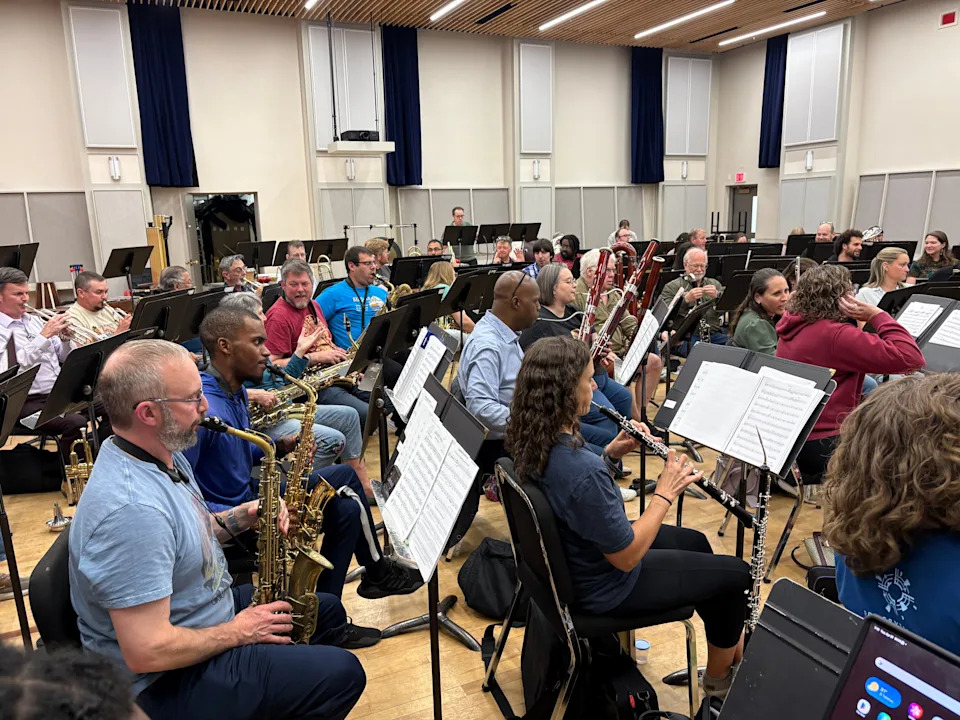
Tallahassee Winds rehearses for its season finale concert on April 28, 2026.
“Symphonic” describes well the breadth and depth of instrumentation that produces the full, rich, lush sound that in my opinion is the hallmark of Tallahassee Winds’ performances. Also, “symphonic band” more readily contemplates the inclusion of some string instruments. Indeed, Tallahassee Winds includes a single string bass player, whose deep bowings enhance each concert, ensuring that Winds’ audiences sample the best of both musical worlds.
However, “wind ensemble” to me has a special charm and appeal. The French adverb “ensemble” translates as “together.” (Thank you, college French.) Some English definitions of ensemble refer to a group working toward “a single effect.” Tallahassee Winds’ members encompass a variety of ages (ranging from twenty-somethings through eighty-somethings), backgrounds, and occupations.
Members share one thing in common. All of them realized during school years the pleasure and satisfaction of performing music in a group in which everyone contributed to a common objective. All cherish the experience and want to continue their avocation after graduating.
Dr. Bentley Shallahamer, then Assistant Dean of FSU’s College of Music, formed Tallahassee Winds in 1997 specifically to provide adult musicians that opportunity. “Wind ensemble” better captures the motivation, sense of purpose, and happy subordination of self to a common goal that permeate Tallahassee Winds’ rehearsals and concerts.
For the final concert of the season, Dunnigan and Plack, who have guided Tallahassee Winds since Shellahamer retired in 2012, invited members to nominate pieces for the program. I will highlight several of the winning entries.
“March King” John Philip Sousa was at the height of his fame in 1928 when he performed in Denton, Texas as part of a tour. Afterwards, he received a petition from an astonishing number of students at a local all-female college urging him to compose a march “just for us.”
The 1997 edition of “Texas Highways” reports that the gallant Sousa responded, “It is impossible to resist the request of 1,700 charming Texas girls.” After something of a false start, Sousa composed “Daughters of Texas.” Not surprisingly, the march became a favorite in Texas venues.
In program notes accompanying “Sailing with Whales,” composer Rossano Galante describes the exhilaration of finding, then journeying with, a group of Orca whales. The piece begins with a trumpet fanfare worthy of a John Williams film score, then depicts the speed, power, and “majesty” of this “apex predator,” as well as the quieter social interactions within the pod.
“Amparita Roca” by Jaime Texidor is a popular example of the “paso doble” (“two step”) march form. Over time, the genre has evolved in remarkable ways. It began as an 18th Century Spanish military march, became a staple of bullfight music during the 19th Century, and finally morphed into a form of ballroom dancing still seen in competitions.
Timothy Mahr based his “Fantasia in G” on the same text of a German poem that inspired Beethoven to compose his Symphony No. 9. Written for the St. Olaf College Band, this piece creates a celebratory atmosphere while conspicuously paying tribute to Beethoven’s famous piece. Imagine — Beethoven in a nutshell!
“Symphonic Dance No. 3” by Clifton Williams’ is part of a larger work that reflects the impact of Latin culture on the City of San Antonio. The music describes the pageantry of traditional celebrations (street parades, bull fights, bright costumes) and recognizes, in the composer’s words, “the colorful legacy of a proud people.” And there is more!
If you go
What: Tallahassee Winds season finale
When: 7:30 p.m. on Tuesday, April 28
Where: Opperman Music Hall, FSU
This article originally appeared on Tallahassee Democrat: Tallahassee Winds presents season finale concert