
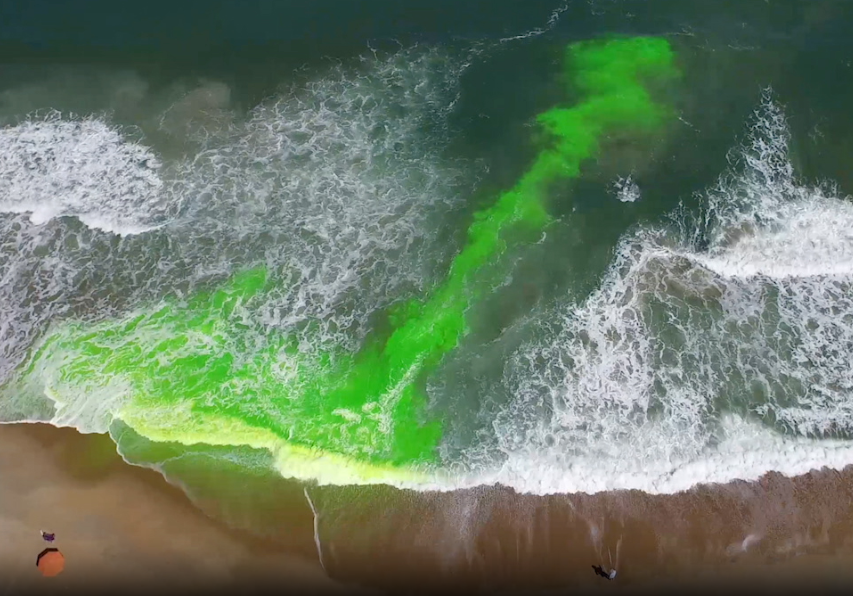
The bright green water shows a rip current in North Carolina in this photograph provided by the National Oceanic and Atmospheric Administration.
Courtesy of NOAA
This cutaway drawing by the National Oceanic and Atmospheric Administration is called “Anatomy of the Rip Current.”
Courtesy of NOAA
Jason DeGray didn’t know much about rip currents, his wife Meagan said. In fact, he didn’t even like the beach.

“He did everything for his kids,” she said, including jumping into the ocean at Cocoa Beach, Fla. a few weeks ago to help his 12-year-old son, who was struggling in a rip current.
Article continues below this ad
Jason DeGray, 42, of Windsor Locks, was able to save his son on April 14, she said, but not himself. The pull of the current proved too strong. Jason DeGray and a woman from Ohio — who Meagan DeGray said went into the water to help — drowned, Cocoa Beach officials said, causing two family vacations to take tragic turns.
Jason DeGray of Windsor Locks died after he was pulled from the water at Cocoa Beach, Fla. April 14, first responders say. His wife, Meagan DeGray, says he rescued his son before falling victim to a rip current. A woman from Ohio also died.
Courtesy of Meagan DeGray, via the East Windsor Community Funeral Home
Cocoa Beach rescuers said they pulled the adults and two others who survived out of the water that day. Losing half the people they rescued spurred the small, oceanside city to step up efforts to educate the public, especially visitors, who Cocoa Beach Fire Chief Justin Grimes said make up most of their rescued swimmers. A few weeks earlier, rescue teams had to pull a visitor from Texas out of the water, and that person survived, he said at a news conference a few days after the drownings.
First responders are talking to hotels and Airbnbs to get the message out to visitors about the deadly danger that lurks beneath the often deceptively smooth surface of the water, Grimes said. They’ve had signs out around the city that warn of rip current threats for weeks, he said. And now he’s asking the media to help spread the word.
Article continues below this ad
Make CT Insider a preferred source on Google to see more of our journalism when you search.
Add Preferred Source
“It’s a tragedy,” Grimes said of the deaths at the April 16 news conference. “And it’s a tragedy that I think, working together, we can try to prevent.”
What are rip currents?
Before people even step foot on a beach, they should look up information about rip currents, Grimes said.
Article continues below this ad
They account for 80 percent of rescues performed by surf beach lifeguards, the National Oceanic and Atmospheric Administration says. The United States Lifesaving Association estimates that the annual number of deaths on our nation’s beaches due to rip currents exceeds 100.
Rip currents are strong underwater currents that pull swimmers away from the beach. (Despite the common misnomer, “rip tides”— and the Vance Joy song — they are not tides.) They are formed in sand bars, often during storms. Cocoa Beach had rough weather in the week before the deaths, Grimes said.
“When sand bars rip away, it creates a funnel where the water comes back out and it can pull people out really quickly,” he said. The force is “equivalent to walking through a hurricane,” Grimes said, and “even the strongest swimmers can be overtaken by rip currents.”
This illustration by the National Oceanic and Atmospheric Administration shows how to swim out of a rip current.
Courtesy of NOAA
They also form near structures such as jetties and piers, according to the National Oceanic and Atmospheric Administration.
Article continues below this ad
Drowning deaths occur when swimmers are pulled away from the shoreline and are unable to keep themselves afloat as they try to swim to shore, the NOAA says.
“This may be due to any combination of fear, panic, exhaustion, or lack of swimming skills,” the agency says. “Once people become tired, they can easily go under without flotation to hold onto.”
Although Connecticut’s Long Island Sound usually isn’t known for its waves or rip currents, they have formed there during storms.
Look for flags, lifeguards
Grimes recommends beachgoers pick a spot near a lifeguard to swim.
Article continues below this ad
“Lifeguards can do something that we can’t do, and that is preventative life guarding,” the fire chief said. “They can make sure that you don’t get into a difficult position, get you out of dangerous situations. They can see if rips are occurring.”
Beachgoers also should note any flags warning of danger, Grimes said.
According to the United States Lifesaving Association, yellow flags mean there is a medium hazard, with “moderate surf and/or currents.” When there is a yellow flag, weak swimmers are discouraged from entering the water, the association says.
Red flags mean the hazard level is high, and all swimmers are discouraged from going into the water, it says.
Article continues below this ad
And purple flags mean there are marine pests, such as jellyfish or other marine life, that can cause minor injuries.
What do rip currents look like?
Swimmers should look for rip currents, too, but they are not easy to spot, the NOAA says. The agency suggests you stay back from the water and look for a few telltale signs:
A narrow gap of darker, seemingly calmer water flanked by areas of breaking waves and white water;
Article continues below this ad
A break in the incoming wave pattern betrays a rip current in this picture provided by the National Oceanic and Atmospheric Administration.
Courtesy of Dr. Tom Herrington, Stevens Institute of Technology via NOAA
A channel of churning or choppy water that is distinct from surrounding water;
A difference in water color, such as an area of muddy-appearing water (which occurs from sediment and sand being carried away from the beach);
A consistent area of foam or seaweed being carried through the surf.
A line of foam in the water signals a rip current in this photograph provided by the National Oceanic and Atmospheric Administration.
Courtesy of Dr. Wendy Carey, Delaware Sea Grant, via NOAA
A dip in the sand where water runs up closer to some sunbathers than others also can signal the presence of a rip current, Wyatt Werneth of the American Lifeguard Association told Good Morning America on May 30, 2025. Werneth was on Melbourne Beach, Fla., where a person on the shore used a drone to deliver a flotation device to a girl caught in a rip current earlier in the month. The girl survived, GMA said.
Article continues below this ad
“What I like to tell people is where there’s a dip, there’s a rip,” said Werneth, who also is founder of Drown Zero International.
What if I’m caught in a rip current?
Rip current speeds are typically 1-2 feet per second, but speeds as high as 8 feet per second — which is faster than an Olympic swimmer — have been detected, NOAA says.
“And if you do find yourself in a rip current, God forbid, it does happen, you need to relax,” Grimes said. “It’s usually not the rip currents that kill people, it’s usually the panic and it’s usually the exhaustion that kills people.”
Article continues below this ad
First, he said swimmers caught in the current should stay calm. Face the shore and wave your hands to make sure people realize what’s going on, Grimes said.
Don’t try to fight it by swimming directly toward the beach, he said. You’ll tire yourself swimming against the current. Rather, if you can, swim parallel to shore.
If that’s too hard, or if the current takes you sideways, flip and float on your back, experts say.
“If you can’t get out of the rip by swimming parallel to shore, let it take you out a little bit and eventually, it will spit you out and you can start swimming to shore,” Grimes said.
Article continues below this ad
A rip current is flowing beneath the smooth surface of the water in this picture provided by the National Oceanic and Atmospheric Administration.
Courtesy of NOAA
Once swimmers feel the pull of the rip current lessen, they should try swimming to the shore diagonally, experts said.
If you’re on the beach seeing someone struggle in the water, throw them something that floats and immediately get a lifeguard, NOAA says. “But don’t try to be a hero and make the rescue yourself,” the agency warns in a video about rip currents.
If you call 911, be sure and give a good location, Grimes said.
Article continues below this ad
But Grimes hopes it doesn’t get to that point.
“We need to do the best we can do to keep this from happening,” he said on April 16. “Because, again, I love the water rescue team that we have. But like I said, we’re reactive.”
To the tourists, the fire chief said: “Hey, we want you to have a fun, great time here, but just be safe and understand what’s going on.”
Article continues below this ad